Sprig Originals's kitchen / Dragon Roll with Warm Unagi and Eel Sauce
Dragon Roll with Warm Unagi and Eel Sauce
 By Sprig Originals · cooked up in Sprig
Worked out from this recipe's ingredients. If you're cooking for an allergy, always read the full ingredient list.
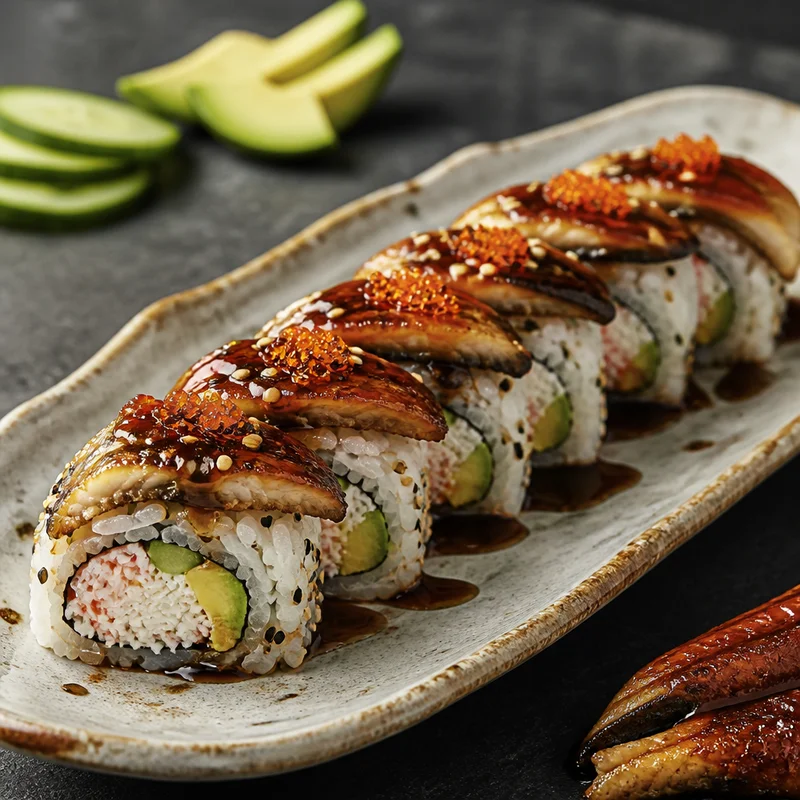
An inside-out California roll — sweet crab, cool cucumber, ripe avocado — shingled with glossy panels of warm barbecued eel and finished with eel sauce, toasted sesame and tobiko. The shortcut that makes it doable on a weeknight: vacuum-packed pre-grilled unagi reheated in the oven and bottled eel sauce, so all your effort goes into seasoning the rice properly and draping the eel so the roll actually looks like a dragon's back.
Ingredients
Sushi rice
- 2 cups Japanese short-grain sushi rice
- 2 1/4 cups cold water
- 1/4 cup unseasoned rice vinegar
- 2 tbsp granulated sugar
- 1 tsp fine sea salt
Filling
- 8 oz imitation crab sticks (kanikama) or lump crabmeat
- 3 tbsp Japanese mayonnaise (Kewpie)
- 1 tsp sriracha, optional
- 1/2 medium English cucumber
- 1 large ripe but firm avocado
- 1/2 tsp fresh lemon juice
- 4 sheets nori (roasted seaweed), full size
Topping and finishing
- 2 packages (about 5-7 oz each) vacuum-packed pre-grilled unagi (kabayaki eel), thawed
- 1/4 cup bottled eel sauce (unagi no tare / nitsume)
- 2 tbsp toasted white and black sesame seeds
- 2 tbsp tobiko or masago, optional
- 2 scallions, thinly sliced
- Pickled ginger, wasabi and soy sauce, for serving
Instructions
- Rinse the rice: put the 2 cups of rice in a bowl, cover with cold water, swish with your hand for 20 seconds, and pour off the cloudy water. Repeat 3–4 times until the water runs nearly clear, then drain in a sieve for 10 minutes. Cook with 2 1/4 cups cold water in a rice cooker on the sushi/white rice setting, or in a covered saucepan: bring to a boil over high heat, drop to the lowest heat for 13 minutes, then rest off heat, still covered, for 10 minutes.
- While the rice cooks, make the seasoning: warm the rice vinegar, sugar and salt in a small saucepan over low heat for 1–2 minutes, stirring just until dissolved. Do not boil. Set aside to cool.
- Turn the hot rice out into a wide non-metal bowl or sheet pan. Drizzle the vinegar mixture over it and fold it in with a rice paddle or silicone spatula using slicing, cutting motions — never stir or mash. Spread the rice in a shallow layer and let it cool to just barely warm, about body temperature, 15–20 minutes. Cover with a damp towel; do not refrigerate.
- Prep the fillings. Shred the crab sticks lengthwise into fine strands (or flake the lump crab) and mix with the Kewpie mayo and the sriracha if using. Cut the cucumber into 1/4-inch batons, discarding the seedy core. Halve, pit and peel the avocado; slice one half into 1/4-inch slices for inside the rolls, and reserve the other half if you want avocado scales as well. Toss the avocado with the lemon juice.
- Heat the oven to 350°F. Slide the unagi fillets out of their pouches onto a foil-lined sheet pan, brush lightly with 1 tablespoon of the eel sauce, and bake 8–10 minutes until the glaze is bubbling and the fish is heated through and fragrant. Let it cool for 5 minutes, then slice each fillet crosswise into strips about 1/2 inch wide and 2 1/2 inches long — you want flat panels the width of a roll, not chunks.
- Set up your rolling station: a bamboo mat wrapped tightly in plastic wrap, a bowl of water with a splash of rice vinegar for your hands (tezu), and a sharp thin-bladed knife. Cut each nori sheet in half along the grain — you'll use 4 half-sheets and have 4 spares.
- Lay a half-sheet of nori shiny side down on the mat. With wet hands, take about 3/4 cup of rice and spread it over the nori in an even 1/4-inch layer, going right to the edges and leaving no bare spots. Sprinkle the rice with sesame seeds, then flip the whole sheet over so the rice is facing down on the mat and the bare nori faces up.
- Across the lower third of the nori, lay a line of the crab mixture, then a row of cucumber batons and 2–3 avocado slices. Keep the fillings compact — an overstuffed roll will not hold eel on top.
- Lift the near edge of the mat and roll up and over the filling, tucking firmly to make a tight cylinder; use the mat to compress the roll along its length with even pressure, then unroll the mat and give the log a final gentle squeeze into a squared-off shape. Repeat with the remaining nori, rice and fillings to make 4 rolls.
- Drape the eel: lay the warm unagi strips over the top of each roll in overlapping shingles, skin side up, angled slightly like scales and running the length of the roll. Lay a sheet of plastic wrap over the roll and press very lightly with the bamboo mat to seat the eel onto the rice so it won't slide off when you cut.
- Cut through the plastic wrap: wipe the knife with a damp towel, then slice each roll in half, then each half into 4 pieces, using a single long draw of the blade per cut and re-wetting the knife between cuts. Peel the plastic away from the cut pieces.
- Arrange the pieces on plates, drizzle generously with the remaining eel sauce, and finish with a pinch of tobiko, sliced scallions and more sesame seeds. Serve immediately with pickled ginger, wasabi and soy sauce.
Chef's tips
- Look for unagi kabayaki in the freezer case of any Asian grocery, usually in a gold or clear vacuum pouch. Thaw it overnight in the fridge; reheating in a 350°F oven for 8–10 minutes revives the glaze far better than the microwave, which turns the flesh rubbery.
- Rice temperature is the whole game: too hot and the nori steams and tears, too cold and the grains won't stick. Aim for warm-to-neutral on the back of your wrist, and never refrigerate seasoned sushi rice.
- For a two-tone dragon, alternate eel panels with paper-thin avocado slices: cut the reserved avocado half into 1/16-inch slices, fan them out, press flat with the side of your knife, and lift them onto the roll with the blade.
- If your rolls come apart, the usual cause is too much rice or too much filling. Three-quarters of a cup of rice per half-sheet and a filling line no thicker than your thumb is the ceiling.
- Rolls can be assembled and topped up to 2 hours ahead; cover tightly in plastic wrap and keep at cool room temperature, not in the fridge, then slice and sauce just before serving.
Nutrition (per serving, estimated)
681calories
28gprotein
93gcarbs
23gfat
Estimates only — values vary with brands and portions.
Made with Sprig
Dragon Roll with Warm Unagi and Eel Sauce was created in Sprig — the AI chef that turns any craving into a complete recipe, plans your week, and shops with one smart list.
Free to start · 14-day Pro trial · cancel anytime
Not ready yet? Get the occasional recipe worth cooking — a couple a month at most.
You're on the list — check your inbox!
Unsubscribe anytime. Privacy Policy
More from Sprig Originals
Are you this recipe's original author or publisher? Report a problem