Sprig Originals's kitchen / Sunday Pot Roast with Real Pan Gravy
Sunday Pot Roast with Real Pan Gravy
 By Sprig Originals · cooked up in Sprig
Worked out from this recipe's ingredients. If you're cooking for an allergy, always read the full ingredient list.
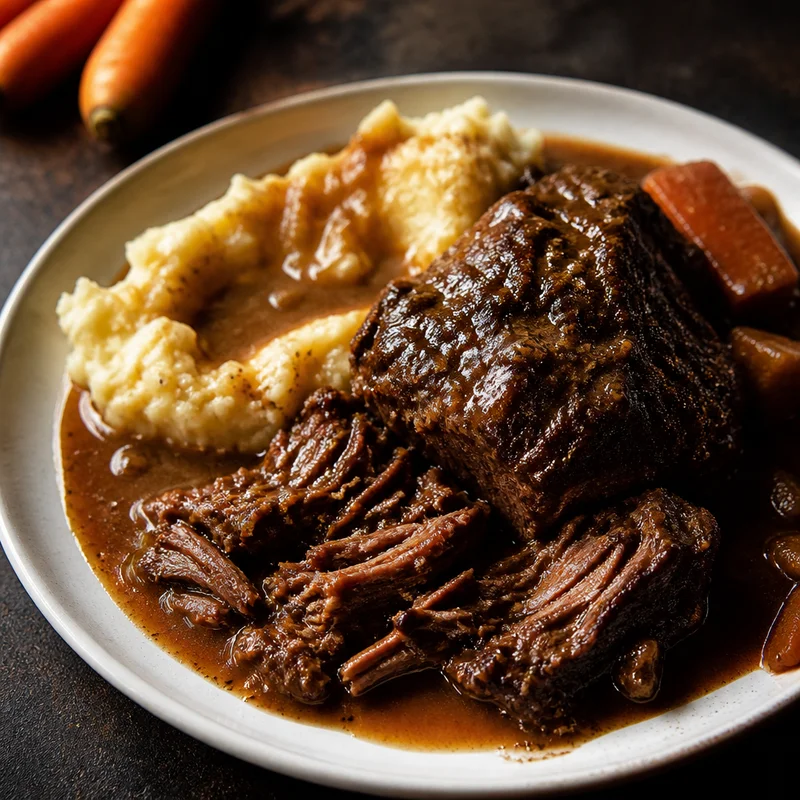
A 3-pound chuck roast gets a hard, dark sear, then goes into a covered low oven with wine, stock and aromatics until it pulls apart under a fork. The real lesson here is the finish: you strain the braising liquid, skim the fat, reduce it hard, and build a glossy gravy that tastes like the roast itself instead of a packet. Carrots and potatoes go in late so they arrive tender instead of dissolved.
Ingredients
Roast and sear
- 3 to 3 1/2 lb boneless beef chuck roast, tied if loose
- 2 1/2 tsp kosher salt
- 1 tsp freshly ground black pepper
- 2 tbsp neutral oil such as canola
Braise
- 2 tbsp unsalted butter
- 2 medium yellow onions, cut into thick wedges
- 3 stalk celery, cut into 2-inch pieces
- 6 clove garlic, smashed
- 2 tbsp tomato paste
- 1 cup dry red wine such as Cabernet or Merlot
- 3 cup low-sodium beef broth
- 1 tbsp Worcestershire sauce
- 2 sprig fresh rosemary
- 6 sprig fresh thyme
- 2 bay leaves
Vegetables
- 1 1/2 lb Yukon Gold potatoes, halved or quartered into 2-inch chunks
- 1 lb carrots, peeled and cut into 2-inch lengths
- 1/2 tsp kosher salt
Gravy
- 3 tbsp unsalted butter
- 3 tbsp all-purpose flour
- 1 tsp red wine vinegar or balsamic vinegar
- Kosher salt and black pepper, to taste
- 2 tbsp chopped fresh parsley, for serving
Instructions
- Pat the chuck roast completely dry with paper towels, then season it all over with 2 1/2 teaspoons kosher salt and 1 teaspoon black pepper. Let it sit uncovered at room temperature for 45 minutes if you have time — a dry, tempered surface is what gives you a dark crust instead of gray steam.
- Set an oven rack in the lower third and heat the oven to 325°F.
- Heat 2 tablespoons oil in a 6- to 7-quart Dutch oven over medium-high until it shimmers and just begins to wisp smoke, about 3 minutes. Lay the roast in and do not touch it for 5 to 6 minutes, until the underside is deep mahogany brown. Sear every side the same way, including the narrow edges, 18 to 22 minutes total. Transfer the roast to a plate.
- Pour off all but about 1 tablespoon of fat. Lower the heat to medium, add 2 tablespoons butter, then the onion wedges, celery and smashed garlic. Cook 6 to 8 minutes, scraping the browned bits off the bottom as the vegetables release moisture.
- Stir in the tomato paste and cook 2 minutes, until it darkens from bright red to brick. Pour in the red wine, bring to a brisk simmer, and reduce by about half, 4 to 5 minutes, scraping up any remaining fond.
- Add the beef broth, Worcestershire, rosemary, thyme and bay leaves. Return the roast and any juices from the plate; the liquid should come about two-thirds up the meat, not cover it. Bring just to a bare simmer.
- Cover with the lid and transfer to the 325°F oven. Braise for 2 hours, flipping the roast once at the halfway mark.
- Add the potatoes and carrots around the roast, sprinkle them with 1/2 teaspoon salt, re-cover, and return to the oven for 1 hour to 1 hour 30 minutes more. The roast is done when a fork twists out of the center with no resistance and the internal temperature reads 200–205°F. If it still feels tight, give it another 30 minutes — chuck goes from tough to tender on its own schedule.
- Move the roast to a cutting board and tent loosely with foil. Using a slotted spoon, lift the potatoes and carrots into a serving dish and cover; discard the spent onion, celery and herb stems or leave them in the pot for straining.
- Strain the braising liquid through a fine-mesh sieve into a large measuring cup or fat separator, pressing gently on the solids to get every drop, then discard the solids. Let it settle 5 minutes and skim off the fat that rises, or pour off the clear liquid from a fat separator. You should have about 3 cups.
- Wipe the Dutch oven clean and set it over medium heat. Melt 3 tablespoons butter, whisk in 3 tablespoons flour, and cook the roux 2 minutes, whisking constantly, until it smells nutty and turns the color of peanut butter.
- Whisk in the strained liquid a splash at a time for the first cup so the roux stays smooth, then add the rest in a steady stream. Simmer, whisking, for 6 to 8 minutes until the gravy coats the back of a spoon. Stir in the vinegar and taste — add salt and pepper as needed; broths vary a lot here.
- Pull the roast apart into large chunks along its natural seams, discarding any big pockets of fat and the kitchen twine. Arrange on a platter with the potatoes and carrots, spoon over some gravy, scatter with parsley, and serve the rest of the gravy alongside.
Chef's tips
- The sear is not optional and it is not a 2-minute job. Every minute of deep browning shows up later in the gravy, since the strained liquid is basically dissolved crust.
- No fat separator? Chill the strained liquid in the freezer for 15 minutes and the fat will firm at the top for easy spooning. This is also why pot roast is better made a day ahead.
- If your gravy tastes flat rather than under-salted, it usually needs the acid: add another 1/2 teaspoon vinegar before reaching for more salt.
- Reheat leftovers gently in the gravy at 300°F, covered, for 25 minutes. Sliced cold pot roast dries out fast on its own.
- Chuck is the right cut because its connective tissue melts into gelatin, which is what gives the gravy body. A lean cut like round will be dry and the sauce thin.
Nutrition (per serving, estimated)
610calories
42gprotein
28gcarbs
32gfat
Estimates only — values vary with brands and portions.
Made with Sprig
Sunday Pot Roast with Real Pan Gravy was created in Sprig — the AI chef that turns any craving into a complete recipe, plans your week, and shops with one smart list.
Free to start · 14-day Pro trial · cancel anytime
Not ready yet? Get the occasional recipe worth cooking — a couple a month at most.
You're on the list — check your inbox!
Unsubscribe anytime. Privacy Policy
More from Sprig Originals
Are you this recipe's original author or publisher? Report a problem