Sprig Originals's kitchen / Mixed Meat Paella in a Wide Skillet
Mixed Meat Paella in a Wide Skillet
 By Sprig Originals · cooked up in Sprig
Worked out from this recipe's ingredients. If you're cooking for an allergy, always read the full ingredient list.
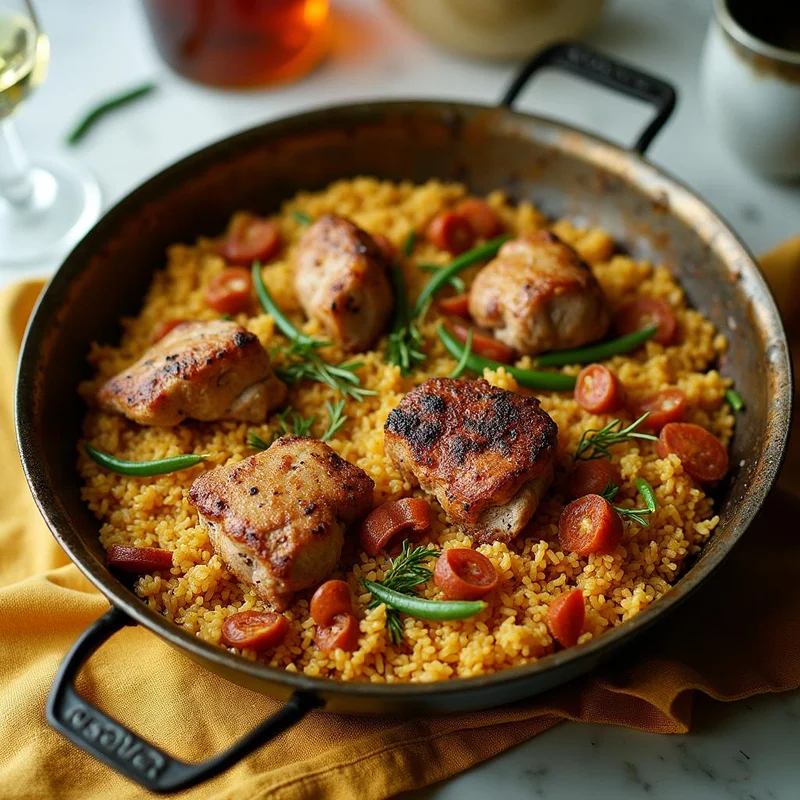
A Valencian-style meat paella rebuilt for one home burner and a 14-inch skillet. Pork ribs, chicken thighs and chorizo are browned in stages so each finishes tender at the same moment, then saffron broth and bomba rice go in for a flat, undisturbed bake. The last two minutes over high heat build socarrat — the crackling toasted crust on the bottom that separates real paella from rice pilaf.
Ingredients
Meats
- 1 1/4 lb bone-in pork spare ribs, cut crosswise into 1 1/2-inch pieces
- 1 lb boneless chicken thighs, cut into 2-inch chunks
- 6 oz Spanish dry-cured chorizo, sliced 1/4-inch thick
- 2 tsp kosher salt
- 1 tsp freshly ground black pepper
- 1/3 cup Spanish olive oil
Sofrito
- 1 medium yellow onion, finely chopped
- 1 medium red bell pepper, cut into 1/2-inch strips
- 4 cloves garlic, minced
- 1 1/2 cups grated ripe tomato (about 3 tomatoes, boxes grated on large holes, skins discarded)
- 2 tsp sweet Spanish paprika (pimentón dulce)
- 1/2 tsp smoked paprika
- 1 sprig fresh rosemary
Rice and Broth
- 5 cups low-sodium chicken broth
- 1/2 tsp saffron threads, crumbled
- 2 cups bomba or Calasparra rice
- 1 cup cut green beans or flat romano beans, in 2-inch lengths
- 3/4 cup cooked white beans or butter beans, drained
- 1 tsp kosher salt, plus more to taste
To Finish
- 1 lemon, cut into wedges
- 2 tbsp chopped flat-leaf parsley
- Flaky salt, for serving
Instructions
- Heat the oven to 425°F with a rack in the middle. Pat the pork ribs and chicken very dry and season all the meat with the 2 teaspoons salt and the pepper. Warm the broth in a saucepan with the crumbled saffron over low heat and hold it at a bare simmer — cold broth added to hot rice stalls the cook and ruins your timing.
- Set a 14-inch (or 12-inch, minimum) heavy skillet or carbon-steel paella pan over medium-high heat and add the olive oil. When it shimmers, add the pork ribs in a single layer and brown 8 to 10 minutes, turning, until deeply colored on all sides. Move them to a plate.
- Add the chicken thigh pieces skin-side or fat-side down and brown 5 to 6 minutes total, turning once. Transfer to the plate with the pork. Add the chorizo and cook 2 minutes, just until the fat runs orange, then remove it too — chorizo cooked longer turns rubbery and can overwhelm the rice.
- Lower the heat to medium. Add the onion and bell pepper to the seasoned fat with a pinch of salt and cook 8 minutes, scraping the browned bits off the bottom, until soft and beginning to color. Add the garlic and cook 1 minute.
- Add the grated tomato, both paprikas and the rosemary sprig. Cook 10 to 12 minutes, stirring often, until the mixture darkens to a brick red and pulls away from the pan in a thick paste with oil pooling at the edges. This sofrito is the flavor backbone — do not rush it.
- Return the pork ribs to the pan along with 2 cups of the hot saffron broth. Simmer 20 minutes, adjusting heat to keep a lively bubble, so the ribs get a head start; they need roughly twice as long as the rice.
- Add the green beans and the remaining 3 cups broth. Bring to a hard boil, then taste the liquid — it should be assertively seasoned, slightly saltier than you want the final dish. Add the 1 teaspoon salt or more as needed.
- Rain the rice evenly across the pan and stir once to distribute it, then shake and tilt the pan to level the surface. From this moment on, do not stir again. Tuck the chicken, chorizo and white beans into the rice and pull the rib pieces up so they sit on top.
- Boil hard over medium-high heat for 8 minutes, rotating the pan a quarter turn every 2 minutes so a single home burner heats the whole diameter. The liquid should drop to just below the level of the rice.
- Slide the pan into the 425°F oven, uncovered, and bake 12 to 14 minutes, until the rice is tender with the faintest bite at the center and the surface looks dry and pitted with small craters.
- Now build the socarrat: return the pan to the stovetop over medium-high heat for 90 seconds to 2 1/2 minutes. Listen — you want a steady crackle and a nutty toasted smell, like popcorn. The instant you catch even a hint of acrid smoke, pull it off. Test by scraping a spoon along the bottom edge; you should hit a thin, crisp, golden crust.
- Cover the pan loosely with foil or a clean kitchen towel and rest 5 to 10 minutes off the heat — the rice finishes absorbing and the grains separate. Scatter with parsley and flaky salt, tuck lemon wedges around the rim, and serve directly from the pan, scraping down to the crust with each portion.
Chef's tips
- Pan width beats pan material. Paella rice should sit no deeper than about 3/4 inch; a deep Dutch oven steams the grains into risotto. If your largest skillet is 12 inches, scale the rice to 1 1/2 cups and the broth to 3 3/4 cups.
- Bomba rice absorbs nearly three times its volume without going gluey and is worth ordering. Arborio is a poor stand-in (too starchy); if you must substitute, use Goya medium-grain and cut the broth to 4 1/2 cups.
- Ask the butcher to band-saw a rack of spare ribs crosswise into 1 1/2-inch pieces. Those bones and their marrow are where meat paella gets its depth — boneless pork shoulder tastes flatter.
- Grating a halved tomato on a box grater and discarding the skin gives you fresh pulp with no watery seeds, which is why the sofrito thickens rather than boils.
- If your burner runs small, do the boiling stage in two stove positions: 4 minutes centered, then 4 minutes with the pan shifted so the far edge sits over the flame. Uneven cooking is the number one home paella failure.
- Leftovers reheat well: press cold paella into an oiled skillet over medium heat for 5 minutes to build a fresh crust on the second side.
Nutrition (per serving, estimated)
785calories
42gprotein
65gcarbs
39gfat
Estimates only — values vary with brands and portions.
Made with Sprig
Mixed Meat Paella in a Wide Skillet was created in Sprig — the AI chef that turns any craving into a complete recipe, plans your week, and shops with one smart list.
Free to start · 14-day Pro trial · cancel anytime
Not ready yet? Get the occasional recipe worth cooking — a couple a month at most.
You're on the list — check your inbox!
Unsubscribe anytime. Privacy Policy
More from Sprig Originals
Are you this recipe's original author or publisher? Report a problem