Sprig Originals's kitchen / Sashimi Platter with Daikon Tsuma and Shiso
Sashimi Platter with Daikon Tsuma and Shiso
 By Sprig Originals · cooked up in Sprig
Worked out from this recipe's ingredients. If you're cooking for an allergy, always read the full ingredient list.
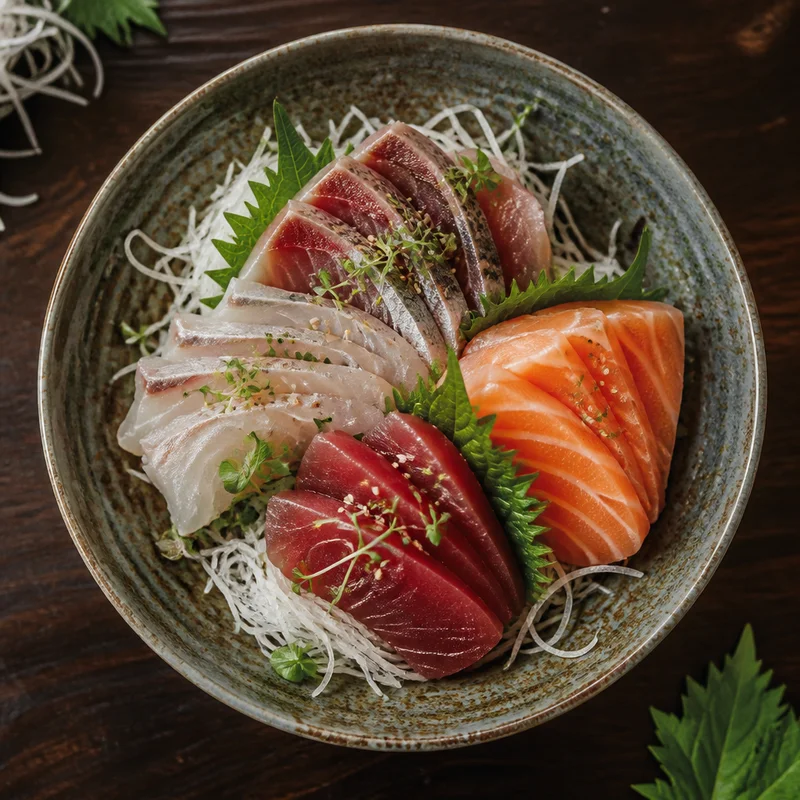
A restaurant-quality sashimi platter is 80% shopping and 20% knife work — there's nothing to cook, nowhere to hide. This walks you through what to ask for at the fish counter, the three cuts that suit tuna, salmon and hamachi, how to shred daikon into cloud-like tsuma, and how to build a plate that looks like it came from a sushi bar. Serve it as the opening act of a Japanese dinner or as a light entrée for four.
Ingredients
The fish (choose 3–4, about 12 oz total)
- 5 oz sashimi-grade bluefin or bigeye tuna loin (akami or chutoro), in one thick block
- 4 oz sashimi-grade hamachi (yellowtail) loin
- 4 oz sashimi-grade king or ora king salmon, skin off, pin bones removed
- 4 oz sashimi-grade sea bream, fluke, or scallops (optional fourth fish)
Garnish and plating
- 1 lb daikon radish, peeled
- 8 leaves fresh shiso (perilla)
- 1 small cucumber (Japanese or Persian)
- 1 lemon, cut into thin half-moons
- 1 tsp toasted sesame seeds
- 2 cups ice cubes, for the plate base (optional)
- 1 small handful microgreens or radish sprouts (kaiware)
Condiments
- 1/4 cup Japanese soy sauce (koikuchi) or tamari
- 2 tsp real wasabi paste, or 2 tsp wasabi powder mixed with 2 tsp cold water
- 2 tbsp ponzu
- 1 tbsp grated fresh ginger
- 2 tbsp sliced pickled ginger (gari)
- 1 pinch flaky sea salt
- 1 lime, for zesting (optional)
Instructions
- SHOP FIRST, PLAN SECOND. Go to a Japanese market or a fish counter that sells whole fish and ask specifically for fish they sell for raw service — the phrase that gets results is "what can I eat raw today?" Buy loin blocks (saku), not pre-cut slices or steaks. Tuna should be deep red to garnet with no rainbow sheen or brown edges; hamachi pale pink and translucent; salmon (farmed or previously frozen, which is the safe choice for salmon) bright and firm. Press a corner: it should spring back, not dent. Skip anything sitting in its own milky liquid. Buy the day you serve, and bring a cooler bag.
- KEEP IT COLD. At home, blot each block dry with paper towels, wrap in a fresh paper towel, then plastic wrap, and set on a plate over a second plate of ice in the coldest part of the fridge (34–38°F). Fish for slicing should be very cold and firm — about 35°F — but never frozen through. If a block feels soft, freeze it for 10–15 minutes before slicing.
- MAKE THE DAIKON TSUMA. Peel a 5-inch length of daikon. If you're patient, do it the traditional way: rotate the daikon against a very sharp knife to peel a long continuous 1/16-inch sheet (katsuramuki), stack the sheet in flat layers, then slice crosswise into hair-thin threads. The easy route: use a mandoline on the thinnest setting or a Japanese turning slicer, then stack and julienne. Drop the threads into ice water for 15 minutes — they'll curl and crisp — then drain and spin dry in a salad spinner or squeeze gently in a clean towel. Refrigerate until plating.
- PREP THE OTHER GARNISHES. Cut the cucumber in half lengthwise, scoop the seeds, and slice on a sharp bias into thin ovals; or make a cucumber fan by slicing a 3-inch piece almost through at 1/8-inch intervals and pressing it flat. Rinse the shiso and pat dry. Grate wasabi (or mix the powder with cold water and let it sit 10 minutes to bloom). Mix the ponzu with the grated ginger. Pour soy into four small dishes.
- SET UP YOUR KNIFE STATION. Use the longest, thinnest, sharpest knife you own — a yanagiba is ideal, but a well-honed 8–10-inch slicer or chef's knife works. Hone it before you start. Keep a damp towel next to the board and wipe the blade after every two or three slices; residue drags and tears the flesh. Chill your serving platter in the fridge or freezer now.
- SLICE THE TUNA — HIRA-ZUKURI (the standard rectangular cut). Set the block with the grain running left to right and the long side facing you. Start with the heel of the blade at the far edge, pull the knife toward you in one single smooth draw at a slight angle, and let the slice fall to the right; do not saw. Aim for slices 1/4 inch thick and about 1 x 2 inches. Line the finished slices up in an overlapping row on a cold plate and return to the fridge.
- SLICE THE HAMACHI — SOGI-ZUKURI (the angled cut). Hamachi is softer, so lay the blade nearly flat, about 30–45 degrees to the board, and draw it through in one pull to make wider, thinner slices roughly 3/16 inch thick. Slicing against the grain here is what keeps it from feeling chewy. If you have very thin belly trim, stack two slices instead of cutting thick.
- SLICE THE SALMON. Trim away any grey bloodline and the thin fatty edge. Cut on a 45-degree bias, against the grain, into slices a scant 1/4 inch thick — salmon is rich, so slightly thinner slices eat better. For a fourth fish like sea bream or fluke, go usu-zukuri: press the blade almost parallel to the board and shave near-translucent slices you can see the plate through.
- BUILD THE PLATTER. If using ice, spread a thin layer on the chilled platter and cover it completely with a clean folded towel or a layer of plastic wrap so the fish never touches ice directly. Mound the daikon tsuma toward the back as a low, airy ridge — it's the structure everything leans against. Lay a shiso leaf in front of the mound for each fish.
- PLATE THE FISH IN GROUPS, NOT A MOSAIC. Set each fish on its own shiso leaf, keeping the varieties separate: fan the tuna in a straight overlapping line, drape the hamachi in a gentle arc, and shingle the salmon in a curve. Prop a few slices against the daikon so the platter has height. Tuck cucumber slices and lemon half-moons between the groups, add a small pinched cone of wasabi and a little pile of gari at the edge, and finish with sprouts and a pinch of sesame seeds. Zest a whisper of lime over the hamachi if you like.
- SERVE IMMEDIATELY, COLDEST FISH LAST. Bring the platter out within 10 minutes of slicing with soy, the ginger-ponzu, and extra wasabi alongside. Coach your table: dip the fish lightly, fish-side down, in soy rather than drowning it; put wasabi on the fish rather than stirring it into the soy; and eat in order from lean to rich — sea bream, tuna, hamachi, salmon — with a slice of gari to reset in between.
Chef's tips
- "Sashimi-grade" is a marketing term, not a legal standard. What actually matters is a high-turnover counter, fish handled cold and clean, and — for anything but tuna — fish that has been commercially frozen to kill parasites. Farmed salmon labeled for raw use has been; wild salmon from the case usually has not.
- Buy 25% more fish than you plan to serve. Trimming the grey bloodline, sinew and thin edges off each block is non-negotiable for texture, and the trim makes excellent poke or a spicy tuna hand roll for the cook.
- One pull per slice. Sawing crushes the muscle fibers and makes the surface look dull and smeared instead of glossy. If the knife won't pass in a single draw, it isn't sharp enough — stop and hone it.
- Never let cut fish sit at room temperature or on bare ice. Slice, plate, chill, serve. Anything left over is not sashimi anymore — cook it that night or turn it into a quick soy-marinated zuke over rice for tomorrow's lunch.
- No shiso at your market? Substitute a small tender lettuce leaf, a nasturtium leaf, or a folded piece of cucumber ribbon. Skip mint or basil — the flavor fights the fish.
Nutrition (per serving, estimated)
198calories
29gprotein
10gcarbs
6gfat
Estimates only — values vary with brands and portions.
Made with Sprig
Sashimi Platter with Daikon Tsuma and Shiso was created in Sprig — the AI chef that turns any craving into a complete recipe, plans your week, and shops with one smart list.
Free to start · 14-day Pro trial · cancel anytime
Not ready yet? Get the occasional recipe worth cooking — a couple a month at most.
You're on the list — check your inbox!
Unsubscribe anytime. Privacy Policy
More from Sprig Originals
Are you this recipe's original author or publisher? Report a problem