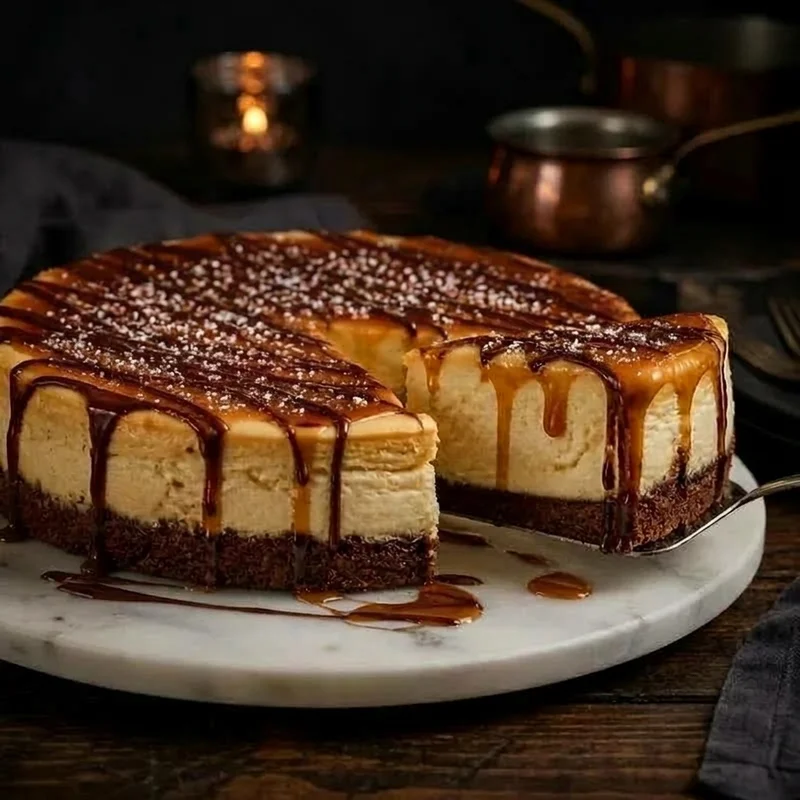
Creole Cream Cheese Cheesecake with Salted Caramel and Dark Chocolate
 By Sprig Originals · cooked up in Sprig
A New Orleans grande-dame dessert rebuilt for a home oven. True Creole cream cheese — the tangy, loose-curd fresh cheese found almost nowhere outside Louisiana — gets faked convincingly with block cream cheese loosened with sour cream and cultured buttermilk, which gives the custard that unmistakable clabbered tang without thinning the set. A slow bake in a water bath at a low temperature yields a satiny, crack-free top; a graham crust, a real stovetop salted caramel and a dark chocolate drizzle finish it the way a white-tablecloth Garden District dining room would.
Ingredients
- 1 3/4 cups graham cracker crumbs (about 12 full sheets)
- 3 tbsp light brown sugar, packed
- 1/4 tsp ground cinnamon
- 1/4 tsp fine sea salt
- 6 tbsp unsalted butter, melted
- 32 oz full-fat block cream cheese, at room temperature (four 8-oz blocks)
- 1 1/4 cups granulated sugar
- 3 tbsp all-purpose flour
- 1/2 tsp fine sea salt
- 3/4 cup full-fat sour cream, at room temperature
- 1/3 cup cultured buttermilk, at room temperature
- 1 tbsp fresh lemon juice
- 1 tsp finely grated lemon zest
- 2 tsp vanilla extract
- 4 large eggs, at room temperature
- 1 large egg yolk, at room temperature
- 1 cup granulated sugar
- 1/4 cup water
- 6 tbsp unsalted butter, cut into pieces
- 1/2 cup heavy cream, warmed
- 3/4 tsp flaky sea salt
- 4 oz bittersweet chocolate (60–70%), finely chopped
- 1/3 cup heavy cream
- 1 tbsp light corn syrup
- Flaky sea salt, for finishing
Instructions
- Heat the oven to 325°F with a rack in the lower third. Wrap the outside of a 9-inch springform pan with two full sheets of heavy-duty aluminum foil, pressing it snugly up the sides so no water can seep in. (If you only have standard foil, use three layers, or set the wrapped pan inside a slow-cooker liner or an oven bag.) Butter the inside of the pan.
- Make the crust: stir together the graham crumbs, brown sugar, cinnamon and 1/4 teaspoon salt, then pour in the melted butter and mix until it looks like damp sand. Press firmly into the bottom of the pan and about 1 inch up the sides, using the flat bottom of a measuring cup to compact it. Bake 10 minutes, until fragrant and set. Cool on a rack while you make the filling; leave the oven at 325°F.
- Put a kettle or large pot of water on to boil for the water bath.
- In a stand mixer with the paddle (or a large bowl with a hand mixer), beat the room-temperature cream cheese on medium-low for 2 to 3 minutes, scraping down the bowl twice, until completely smooth with no lumps. Lumps at this stage never disappear later.
- Whisk the sugar, flour and 1/2 teaspoon salt together, then add to the cream cheese and beat on low for 1 minute until fully incorporated and glossy. Scrape the bowl and paddle thoroughly.
- Add the sour cream, buttermilk, lemon juice, lemon zest and vanilla. Beat on low just until uniform, about 30 seconds — this loose, cultured mixture is what stands in for true Creole cream cheese. Scrape down again.
- With the mixer on the lowest speed, add the eggs one at a time and then the yolk, mixing only until each disappears. Stop the moment the last yolk is incorporated; whipping air in now is what causes cracks and soufflé-like rise.
- Pour the batter over the cooled crust and smooth the top. Rap the pan gently on the counter 5 or 6 times to release trapped air bubbles, then pop any surface bubbles with a toothpick.
- Set the wrapped springform inside a roasting pan and place it in the oven. Carefully pour boiling water into the roasting pan until it comes about 1 inch up the sides of the springform. Bake 70 to 80 minutes, until the outer 2 inches are set and the center 3-inch circle still wobbles like loose gelatin when you nudge the pan. An instant-read thermometer inserted 1 inch from the edge should read 150°F.
- Turn the oven off, prop the door open with a wooden spoon, and let the cheesecake sit in the cooling oven and water bath for 1 hour. Then lift it out, unwrap the foil, and cool on a rack to room temperature, about 2 hours. Run a thin knife around the edge, then refrigerate uncovered for 1 hour before covering loosely; chill at least 8 hours or overnight.
- Make the caramel: combine the sugar and water in a heavy 2-quart saucepan over medium-high heat. Swirl the pan (do not stir) and cook 8 to 12 minutes, until the syrup turns a deep amber, about the color of an old penny, and smells nutty. Kill the heat, add the butter piece by piece — it will bubble violently — then slowly whisk in the warm cream. Stir in the flaky salt. Cool at least 30 minutes; it thickens as it sits.
- Make the chocolate drizzle: put the chopped chocolate in a small bowl. Bring the cream and corn syrup just to a simmer, pour over the chocolate, wait 2 minutes, then stir from the center out until smooth and shiny. Let it cool 10 minutes to a drizzling consistency.
- To serve, release the springform ring and slide the cheesecake onto a platter. Spoon a thin layer of caramel over the top, letting a little run down the sides, then drizzle the chocolate over in fine ribbons with a spoon or a zip-top bag with a snipped corner. Finish with a pinch of flaky salt.
- Slice with a long thin knife dipped in hot water and wiped clean between every cut. Serve cold, with extra caramel and chocolate passed at the table.
Chef's tips
- Room temperature is not optional. Cold cream cheese, sour cream or eggs will leave lumps that no amount of beating fixes. Set everything on the counter 2 hours ahead, or microwave unwrapped cream cheese blocks in 15-second bursts to about 68°F.
- The buttermilk is the whole point of the substitution — use real cultured buttermilk, not a lemon-juice-and-milk hack, for that clabbered Louisiana tang. Kefir or thinned crème fraîche also work.
- No roasting pan large enough? Set the wrapped springform on a rimmed baking sheet on the middle rack and place a separate pan of boiling water on the rack below. You get most of the steam benefit, though the bake may run 5 to 10 minutes shorter.
- Underbaking slightly is always safer than overbaking. The center firms up completely during the overnight chill; a fully set center in the oven means a dry, grainy slice.
- The cheesecake is better on day two and keeps 5 days refrigerated. Sauce individual slices rather than the whole cake if you plan on leftovers — caramel weeps a bit after a day.
- Cheesecake freezes beautifully undressed: chill fully, freeze uncovered until firm, then double-wrap for up to 2 months. Thaw overnight in the fridge and add the caramel and chocolate the day you serve.
Nutrition (per serving, estimated)
Made with Sprig
Creole Cream Cheese Cheesecake with Salted Caramel and Dark Chocolate was created in Sprig — the AI chef that turns any craving into a complete recipe, plans your week, and shops with one smart list.
More from Sprig Originals
Are you this recipe's original author or publisher? Report a problem