Sprig Originals's kitchen / Grilled Whole Red Snapper with Lemon-Oregano Ladolemono
Grilled Whole Red Snapper with Lemon-Oregano Ladolemono
 By Sprig Originals · cooked up in Sprig
Worked out from this recipe's ingredients. If you're cooking for an allergy, always read the full ingredient list.
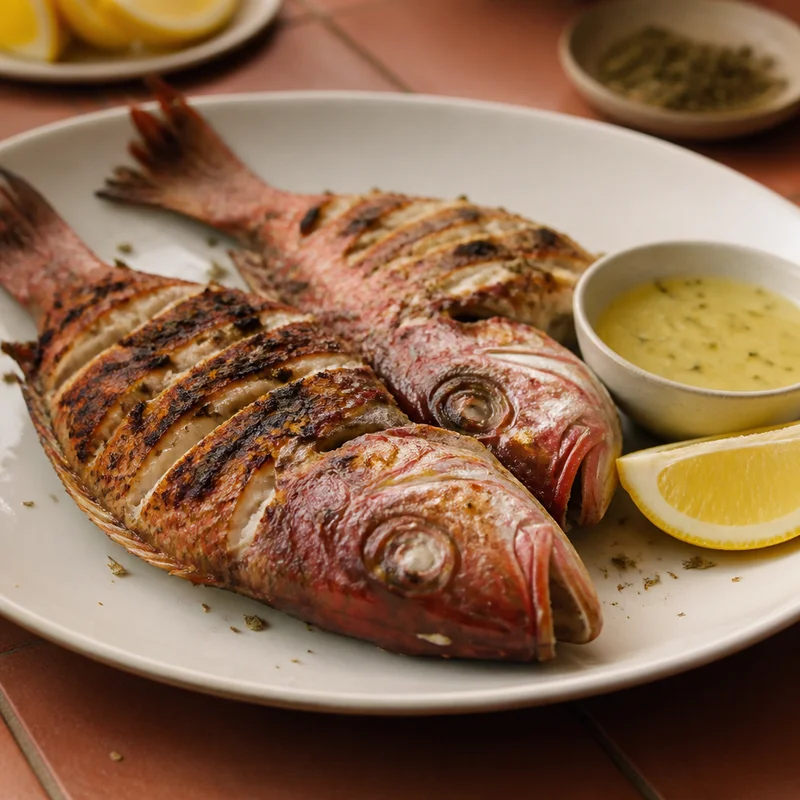
Two whole red snapper, scored to the bone, rubbed with olive oil and grilled over direct heat until the skin blisters and the flesh slips off the frame. The moment they come off the grate, a hand-whisked lemon-oregano ladolemono goes over the hot fish so it sizzles into every cut. The technique that makes it work — scoring, oiling both fish and grate, and flipping only once with two spatulas — is spelled out step by step.
Ingredients
Fish and Grill
- 2 whole red snapper, 1 1/4 to 1 1/2 lb each, scaled and gutted, gills removed
- 1 tbsp kosher salt, plus more for finishing
- 1/2 tsp freshly ground black pepper
- 3 tbsp extra-virgin olive oil, for the fish
- 2 tbsp neutral oil such as grapeseed, for the grate
- 1 lemon, thinly sliced
- 6 fresh oregano sprigs (or flat-leaf parsley stems)
- 4 garlic cloves, smashed
Ladolemono
- 1/2 cup extra-virgin olive oil, best quality
- 1/4 cup fresh lemon juice (about 2 lemons)
- 1 tsp finely grated lemon zest
- 1 1/2 tsp dried Greek oregano, crumbled between your palms
- 1 tsp Dijon mustard
- 1 small garlic clove, grated
- 3/4 tsp kosher salt
- 1/4 tsp black pepper
- 2 tbsp chopped fresh flat-leaf parsley
To Serve
- 1 lemon, cut into wedges
- flaky sea salt
- 1 pinch dried Greek oregano
Instructions
- Pull the snapper out of the fridge 30 minutes before cooking. Rinse each fish under cold water, then run your thumb against the grain along the skin to check for missed scales — any that remain will stick to the grate. Pat the fish bone-dry inside and out with paper towels, then set them on a rack over a sheet pan while you prep everything else; dry skin is the single biggest factor in a clean release.
- Score each fish: with a sharp thin knife held at a 45-degree angle, cut 3 diagonal slashes per side, spaced about 1 1/2 inches apart, running from just behind the head toward the tail. Press until the blade touches the spine — you should feel bone. Scoring lets heat reach the thick shoulder meat so the fish cooks evenly and gives the ladolemono somewhere to go.
- Season aggressively: sprinkle the 1 tablespoon kosher salt and the black pepper over both sides of both fish, working salt down into each slash and generously into the belly cavity. Stuff each cavity with lemon slices, 3 oregano sprigs and 2 smashed garlic cloves — don't overpack or the belly will gape open on the grill. Rub 3 tablespoons olive oil over the skin, massaging it into the scores.
- Build a hot direct fire. For charcoal, spread a full chimney of lit coals in an even single layer and set the grate 4 inches above; for gas, run all burners on high with the lid closed for 15 minutes. You want the grate at 450–500°F — hold your hand 4 inches above it and you should only last 2 to 3 seconds.
- Clean the hot grate hard with a wire brush, then oil it: fold a paper towel into a tight pad, grip it with tongs, dip it in the 2 tablespoons neutral oil and wipe the bars 3 or 4 times until they look glossy and just start to smoke. Re-oil right before the fish goes on. A clean, hot, oiled grate is what keeps the skin on the fish instead of on the grill.
- Lay both fish on the grate at a 45-degree angle to the bars, backbone side facing away from you, with 3 inches between them. Close the lid and do not touch them for 6 to 7 minutes. Resist every urge to nudge — the skin needs to set and contract before it will release.
- Test for release: slide a thin metal spatula under the head end and lift gently. If it resists, close the lid and give it another 60 to 90 seconds. When it lifts freely with the skin intact, flip using two spatulas — one under the head/shoulder, one under the tail — and turn the fish toward you in one confident motion, laying it back down at the same angle. One flip only.
- Grill the second side 5 to 7 minutes with the lid closed. The fish is done when an instant-read thermometer pushed into the thickest part behind the head reads 130–135°F, or when a paring blade slipped along the backbone shows opaque flesh that flakes away from the bone. Total time runs 12 to 15 minutes for 1 1/4 lb fish, up to 18 for larger.
- While the fish grills, make the ladolemono: in a small bowl whisk the lemon juice, zest, dried oregano, Dijon, grated garlic, 3/4 teaspoon salt and pepper until the salt dissolves. Whisk in the 1/2 cup olive oil in a thin stream until it thickens and turns pale and glossy, then stir in the parsley. Whisk again just before pouring — it separates fast, and that's fine.
- Transfer the fish straight to a warm platter and immediately spoon about two-thirds of the ladolemono over the top while the skin is still crackling; it should hiss and the oregano should bloom. Let the fish rest 3 minutes, finish with flaky salt and a pinch of dried oregano, and serve with lemon wedges and the remaining ladolemono on the side.
- To serve at the table, run a spoon down the length of the backbone, lift the top fillet off in two pieces, then lift the spine and head away in one piece to expose the bottom fillet. Spoon the pooled lemon oil from the platter over each portion.
Chef's tips
- If your fishmonger will do it, ask for the snapper scaled, gutted, gills out and fins trimmed — trimmed dorsal and pectoral fins make flipping far less awkward.
- No grill? Heat a heavy cast-iron griddle or two large skillets over medium-high for 5 minutes, oil well, and cook the scored fish 6 minutes per side; or roast on an oiled sheet pan at 450°F for 20 to 25 minutes and skip the flip entirely. Pour the ladolemono on hot either way.
- A fish basket or two long metal skewers run through the fish from head to tail turn the flip into a no-brainer, and are worth using if your fish are over 1 1/2 lb.
- Use real dried Greek oregano (rigani) on the branch if you can find it — crumble it between your palms right before it goes in the dressing to wake up the oils.
- Ladolemono keeps 3 days refrigerated in a jar. Bring it to room temperature and shake hard before using; it's also excellent on grilled lamb chops, octopus or roasted potatoes.
- Sea bass, branzino, porgy or black bass all work in place of snapper at the same weight and timing.
Nutrition (per serving, estimated)
621calories
36gprotein
7gcarbs
49gfat
Estimates only — values vary with brands and portions.
Made with Sprig
Grilled Whole Red Snapper with Lemon-Oregano Ladolemono was created in Sprig — the AI chef that turns any craving into a complete recipe, plans your week, and shops with one smart list.
Free to start · 14-day Pro trial · cancel anytime
Not ready yet? Get the occasional recipe worth cooking — a couple a month at most.
You're on the list — check your inbox!
Unsubscribe anytime. Privacy Policy
More from Sprig Originals
Are you this recipe's original author or publisher? Report a problem