Sprig Originals's kitchen / Baked Meat Lasagna with Béchamel and Parmesan
Baked Meat Lasagna with Béchamel and Parmesan
 By Sprig Originals · cooked up in Sprig
Worked out from this recipe's ingredients. If you're cooking for an allergy, always read the full ingredient list.
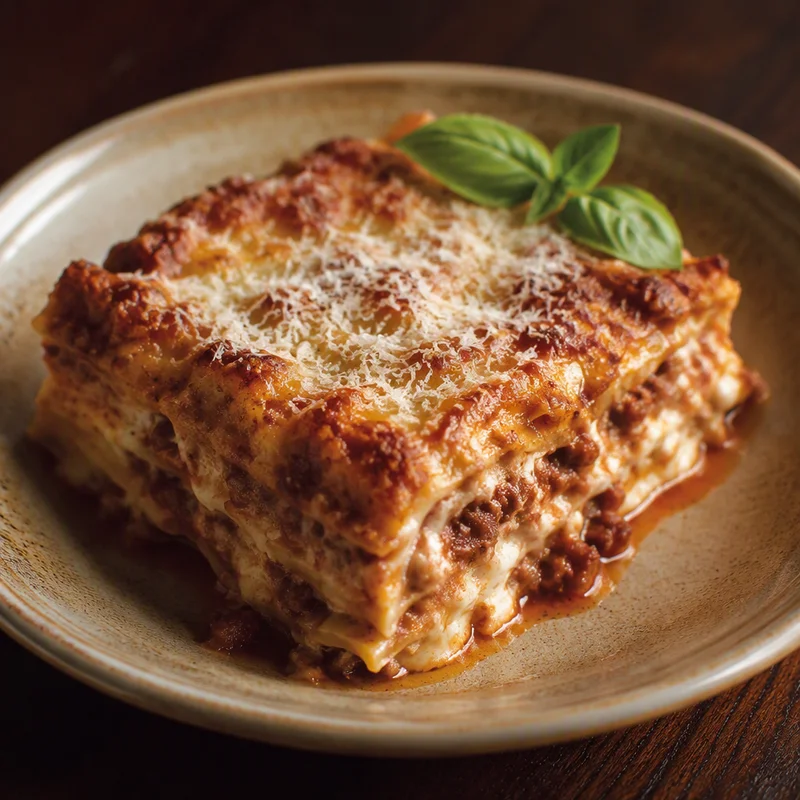
A restaurant-caliber lasagna built the classic way: a slow-simmered beef-and-pork ragù thickened with milk and tomato paste, a nutmeg-scented béchamel instead of ricotta, and no-boil noodles that drink up all that sauce as it bakes. It assembles a day ahead and slices into clean, architectural squares if you give it the full 20-minute rest.
Ingredients
Meat Sauce
- 2 tbsp olive oil
- 4 oz pancetta, finely chopped
- 1 large yellow onion, finely diced
- 2 medium carrots, finely diced
- 2 stalks celery, finely diced
- 4 cloves garlic, minced
- 1.5 lb ground beef chuck (80/20)
- 3/4 lb ground pork
- 2 tsp kosher salt
- 1 tsp black pepper
- 1/2 tsp red pepper flakes
- 1 cup whole milk
- 1 cup dry red wine
- 1/3 cup tomato paste
- 28 oz canned San Marzano whole tomatoes, crushed by hand
- 1 cup low-sodium chicken or beef broth
- 1 sprig fresh rosemary
- 2 sprigs fresh thyme
- 1 bay leaf
- 1 piece Parmigiano-Reggiano rind (optional)
Béchamel
- 6 tbsp unsalted butter
- 1/2 cup all-purpose flour
- 5 cups whole milk, warmed
- 1.5 tsp kosher salt
- 1/4 tsp freshly grated nutmeg
- 1/4 tsp white pepper
- 1 oz Parmigiano-Reggiano, finely grated
Assembly
- 12 oz no-boil lasagna noodles (about 15–18 sheets)
- 6 oz Parmigiano-Reggiano, finely grated
- 1 lb low-moisture whole-milk mozzarella, shredded
- 2 tbsp unsalted butter, for the pan and top
- 2 tbsp chopped fresh basil or parsley, to finish
Instructions
- Make the ragù base: heat 2 tbsp olive oil in a large Dutch oven over medium heat. Add the pancetta and cook 5–6 minutes until the fat renders and the bits are lightly golden.
- Add the onion, carrot, and celery with a pinch of salt. Cook 10–12 minutes, stirring often, until very soft and just beginning to color. Stir in the garlic and cook 1 minute more.
- Raise the heat to medium-high and add the ground beef and pork. Break the meat up with a wooden spoon and cook 10–12 minutes, letting it brown in spots rather than steam. Season with 2 tsp salt, black pepper, and red pepper flakes.
- Pour in the milk and simmer, stirring, 6–8 minutes until it has almost completely evaporated — this is what makes the meat tender. Add the red wine and simmer another 5 minutes until the raw alcohol smell is gone.
- Push the meat to one side, add the tomato paste to the bare spot, and toast it 2 minutes until it darkens to brick red. Stir it through, then add the crushed tomatoes, broth, rosemary, thyme, bay leaf, and Parmesan rind if using.
- Bring to a bare simmer, partially cover, and cook 90 minutes over low heat, stirring every 20 minutes. The finished sauce should be thick enough that a spoon dragged through the pot leaves a trail that closes slowly. If it looks loose at the end, simmer uncovered 10–15 minutes more. Remove the herb stems, bay leaf, and rind. Taste and adjust salt. You should have about 8 cups.
- Make the béchamel: melt 6 tbsp butter in a saucepan over medium heat. Whisk in the flour and cook 2 minutes, whisking constantly, until it smells faintly nutty but stays pale. Add the warm milk in three additions, whisking smooth after each.
- Bring to a gentle simmer and cook 6–8 minutes, whisking, until the sauce thickly coats a spoon. Off heat, whisk in 1.5 tsp salt, the nutmeg, white pepper, and 1 oz grated Parmesan. Press plastic wrap directly on the surface if not using immediately.
- Assemble: butter a 9x13-inch baking dish (at least 3 inches deep). Spread 1 cup of ragù over the bottom, then a thin drizzle of béchamel. Lay down a single layer of no-boil noodles, breaking sheets to fit without overlapping more than 1/4 inch.
- Build four more layers in this order each time: about 1 1/2 cups ragù, 3/4 cup béchamel spread to the edges, a generous 1/4 cup grated Parmesan, and a scattering of mozzarella, then noodles. Reserve the last 1 cup béchamel, 1 cup Parmesan, and 1 cup mozzarella for the top.
- Finish the top with the reserved béchamel spread edge to edge, then the mozzarella and Parmesan, and dot with the remaining 2 tbsp butter. The noodles must be fully covered in sauce everywhere or they will bake up leathery.
- To bake now: cover tightly with buttered foil and bake at 375°F for 40 minutes. To bake later: cool, cover, and refrigerate up to 2 days — then bake covered at 375°F for 55 minutes straight from the fridge.
- Uncover and bake 20–25 minutes more, until the top is bubbling at the edges and deeply browned in patches. If it needs color, broil 2 minutes on the second rack, watching constantly.
- Rest the lasagna on a rack, uncovered, for a full 20 minutes before cutting. This is not optional — it lets the béchamel and starch set so a knife gives you clean, layered squares instead of a slide. Cut with a thin serrated knife, lift with an offset spatula, and scatter with basil or parsley.
Chef's tips
- Thick sauce is everything with no-boil noodles: they absorb roughly a cup of liquid as they bake, but a soupy ragù still means a soupy lasagna. Reduce until a spoon leaves a trail.
- No ricotta here on purpose — béchamel is the fine-dining move. It bakes into a silky, sliceable custard layer instead of going grainy the way ricotta can.
- Shred your own mozzarella from a block. Pre-shredded is coated in starch and bakes up rubbery and oily on top.
- Assembled and chilled overnight, the layers hydrate evenly and the lasagna slices even more cleanly. Just add 15 minutes to the covered bake time.
- Leftovers reheat best in individual squares: cover with foil and warm at 325°F for 20 minutes, or crisp a cut side in a buttered nonstick skillet for 3 minutes.
Nutrition (per serving, estimated)
720calories
42gprotein
36gcarbs
43gfat
Estimates only — values vary with brands and portions.
Made with Sprig
Baked Meat Lasagna with Béchamel and Parmesan was created in Sprig — the AI chef that turns any craving into a complete recipe, plans your week, and shops with one smart list.
Free to start · 14-day Pro trial · cancel anytime
Not ready yet? Get the occasional recipe worth cooking — a couple a month at most.
You're on the list — check your inbox!
Unsubscribe anytime. Privacy Policy
More from Sprig Originals
Are you this recipe's original author or publisher? Report a problem