Sprig Originals's kitchen / Crackling Chinese Roast Duck
Crackling Chinese Roast Duck
 By Sprig Originals · cooked up in Sprig
Worked out from this recipe's ingredients. If you're cooking for an allergy, always read the full ingredient list.
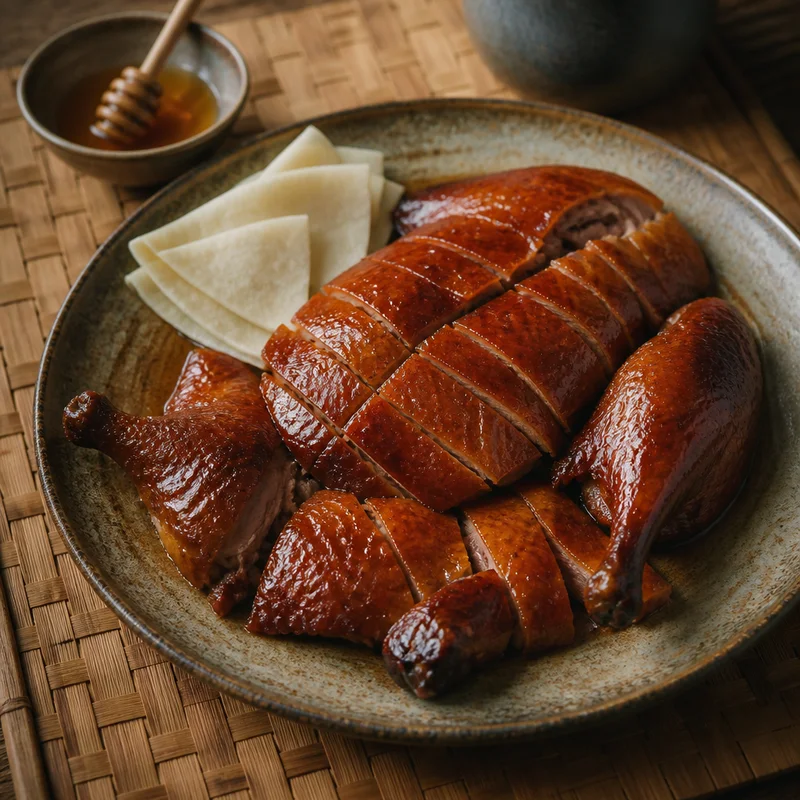
A whole duck scalded with boiling water, glazed with maltose vinegar, then air-dried uncovered in the fridge for a full day so the skin turns to parchment. It roasts low and slow to render out the fat, then gets a blast of high heat that blisters the skin into glass. The kind of duck that costs $30 a plate in Chinatown, built for a standard home oven with nothing more exotic than a roasting rack.
Ingredients
Duck and cavity seasoning
- 1 whole Pekin (Long Island) duck, 5 to 6 lb, giblets and neck removed
- 1 tbsp kosher salt
- 1 1/2 tsp five-spice powder
- 1 tsp granulated sugar
- 1 tsp Sichuan peppercorns, lightly crushed
- 4 scallions, halved crosswise
- 4 slices fresh ginger, 1/4-inch thick
- 3 star anise pods
- 1 strip orange or tangerine peel, 3 inches
Scald and glaze
- 3 quarts water, for boiling
- 3 tbsp maltose syrup (or honey)
- 3 tbsp boiling water
- 2 tbsp Shaoxing wine
- 2 tbsp rice vinegar
- 1 tsp dark soy sauce
To serve
- 16 thin Mandarin pancakes or steamed folded buns
- 1/2 cup hoisin sauce
- 2 tsp toasted sesame oil
- 6 scallions, cut into 3-inch julienne
- 1 English cucumber, seeded and cut into batons
- flaky salt, for the skin
Instructions
- Start 24 to 36 hours ahead. Pull the duck from its packaging and remove any large pads of loose fat from inside the neck and tail cavities (save them to render if you like). Trim the flap of neck skin to about 1 inch and cut off the wing tips. Pat the bird bone dry inside and out with paper towels.
- Loosen the skin: slide a finger or the handle of a wooden spoon between the skin and the breast meat, working from the neck end and along both sides of the breastbone and over the thighs, without tearing the skin. This air gap is what lets fat drain and skin crisp. Then prick the skin all over the thighs, back, and along the sides of the breast with the tip of a paring knife or a metal skewer, angling shallowly so you pierce only skin and fat, never the meat — roughly 40 to 50 pricks.
- Mix the kosher salt, five-spice powder, sugar, and crushed Sichuan peppercorns. Rub all of it inside the cavity only — leave the exterior skin unsalted for now. Stuff the cavity with the scallions, ginger, star anise, and citrus peel. Close the cavity opening with two or three short bamboo skewers laced through the skin, or sew it shut with kitchen twine.
- Scald the skin: set the duck breast-up on a rack in the clean kitchen sink. Bring 3 quarts of water to a hard boil and ladle it slowly over the entire bird, about 2 quarts over the top and sides and 1 quart after flipping it to hit the back. You will see the skin visibly tighten and turn opaque and slightly rubbery — that's the point. Discard the water and pat the duck dry.
- Make the glaze: whisk the maltose with 3 tablespoons boiling water until it dissolves (maltose is stiff; warm the jar in hot tap water first). Stir in the Shaoxing wine, rice vinegar, and dark soy sauce. Brush the entire outside of the duck with a thin, even coat — you want a sheen, not puddles. Reserve the rest, covered, in the fridge.
- Air-dry: set the duck breast-up on a rack over a rimmed sheet pan and refrigerate uncovered, with nothing touching the skin, for 18 to 24 hours (up to 36 is better). If your fridge has a fan, position the bird in the airflow. After the first 8 hours, brush on a second thin coat of glaze. The skin should end up dry, taut, and papery to the touch, like a parchment drum. Do not skip or shorten this step; it is the entire recipe.
- Roast low: pull the duck out and let it sit at room temperature 45 minutes. Heat the oven to 300°F. Pour 2 cups of water into a roasting pan and set the duck breast-up on a rack above it (the water keeps the dripping fat from smoking). Roast 45 minutes, then flip breast-down and roast 45 minutes more, then flip breast-up again for a final 30 minutes — 2 hours total at 300°F. Add water to the pan if it runs dry. The duck will look pale and shrunken and a great deal of fat will have rendered out. That's correct.
- Carefully pour off the pan liquid (save the fat for potatoes; it's the best part of the deal). Return the duck breast-up on the rack over the now-empty, dry pan. Raise the oven to 475°F and roast 12 to 20 minutes, rotating the pan once, until the skin is deep mahogany, tight, and audibly crisp when tapped. Watch it constantly after minute 10 — the sugar in the glaze goes from bronze to burnt fast. Tent any spot getting too dark with a scrap of foil.
- Check doneness: an instant-read thermometer in the thickest part of the thigh, away from bone, should read 175 to 180°F. Duck legs want to be well past medium; the breast will still be juicy because the fat cap protected it.
- Rest the duck on a cutting board, uncovered, for 15 minutes — do not tent with foil or you'll steam the skin soft. Meanwhile steam the pancakes or buns, and stir the sesame oil into the hoisin.
- Carve: remove the skewers and drain the cavity juices into a bowl (spoon them over the meat later). Slice the crisp skin off the breast in wide strips and set aside. Remove the legs and wings, then carve the breast meat into thin slices. Arrange meat and skin on a warm platter, sprinkle the skin with a little flaky salt, and serve with pancakes, hoisin, scallions, and cucumber.
Chef's tips
- Pekin duck (the standard supermarket duck, usually frozen) is the right bird. Thaw it in the fridge for two full days before you start — a partly frozen duck will weep and never dry properly.
- Maltose gives the classic lacquer and a cleaner, less-sweet finish than honey. Look for it in jars at Chinese groceries; if you use honey instead, cut the final blast to 450°F because it scorches sooner.
- No room for an uncovered duck in the fridge? Dry it 6 hours in the fridge, then finish with a fan on low pointed at it on the counter for 2 hours in a cool room, then return to the fridge until you roast.
- The low-and-slow stage is about fat, not doneness. If your duck still feels heavy and soft-skinned after 2 hours at 300°F, give it another 20 minutes before you go to high heat — a fatty layer under the skin will steam instead of crisp.
- Simmer the carcass with ginger, scallion, and a splash of Shaoxing for an hour to make a duck broth for noodles the next day.
Nutrition (per serving, estimated)
1485calories
52gprotein
143gcarbs
79gfat
Estimates only — values vary with brands and portions.
Made with Sprig
Crackling Chinese Roast Duck was created in Sprig — the AI chef that turns any craving into a complete recipe, plans your week, and shops with one smart list.
Free to start · 14-day Pro trial · cancel anytime
Not ready yet? Get the occasional recipe worth cooking — a couple a month at most.
You're on the list — check your inbox!
Unsubscribe anytime. Privacy Policy
More from Sprig Originals
Are you this recipe's original author or publisher? Report a problem