Sprig Originals's kitchen / Classic Margherita Pizza with Drained Fresh Mozzarella
Classic Margherita Pizza with Drained Fresh Mozzarella
 By Sprig Originals · cooked up in Sprig
Worked out from this recipe's ingredients. If you're cooking for an allergy, always read the full ingredient list.
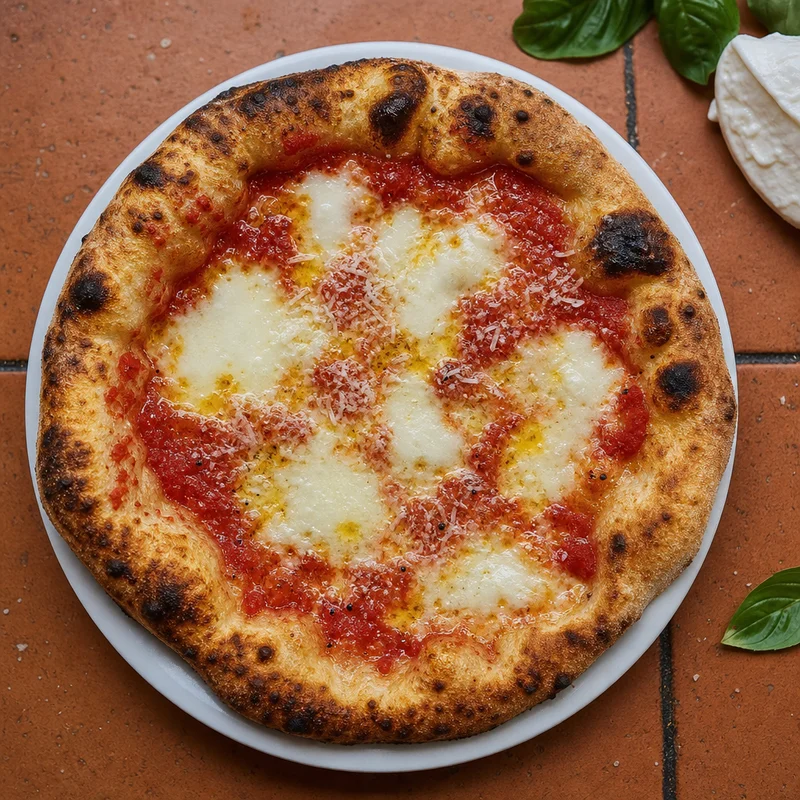
A trattoria-style margherita you can actually pull off at home: a slow-fermented dough stretched thin, a bright no-cook San Marzano sauce, and fresh mozzarella that's been salted and drained so it melts instead of flooding the crust. The stone goes in a screaming-hot oven for a full hour, and the basil goes on after the bake so it stays green and fragrant instead of scorching.
Ingredients
Dough (two 12-inch pizzas)
- 375 g bread flour or Italian 00 flour (about 3 cups)
- 245 g cool water (about 1 cup plus 1 tablespoon)
- 9 g fine sea salt (1 1/2 teaspoons)
- 1/2 tsp instant yeast
- 1 tsp extra-virgin olive oil
- Semolina or coarse cornmeal, for the peel
Sauce
- 1 14-oz can whole peeled San Marzano tomatoes
- 1/2 tsp fine sea salt
- 1 tbsp extra-virgin olive oil
- 1 small clove garlic, peeled and lightly smashed (optional)
Topping
- 8 oz fresh mozzarella ball packed in water
- 1/4 tsp kosher salt, for draining the cheese
- 1/3 cup finely grated Parmigiano-Reggiano
- 20 leaves fresh basil
- 2 tbsp good extra-virgin olive oil, for finishing
- Flaky sea salt, for finishing
Instructions
- Make the dough (ideally a day ahead): In a large bowl, whisk the flour, salt, and instant yeast. Add the water and 1 teaspoon olive oil and stir with a sturdy spoon or your hand until no dry flour remains and you have a shaggy, sticky mass, about 1 minute. Cover and rest 20 minutes.
- Knead in the bowl or on a lightly oiled counter for 3 to 4 minutes, using a stretch-and-fold motion rather than aggressive pushing, until the dough smooths out and pulls back when stretched. Cover the bowl and let rise at room temperature until roughly doubled and visibly bubbly, 2 to 3 hours. For much better flavor, instead refrigerate the covered bowl for 24 to 48 hours after 1 hour at room temperature.
- Divide the dough into two equal pieces (about 315 g each). Shape each into a tight ball by dragging it against the counter with cupped hands until the surface is taut. Place the balls on a floured tray or in separate lightly oiled containers, cover, and let them relax 1 1/2 to 2 hours at room temperature. Cold dough needs the full 2 hours to come to temperature or it will fight you.
- Drain the mozzarella: tear or slice the mozzarella into rough 1/2-inch pieces, toss with the 1/4 teaspoon kosher salt, and spread on a paper-towel-lined plate or in a strainer set over a bowl. Let it sit at room temperature for at least 30 minutes, blotting once or twice. This is the single most important step for a pizza that isn't soupy.
- Make the sauce: pour the tomatoes into a bowl and crush them thoroughly with your hands or a potato masher until pulpy with a few small pieces left. Stir in the 1/2 teaspoon sea salt, 1 tablespoon olive oil, and the smashed garlic clove if using. Do not cook it; it will cook on the pizza. Let it stand at least 20 minutes, then fish out the garlic. You will use about 1/3 cup per pizza.
- At least 1 hour before baking, set a pizza stone or steel on an oven rack in the upper third of the oven and heat to 550°F (or your oven's maximum). A full hour of preheating is not optional; the stone needs to be saturated with heat to blister the crust in a few minutes. If you have a broiler in the main oven cavity, switch it on for the last 5 minutes of preheating, then back to bake right before the pizza goes in.
- Shape the first pizza: flour a work surface generously. Press one dough ball from the center outward with your fingertips, leaving a 1/2-inch rim untouched, then lift it and let gravity stretch it as you rotate the edge through your hands until you have a 12-inch round with a thin center and a puffier border. Never use a rolling pin. Transfer it to a pizza peel or the back of a rimless baking sheet dusted with semolina.
- Top quickly: spoon about 1/3 cup sauce onto the center and spread it in a spiral with the back of the spoon, stopping 3/4 inch from the edge. Scatter half the drained mozzarella in an even layer, leaving small gaps of bare sauce, then sprinkle with half the Parmigiano. Add no basil yet.
- Slide the pizza onto the hot stone with a quick forward-and-back jerk of the peel. Bake 6 to 8 minutes, until the crust is puffed and spotted deep brown in places and the cheese is bubbling. If the top is lagging behind the bottom, switch on the broiler for the last 60 to 90 seconds and watch it closely.
- Transfer to a cutting board. Immediately tear or scatter 10 basil leaves over the hot pizza, drizzle with 1 tablespoon of the finishing olive oil, and add a pinch of flaky salt. The residual heat releases the basil's aroma without turning the leaves black. Cut into 6 slices and serve at once, then repeat with the second dough ball, giving the stone 5 to 10 minutes to reheat first.
Chef's tips
- If you skip the mozzarella draining step, use low-moisture whole-milk mozzarella instead. Fresh mozzarella straight from the tub will release enough water to steam the center of the crust into a soggy patch.
- No stone or steel? Preheat a heavy rimless baking sheet or a large cast-iron skillet upside down on the rack for 45 minutes and bake directly on it. Expect an extra 2 to 3 minutes and a slightly less blistered bottom.
- A 24- to 48-hour cold ferment in the fridge is what separates homemade pizza from good pizza. The dough browns better, tastes faintly sweet and yeasty, and is far easier to stretch thin.
- Keep the toppings restrained: too much sauce or cheese lowers the surface temperature and you'll get a pale, bready crust instead of a crisp one.
- Leftover no-cook sauce keeps 4 days refrigerated and freezes well in a small jar; it's also excellent on pasta with a knob of butter.
Nutrition (per serving, estimated)
620calories
27gprotein
78gcarbs
22gfat
Estimates only — values vary with brands and portions.
Made with Sprig
Classic Margherita Pizza with Drained Fresh Mozzarella was created in Sprig — the AI chef that turns any craving into a complete recipe, plans your week, and shops with one smart list.
Free to start · 14-day Pro trial · cancel anytime
Not ready yet? Get the occasional recipe worth cooking — a couple a month at most.
You're on the list — check your inbox!
Unsubscribe anytime. Privacy Policy
More from Sprig Originals
Are you this recipe's original author or publisher? Report a problem