Sprig Originals's kitchen / Silky Béchamel (The Mother Sauce, Done Properly)
Silky Béchamel (The Mother Sauce, Done Properly)
 By Sprig Originals · cooked up in Sprig
Worked out from this recipe's ingredients. If you're cooking for an allergy, always read the full ingredient list.
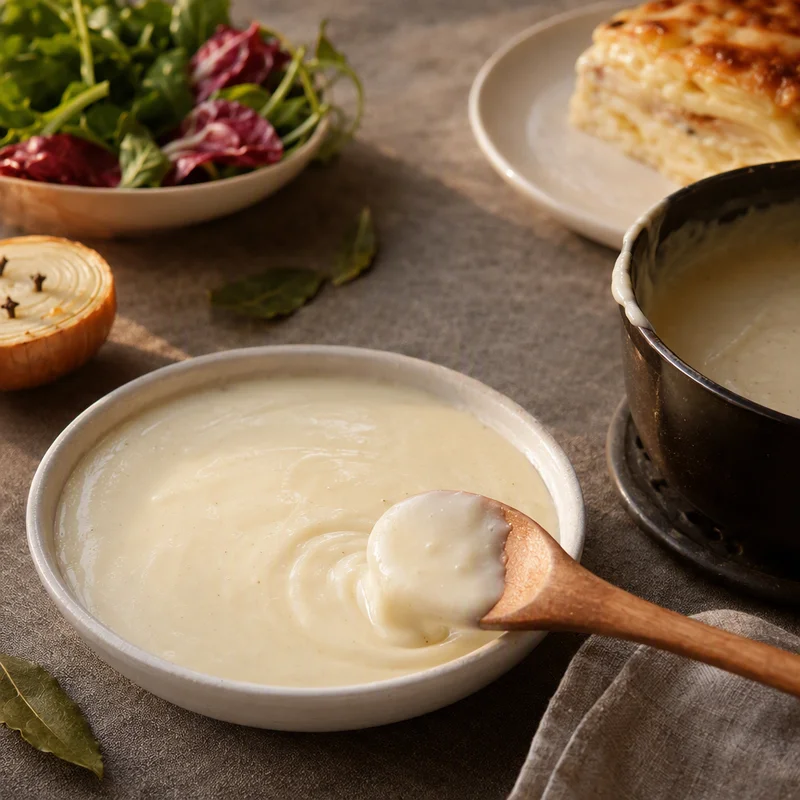
The white sauce that props up half of classic cooking: lasagna, gratins, croque monsieur, mac and cheese. The trick isn't the roux, it's the patience — an onion-and-bay infused milk, a blond roux cooked just long enough to lose its raw taste, and a full 15 minutes of low simmering so the starch fully swells and the sauce turns glossy instead of pasty. Master this one pot and you also own Mornay, soubise and every cheese sauce you'll ever need.
Ingredients
Infused Milk
- 4 cups whole milk
- 1/2 small yellow onion, peeled, root end intact
- 2 whole cloves
- 1 dried bay leaf
- 4 black peppercorns
Roux & Seasoning
- 5 tbsp unsalted butter
- 1/3 cup all-purpose flour (about 45 g)
- 1 1/4 tsp fine sea salt, plus more to taste
- 1/4 tsp ground white pepper
- 1/8 tsp freshly grated nutmeg
Optional — Turn It Into Mornay
- 1 cup Gruyère, finely grated
- 1/4 cup Parmesan, finely grated
- 1 egg yolk (for extra richness and browning)
Instructions
- Make an onion piqué: pin the bay leaf to the flat cut side of the onion half using the two whole cloves as tacks. Drop it into a saucepan with the milk and peppercorns.
- Warm the milk over medium-low heat until steam rises and small bubbles ring the edge of the pan, about 6–8 minutes; do not let it boil. Kill the heat, cover, and let it infuse 15 minutes. Strain through a fine-mesh sieve into a pitcher or measuring cup and keep it warm (or reheat briefly before using — warm milk is the single best insurance against lumps).
- In a heavy 3-quart saucepan, melt the butter over medium-low heat until it foams but has not browned. Add the flour all at once and whisk hard into a smooth paste.
- Cook the roux, whisking constantly, for 2–3 minutes. It should smell faintly of toasted pastry and look like wet sand; stop before it takes on any real color. This is a blond roux — enough cooking to lose the raw flour flavor, not enough to tint the sauce.
- Pour in about 1 cup of the warm milk and whisk immediately and vigorously. It will seize into a thick paste — keep whisking until perfectly smooth before adding more. Add the remaining milk in two more additions, whisking smooth each time.
- Raise the heat to medium and bring the sauce to a bare simmer, whisking often, 4–6 minutes. It will thicken noticeably right as it reaches the boil.
- Drop the heat to low so only an occasional bubble breaks the surface. Cook 15 minutes, whisking every 2 minutes and scraping the corners and bottom of the pan. This long, gentle simmer is what makes the sauce taste clean and feel glossy rather than chalky.
- Whisk in the salt, white pepper and nutmeg. The finished sauce should coat the back of a spoon and hold a clear line when you drag a finger through it. For a pourable sauce, thin with a few tablespoons of warm milk; for lasagna or soufflé base, simmer 3–5 minutes longer.
- For absolute silk, pour the sauce through a fine-mesh sieve, pressing with a ladle. Taste and adjust salt — béchamel needs more than you'd guess.
- To make Mornay, pull the pan off the heat and let it sit 1 minute so it stops bubbling, then whisk in the Gruyère and Parmesan a handful at a time until melted and smooth. Off-heat melting keeps the cheese from breaking into grease. Whisk in the egg yolk last if you want a sauce that browns beautifully under the broiler.
- Use immediately, or press a piece of buttered parchment or plastic wrap directly onto the surface to stop a skin forming. It keeps 4 days refrigerated.
Chef's tips
- Ratios to memorize, per 1 cup milk: 1 tbsp each butter and flour for a thin sauce (soups, creamed vegetables), 1½ tbsp each for medium (gratins, mac and cheese — this recipe), 2 tbsp each for thick (croquettes, soufflé bases).
- If you get lumps, don't panic and don't add more flour: blitz the sauce with an immersion blender for 15 seconds or push it through a sieve. Both fixes are invisible in the finished dish.
- Cold milk into hot roux works fine if you add it slowly and whisk relentlessly — warm milk is just faster and more forgiving. What doesn't work is dumping all the liquid in at once.
- A heavy-bottomed pan matters more than you'd think. Thin pans scorch the flour on the bottom, and scorched béchamel tastes bitter all the way through.
- Reheat gently over low heat with a splash of milk, whisking; it will be very stiff straight from the fridge and will loosen right back to its original texture.
Nutrition (per serving, estimated)
283calories
14gprotein
16gcarbs
18gfat
Estimates only — values vary with brands and portions.
Made with Sprig
Silky Béchamel (The Mother Sauce, Done Properly) was created in Sprig — the AI chef that turns any craving into a complete recipe, plans your week, and shops with one smart list.
Free to start · 14-day Pro trial · cancel anytime
Not ready yet? Get the occasional recipe worth cooking — a couple a month at most.
You're on the list — check your inbox!
Unsubscribe anytime. Privacy Policy
More from Sprig Originals
French Onion Patty Melts on Rye

Dark Roux Seafood Gumbo with Quick Shrimp Stock

One-Skillet Blackened Cajun Chicken Pasta
Are you this recipe's original author or publisher? Report a problem