Sprig Originals's kitchen / Charred Wide Rice Noodles in Silky Pork Gravy (Rad Na)
Charred Wide Rice Noodles in Silky Pork Gravy (Rad Na)
 By Sprig Originals · cooked up in Sprig
Worked out from this recipe's ingredients. If you're cooking for an allergy, always read the full ingredient list.
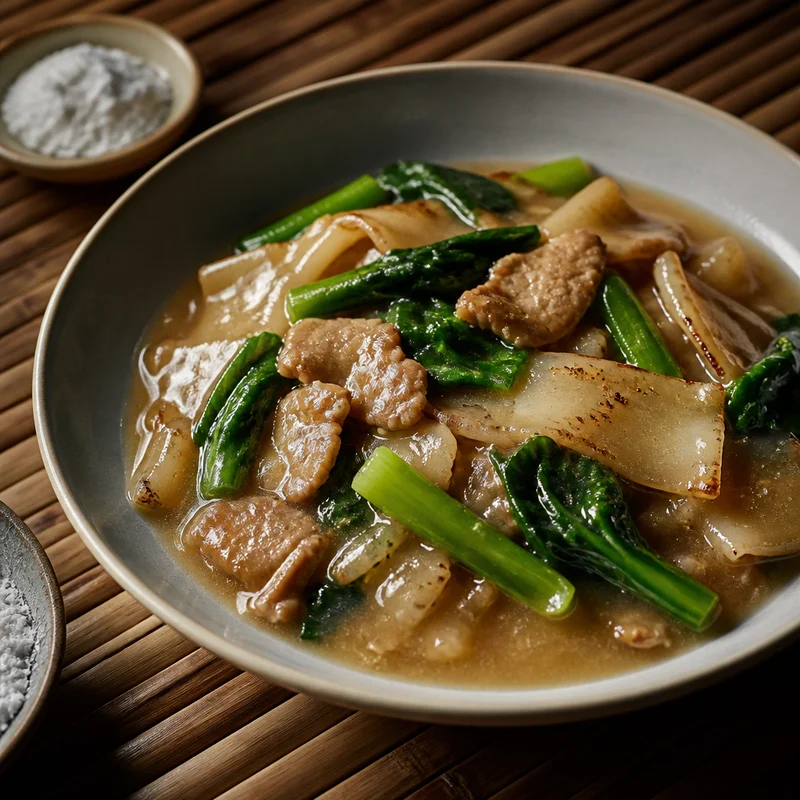
Thailand's great comfort-food noodle plate: fresh wide rice noodles blistered in a smoking-hot pan, then flooded with a glossy pork-and-Chinese-broccoli gravy. The trick is to keep the two halves apart until the last second — the noodles get their smoky char and slightly crisp edges, and the gravy gets thickened with tapioca starch instead of cornstarch so it stays clear, shiny and pourable rather than turning to paste on the plate.
Ingredients
Pork and marinade
- 10 oz pork shoulder or pork loin, sliced 1/8-inch thick against the grain
- 2 tsp light soy sauce
- 1 tsp tapioca starch
- 1 tsp toasted sesame oil
- 1/4 tsp ground white pepper
- 1/8 tsp baking soda (optional, for tenderizing)
Noodles
- 1 1/4 lb fresh wide rice noodles (sen yai / ho fun sheets), cut into 1-inch ribbons
- 2 tbsp neutral oil, such as canola
- 1 tbsp dark sweet soy sauce (see tips)
- 1/2 tsp light soy sauce
Gravy
- 2 tbsp neutral oil
- 4 cloves garlic, finely chopped
- 2 tbsp Thai yellow bean sauce (tao jiao), lightly mashed
- 1 lb Chinese broccoli (gai lan), stems sliced on a bias, leaves cut in 2-inch pieces
- 2 1/2 cups chicken stock
- 1 1/2 tbsp oyster sauce
- 2 tsp light soy sauce
- 2 tsp granulated sugar
- 1/2 tsp ground white pepper
- 3 1/2 tbsp tapioca starch
- 5 tbsp cold water
Table condiments
- 3 tbsp distilled white vinegar
- 2 Thai chiles or 1 jalapeño, thinly sliced
- dried chile flakes, sugar and fish sauce, for serving
Instructions
- Toss the sliced pork with 2 tsp light soy sauce, 1 tsp tapioca starch, the sesame oil, 1/4 tsp white pepper and the baking soda if using. Let it sit at room temperature for 15 minutes while you prep everything else. Combine the sliced chiles and vinegar in a small bowl and set aside for the table.
- Bring the fresh rice noodles to room temperature. If they came refrigerated and are stiff, microwave the unopened package or a covered plate of noodles in 30-second bursts (60–90 seconds total) until pliable, then gently peel the ribbons apart with your fingers. Torn noodles are fine; forcing cold noodles apart shreds them.
- Whisk 3 1/2 tbsp tapioca starch with 5 tbsp cold water in a small bowl and keep it near the stove. Whisk again right before using — it settles fast.
- Heat a 12-inch nonstick or well-seasoned carbon steel skillet or wok over high heat until it just begins to smoke, about 2 minutes. Add 2 tbsp neutral oil, then the noodles in an even layer. Drizzle over the dark sweet soy and 1/2 tsp light soy. Now leave them alone for 2 to 3 minutes so the undersides blister and pick up some char.
- Flip the noodles in large sections with a wide spatula, toss just enough to distribute the soy, and char the second side another 2 minutes. You want dark spots and a few crisp edges, not uniform browning. Divide the charred noodles among 3 wide shallow bowls or plates and set aside — they can sit while you make the gravy.
- Wipe the pan, return it to high heat, and add 2 tbsp oil. Add the pork in a single layer and sear undisturbed for 45 seconds, then stir-fry 1 minute more until just cooked through. Push it to one side, add the garlic and yellow bean sauce, and stir-fry 20 seconds until fragrant.
- Add the Chinese broccoli stems and stir-fry 1 minute, then the leaves, and cook 30 seconds until they collapse and turn bright green.
- Pour in the chicken stock, oyster sauce, 2 tsp light soy, sugar and 1/2 tsp white pepper. Bring to a full boil, then reduce to a strong simmer and cook 2 minutes so the broccoli stems turn tender-crisp.
- With the gravy at a bare simmer (not a hard boil), stir the tapioca slurry to recombine and drizzle in about two-thirds of it while stirring constantly. Let it come back to a simmer for 30 seconds — it will turn glossy and thicken to the consistency of heavy cream that coats a spoon. Add more slurry only if you want it thicker, and stop cooking as soon as it's there; tapioca thins out if boiled hard.
- Taste and adjust with a splash more soy or a pinch of sugar. Immediately ladle the hot gravy over the charred noodles, letting some noodle edges stay exposed. Serve right away with the chile vinegar, chile flakes, sugar and fish sauce at the table.
Chef's tips
- Fresh wide rice noodles are the whole point — look for refrigerated sheets at a Chinese or Thai market and buy them the day you cook. If you must substitute, soak 10 oz of the widest dried rice sticks until pliable, boil 3 minutes, drain very well, then char as directed.
- Tapioca starch (not cornstarch) is what gives rad na its clear, glassy shine. Cornstarch works in a pinch but goes cloudy and turns gluey as it cools; if you use it, cut the amount to 3 tbsp.
- Yellow bean sauce (tao jiao) is the savory backbone. No substitute is perfect, but 1 tbsp white miso plus 1 tsp fish sauce gets close.
- Char the noodles in two batches if your pan is smaller than 12 inches. Crowding steams them and you'll lose the smoky flavor that makes this version worth the extra pan.
- Rad na does not reheat gracefully — the gravy loosens and the noodles soften. Make only what you'll eat, or store gravy and noodles separately and re-char the noodles in a dry hot pan.
Nutrition (per serving, estimated)
623calories
29gprotein
86gcarbs
19gfat
Estimates only — values vary with brands and portions.
Made with Sprig
Charred Wide Rice Noodles in Silky Pork Gravy (Rad Na) was created in Sprig — the AI chef that turns any craving into a complete recipe, plans your week, and shops with one smart list.
Free to start · 14-day Pro trial · cancel anytime
Not ready yet? Get the occasional recipe worth cooking — a couple a month at most.
You're on the list — check your inbox!
Unsubscribe anytime. Privacy Policy
More from Sprig Originals
Are you this recipe's original author or publisher? Report a problem