Sprig Originals's kitchen / Bakery-Style Soft Pretzels with a Baked-Soda Bath
Bakery-Style Soft Pretzels with a Baked-Soda Bath
 By Sprig Originals · cooked up in Sprig
Worked out from this recipe's ingredients. If you're cooking for an allergy, always read the full ingredient list.
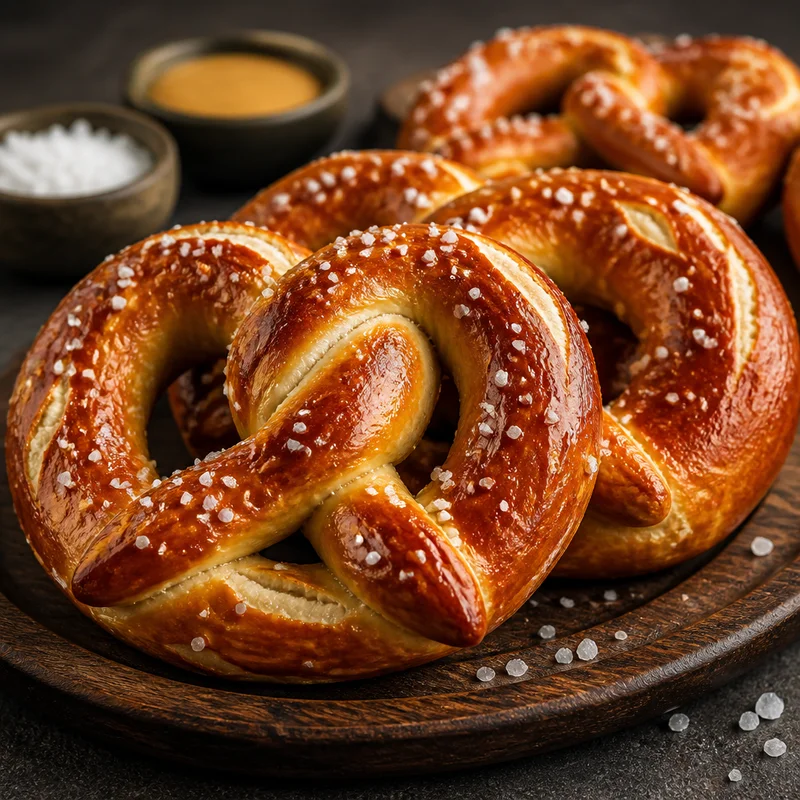
Deep mahogany, blistered soft pretzels with the chewy pull and faintly mineral tang of a real German bakery — no food-grade lye required. Baking your baking soda in the oven for an hour drives off water and carbon dioxide, converting it into stronger sodium carbonate, which gives a dipping bath close to lye strength. The result is a lacquered, crackly skin over a tight, buttery crumb, finished with coarse pretzel salt and eaten warm by hand.
Ingredients
Pretzel dough
- 480 g bread flour (about 4 cups, spooned and levelled)
- 280 g warm water, about 100°F (1 cup plus 3 tbsp)
- 2 tbsp barley malt syrup (or packed dark brown sugar)
- 1 1/2 tsp instant yeast
- 2 tsp fine sea salt
- 3 tbsp unsalted butter, very soft
- neutral oil, for the bowl and hands
Baked-soda bath
- 3/4 cup baking soda (to be oven-baked)
- 9 cups water
- 1 tbsp barley malt syrup, optional, for deeper colour
Finishing
- 1 large egg yolk, beaten with 1 tbsp water
- 2 tbsp coarse pretzel salt or flaky sea salt
- 2 tbsp unsalted butter, melted, for brushing after baking
Instructions
- Bake the soda first (it can be done days ahead): spread 3/4 cup baking soda in a thin layer on a foil-lined rimmed baking sheet and bake at 300°F for 1 hour, stirring once at the 30-minute mark. It will look slightly duller and feel finer. Cool completely and store in a sealed jar. You should have a scant 2/3 cup; it is more caustic than plain baking soda, so keep it away from skin, eyes and aluminium.
- Make the dough: in a stand mixer bowl, whisk 280 g warm water (100°F) with 2 tbsp barley malt syrup until dissolved. Add 480 g bread flour, 1 1/2 tsp instant yeast and 2 tsp fine sea salt. Mix with the dough hook on low for 2 minutes until no dry flour remains — the dough will look stiff and shaggy. This is correct; pretzel dough is much drier than pizza dough.
- Add the 3 tbsp soft butter a tablespoon at a time, then knead on medium-low for 8 to 10 minutes, until the dough is smooth, elastic, and cleans the bowl. It should feel firm, like a well-inflated basketball, and pull into a thick translucent sheet when stretched. By hand, knead 12 minutes on an unfloured counter.
- Shape into a ball, place in a lightly oiled bowl, cover, and let rise at warm room temperature (about 75°F) for 1 to 1 1/2 hours, until puffy and increased by roughly half. It will not double — that's fine.
- Line two rimmed baking sheets with parchment. Turn the dough out and divide into 8 equal pieces, about 100 g each. Roll each into a tight log, cover, and rest 10 minutes so they roll out without fighting you.
- Roll each piece into a rope 22 to 24 inches long, fat in the middle and tapering to thin ends: press flat, roll up tightly, then roll under lightly oiled palms, working outward. If the rope resists, let it rest 2 minutes and come back to it.
- Twist: lay the rope in a U with the ends pointing away from you. Cross the ends over each other twice to make a twist, then fold them down and press the tips firmly onto the bottom curve, about 1 1/2 inches apart. Place on the parchment, spacing them well.
- Chill the shaped pretzels, uncovered, on the sheets in the refrigerator for 30 minutes (up to 2 hours). The dried, firmed surface takes the bath cleanly and holds its shape.
- Heat the oven to 450°F with racks in the upper-middle and lower-middle positions. In a wide stainless steel or enamel pot (never aluminium), bring 9 cups water to a bare simmer, turn off the heat, then whisk in the baked soda and the optional 1 tbsp malt syrup. It will fizz. Wear rubber gloves and keep the pot away from anything reactive.
- Working with 2 pretzels at a time, lower them into the hot bath with a slotted spatula and dip for 30 seconds, flipping once at 15 seconds. Lift, let drain for a few seconds, and return to the parchment, re-tucking the ends if they loosen. The surface will look slick and slightly yellow.
- Brush each pretzel lightly with the egg yolk wash, then, with a sharp paring knife or razor, slash the fat belly of each pretzel about 1/4 inch deep. Sprinkle generously with coarse pretzel salt.
- Bake 12 to 15 minutes, rotating and swapping the sheets at 8 minutes, until deep glossy mahogany — go darker than feels comfortable; pale pretzels taste flat. Internal temperature should read 200 to 205°F.
- Brush the hot pretzels with melted butter and cool 5 minutes on a rack. Eat within a few hours, while the skin is still snappy and the inside is warm.
Chef's tips
- Baked soda is a real alkali: wear gloves, use stainless or enamel cookware, and don't let the bath splash. It rinses off skin with plenty of water plus a splash of vinegar.
- No time to bake the soda? Use 2/3 cup plain baking soda in the same amount of water and dip for 45 seconds. The colour and tang will be milder but the pretzels are still very good.
- Weigh the flour and water if you can. At this stiff hydration, an extra 2 tbsp of water turns a chewy pretzel into a soft dinner roll.
- Barley malt syrup (health-food aisle or online) is what gives that classic malty bakery flavour and dark crust; dark brown sugar or 1 1/2 tsp diastatic malt powder plus 1 tbsp honey are workable stand-ins.
- To make pretzel bites, cut the ropes into 1 1/2-inch pieces, dip 20 seconds, and bake at 450°F for 9 to 11 minutes.
- Freeze baked, cooled pretzels in a zip-top bag; reheat straight from frozen at 350°F for 6 to 8 minutes to bring the crust back. Do not microwave — they go leathery.
- Serve with a fast beer cheese: melt 8 oz grated sharp cheddar into 1/3 cup warm lager with 1 tsp cornstarch and 1 tsp mustard over low heat, whisking until smooth.
Nutrition (per serving, estimated)
320calories
9gprotein
53gcarbs
8gfat
Estimates only — values vary with brands and portions.
Made with Sprig
Bakery-Style Soft Pretzels with a Baked-Soda Bath was created in Sprig — the AI chef that turns any craving into a complete recipe, plans your week, and shops with one smart list.
Free to start · 14-day Pro trial · cancel anytime
Not ready yet? Get the occasional recipe worth cooking — a couple a month at most.
You're on the list — check your inbox!
Unsubscribe anytime. Privacy Policy
More from Sprig Originals
French Onion Patty Melts on Rye
Dark Roux Seafood Gumbo with Quick Shrimp Stock
One-Skillet Blackened Cajun Chicken Pasta
Are you this recipe's original author or publisher? Report a problem