Sprig Originals's kitchen / Tall, Fluffy Buttermilk Pancakes
Tall, Fluffy Buttermilk Pancakes
 By Sprig Originals · cooked up in Sprig
Worked out from this recipe's ingredients. If you're cooking for an allergy, always read the full ingredient list.
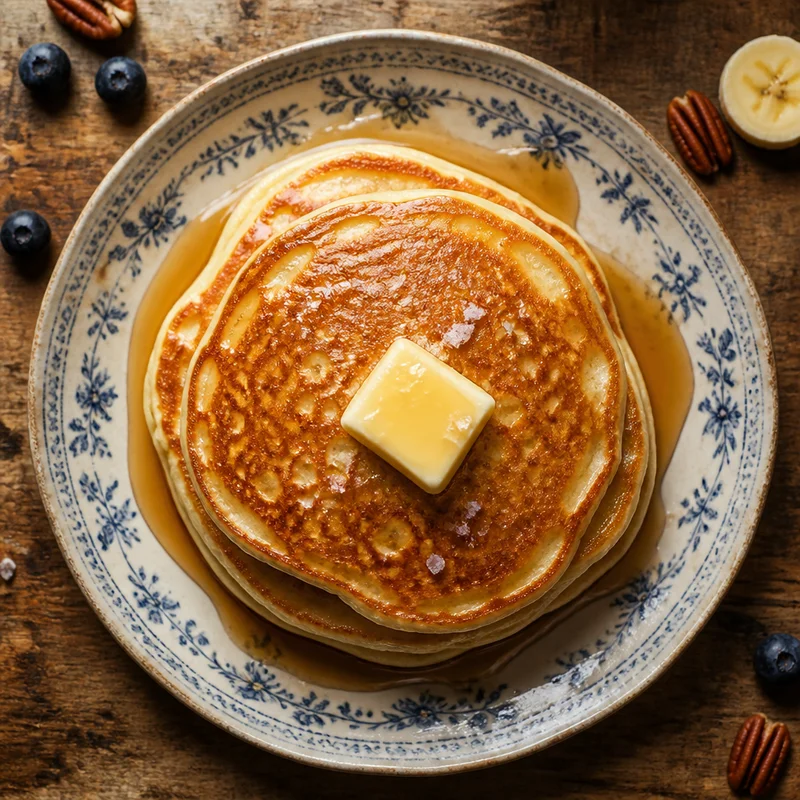
The pancake every good diner gets right: tangy buttermilk, a batter you deliberately leave lumpy, and a ten-minute rest that lets the flour hydrate and the baking soda start working. Get your griddle to a steady 350–375°F and you'll pull off tall, golden, custardy-centered pancakes every time. One base batter, three toppings — blueberry-lemon, banana-pecan, or macerated strawberries — plus a two-minute warm maple butter.
Ingredients
Base Batter (makes about 12 pancakes)
- 2 cups all-purpose flour, spooned and leveled (250g)
- 2 tablespoons granulated sugar
- 2 teaspoons baking powder
- 1 teaspoon baking soda
- 3/4 teaspoon fine sea salt
- 2 cups cold buttermilk, well shaken
- 2 large eggs
- 4 tablespoons unsalted butter, melted and slightly cooled
- 1 teaspoon vanilla extract
For the Griddle
- 2 tablespoons unsalted butter or neutral oil, for cooking
Warm Maple Butter (base syrup)
- 3/4 cup pure maple syrup
- 3 tablespoons unsalted butter
- 1 pinch flaky salt
Variation 1: Blueberry-Lemon
- 1 1/4 cups blueberries, fresh or frozen (do not thaw)
- 2 teaspoons lemon zest
- 1 tablespoon granulated sugar
Variation 2: Banana-Pecan
- 2 medium ripe bananas, sliced 1/4-inch thick
- 2/3 cup pecans, toasted and roughly chopped
- 1/2 teaspoon ground cinnamon
Variation 3: Macerated Strawberries
- 1 pound strawberries, hulled and sliced
- 3 tablespoons granulated sugar
- 1 teaspoon fresh lemon juice
- 1 pinch salt
Instructions
- If you're doing the strawberry variation, start it first: toss the sliced strawberries with 3 tablespoons sugar, the lemon juice, and a pinch of salt in a bowl. Set aside at room temperature for at least 20 minutes, stirring once, until glossy and syrupy.
- Whisk the flour, sugar, baking powder, baking soda, and salt together in a large bowl for a full 20 seconds so the leaveners are evenly distributed. Lumps of flour are fine; clumps of baking soda are not.
- In a second bowl, whisk the buttermilk, eggs, and vanilla until uniform. Stream in the melted butter while whisking — if the buttermilk is very cold the butter may bead into tiny flecks, which is fine and actually helps the texture.
- Pour the wet mixture into the dry all at once. Switch to a rubber spatula and fold just 10 to 12 strokes, scraping from the bottom. Stop while the batter still has visible dry streaks and marble-sized lumps. This is the single most important step: an overmixed batter builds gluten and bakes into rubbery, flat pancakes.
- Let the batter rest, uncovered, at room temperature for 10 minutes. It will thicken noticeably and you'll see bubbles rise to the surface — the flour is hydrating and the baking soda is reacting with the buttermilk. Do not stir it again after resting.
- While the batter rests, heat a large nonstick skillet, cast-iron pan, or electric griddle over medium heat for 4 to 5 minutes. Target 350–375°F. Test it: a few drops of water flicked onto the surface should sizzle and skitter, not vanish instantly (too hot) or sit and steam (too cool). If you have an electric griddle, set it to 375°F.
- Wipe the surface with about 1/2 teaspoon butter, then wipe most of it away with a folded paper towel — you want a barely-there film, not a pool, or the pancakes will fry unevenly and streak.
- Scoop 1/3-cup portions of batter onto the griddle, leaving 2 inches between them. Do not press or spread them. If you're doing a variation, scatter the add-ins onto the wet surface now: about 2 tablespoons blueberries tossed with lemon zest and sugar, or 5 to 6 banana slices plus a sprinkle of pecans and cinnamon.
- Cook 2 to 3 minutes, until the edges look dry and matte and bubbles form and pop across the surface without immediately filling back in. Flip once and cook 1 1/2 to 2 minutes more, until the second side is golden and the pancake springs back when pressed lightly at the center. Never press down with the spatula.
- Transfer finished pancakes to a wire rack set on a sheet pan in a 200°F oven — stacking them on a plate traps steam and softens the crust. Wipe the griddle, re-butter lightly, and repeat. Adjust heat down slightly between batches if the pancakes are browning in under 2 minutes.
- For the maple butter, warm the maple syrup and 3 tablespoons butter in a small saucepan over low heat, swirling until the butter melts and emulsifies, about 2 minutes. Finish with a pinch of flaky salt.
- Serve immediately, three pancakes per plate, with the warm maple butter and your chosen topping: leftover blueberries warmed in a pan, extra toasted pecans, or a generous spoonful of the strawberries with their syrup.
- Note the exact same batter, made three ways, needs no changes. Add-ins go on the griddle, not in the bowl — folding fruit into batter means more stirring, and stirring is the enemy here.
Chef's tips
- No buttermilk? Whisk 2 tablespoons lemon juice or white vinegar into 2 cups whole milk and let it sit 10 minutes. It won't be quite as thick or tangy, so add an extra 1/4 teaspoon baking soda.
- Weigh your flour if you can. Two cups scooped straight from the bag can be 20% more flour than 250g, which is the difference between fluffy and dense.
- The first pancake is a test pancake. Its job is to tell you whether the griddle is too hot or too cool — expect to sacrifice it and adjust.
- Batter holds in the fridge up to 2 hours, but no longer; the baking soda's lift fades. Let it sit out 10 minutes before cooking so it spreads properly.
- Cooked pancakes freeze well. Cool completely on a rack, freeze flat on a sheet pan, then bag. Reheat straight from frozen in a 350°F oven for 8 minutes or a toaster on medium.
Nutrition (per serving, estimated)
1185calories
18gprotein
163gcarbs
54gfat
Estimates only — values vary with brands and portions.
Made with Sprig
Tall, Fluffy Buttermilk Pancakes was created in Sprig — the AI chef that turns any craving into a complete recipe, plans your week, and shops with one smart list.
Free to start · 14-day Pro trial · cancel anytime
Not ready yet? Get the occasional recipe worth cooking — a couple a month at most.
You're on the list — check your inbox!
Unsubscribe anytime. Privacy Policy
More from Sprig Originals
Duck Confit Cornbread Waffles with Cane Syrup Gastrique
French Onion Patty Melts on Rye
Dark Roux Seafood Gumbo with Quick Shrimp Stock
Are you this recipe's original author or publisher? Report a problem