Sprig Originals's kitchen / Apple-Raisin Stuffed Pork Tenderloin
Apple-Raisin Stuffed Pork Tenderloin
 By Sprig Originals · cooked up in Sprig
Worked out from this recipe's ingredients. If you're cooking for an allergy, always read the full ingredient list.
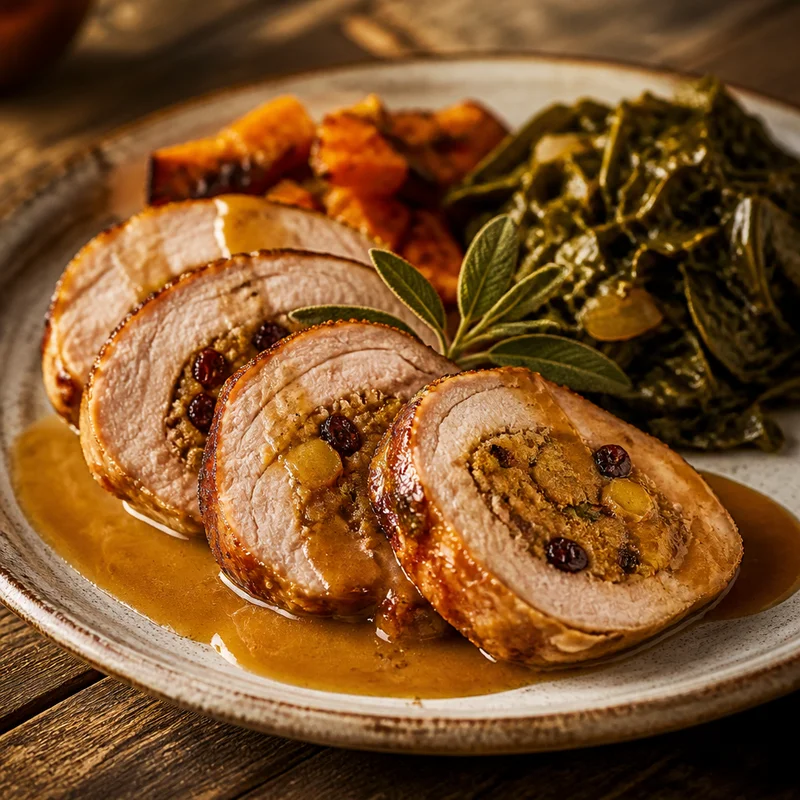
A Sunday-supper pork tenderloin butterflied and pounded thin, spread with a buttery cornbread dressing full of sautéed apples, plumped raisins and sage, then rolled, tied and roasted to a juicy 145°F. Every slice comes off the board as a neat spiral, and the pan drippings become a quick cider gravy.
Ingredients
Pork and rub
- 2 pork tenderloins, about 1 1/4 lb each, silverskin trimmed
- 1 1/2 tsp kosher salt
- 1 tsp smoked paprika
- 1/2 tsp garlic powder
- 1/2 tsp onion powder
- 1/2 tsp black pepper
- 1/4 tsp cayenne pepper
- 2 tbsp vegetable oil
Apple-raisin cornbread stuffing
- 1/2 cup golden raisins
- 1/2 cup apple cider, warm
- 3 tbsp unsalted butter
- 1 small yellow onion, finely diced
- 1 stalk celery, finely diced
- 1 large Granny Smith apple, peeled and cut into 1/4-inch dice
- 2 cloves garlic, minced
- 1 tbsp fresh sage, chopped (or 1 tsp dried)
- 1/2 tsp fresh thyme leaves
- 2 cups cornbread, crumbled and dried out (about 5 oz)
- 1/4 cup chicken broth
- 1 tbsp Dijon mustard
- 1/2 tsp kosher salt
- 1/4 tsp black pepper
Cider pan gravy
- 1 tbsp unsalted butter
- 1 tbsp all-purpose flour
- 3/4 cup apple cider
- 3/4 cup chicken broth
- 1 tsp apple cider vinegar
- kosher salt and black pepper, to taste
Equipment
- 6 ft butcher's twine
Instructions
- Soak the raisins: put the golden raisins in a small bowl, pour the warm 1/2 cup apple cider over them, and let them plump for at least 20 minutes while you work. Drain before using and save the soaking cider for the gravy if you like.
- Make the stuffing: melt 3 tbsp butter in a 10-inch skillet over medium heat. Add the onion, celery and diced apple with 1/2 tsp salt and cook 6–8 minutes, stirring, until the onion is translucent and the apple is just tender at the edges. Stir in the garlic, sage and thyme and cook 1 minute more.
- Scrape the apple mixture into a bowl. Add the crumbled cornbread, drained raisins, 1/4 cup chicken broth, Dijon and 1/4 tsp pepper. Toss with a fork until the cornbread is evenly moistened but still has texture — it should hold together when squeezed, not turn to paste. Spread on a plate and cool to room temperature (about 15 minutes); warm stuffing will overcook the pork from the inside.
- Butterfly the pork: lay one tenderloin on a cutting board. Holding a sharp knife parallel to the board, cut lengthwise down the center, stopping 1/2 inch from the far edge, and open it like a book. Cover with plastic wrap and pound with a mallet or heavy skillet to an even 1/3-inch thickness, working from the center outward into a rough 10 x 7-inch rectangle. Repeat with the second tenderloin.
- Season and fill: pat both pieces dry. Mix the 1 1/2 tsp salt, smoked paprika, garlic powder, onion powder, 1/2 tsp black pepper and cayenne; sprinkle about one-third of it over the cut sides of the pork. Spread half the cooled stuffing over each piece in an even layer, leaving a 1-inch border along the long edge farthest from you.
- Roll and tie: starting at the long edge nearest you, roll each tenderloin up snugly into a log, ending seam-side down. Tie with butcher's twine at 1 1/2-inch intervals, plus one loop lengthwise if any stuffing wants to escape. Rub the outside of each roast with the remaining spice mix.
- Heat the oven to 400°F. Heat the 2 tbsp vegetable oil in a large oven-safe skillet or roasting pan over medium-high until it shimmers. Sear the roasts 2 minutes per side, turning to hit all four sides, 7–8 minutes total, until deeply browned. Wipe up any stuffing crumbs that scorch in the pan.
- Transfer the skillet to the oven (or move the roasts to a foil-lined sheet pan) and roast 20–25 minutes, until an instant-read thermometer inserted into the meat — not the stuffing — reads 140–142°F. Move the roasts to a board, tent loosely with foil, and rest 10 minutes; they will carry over to 145°F.
- Make the gravy: pour off all but 1 tbsp fat from the skillet and set it over medium heat. Add 1 tbsp butter and the flour and whisk 1 minute until it smells nutty. Whisk in the 3/4 cup cider (plus any raisin soaking liquid) and 3/4 cup broth, scraping up the browned bits, and simmer 4–6 minutes until it lightly coats a spoon. Stir in the vinegar and season with salt and pepper.
- Snip and remove the twine, then slice the roasts crosswise into 3/4-inch spirals with a sharp knife, wiping the blade between cuts. Fan the slices onto a platter, spoon the cider gravy around them, and pour any resting juices over the top.
Chef's tips
- Dry cornbread is essential. If yours is fresh or moist, crumble it onto a sheet pan and bake at 300°F for 12–15 minutes until dry to the touch, then cool. Fresh cornbread turns the filling to mush and makes the roll slip apart.
- Chill the tied roasts uncovered in the fridge for up to 8 hours before searing — they hold their shape better and the surface dries out for a darker crust. Add 3–5 minutes to the roasting time if going straight from the fridge.
- Don't stuff too generously. A 1/4-inch layer of dressing rolls tight and slices cleanly; pile it on and the log won't close. Bake extra stuffing in a small buttered dish alongside the pork for the last 20 minutes.
- 145°F with a 10-minute rest is USDA-safe and leaves the pork faintly pink and juicy. Pull it at 155°F and no amount of gravy will save it — use a thermometer, not the clock.
- Leftovers slice beautifully cold. Griddle the spirals in butter for 2 minutes a side and serve on a biscuit with a spoonful of the gravy.
Nutrition (per serving, estimated)
521calories
42gprotein
43gcarbs
22gfat
Estimates only — values vary with brands and portions.
Made with Sprig
Apple-Raisin Stuffed Pork Tenderloin was created in Sprig — the AI chef that turns any craving into a complete recipe, plans your week, and shops with one smart list.
Free to start · 14-day Pro trial · cancel anytime
Not ready yet? Get the occasional recipe worth cooking — a couple a month at most.
You're on the list — check your inbox!
Unsubscribe anytime. Privacy Policy
More from Sprig Originals
Are you this recipe's original author or publisher? Report a problem