Sprig Originals's kitchen / Oven-Smoked Beef Brisket, No Smoker Needed
Oven-Smoked Beef Brisket, No Smoker Needed
 By Sprig Originals · cooked up in Sprig
Worked out from this recipe's ingredients. If you're cooking for an allergy, always read the full ingredient list.
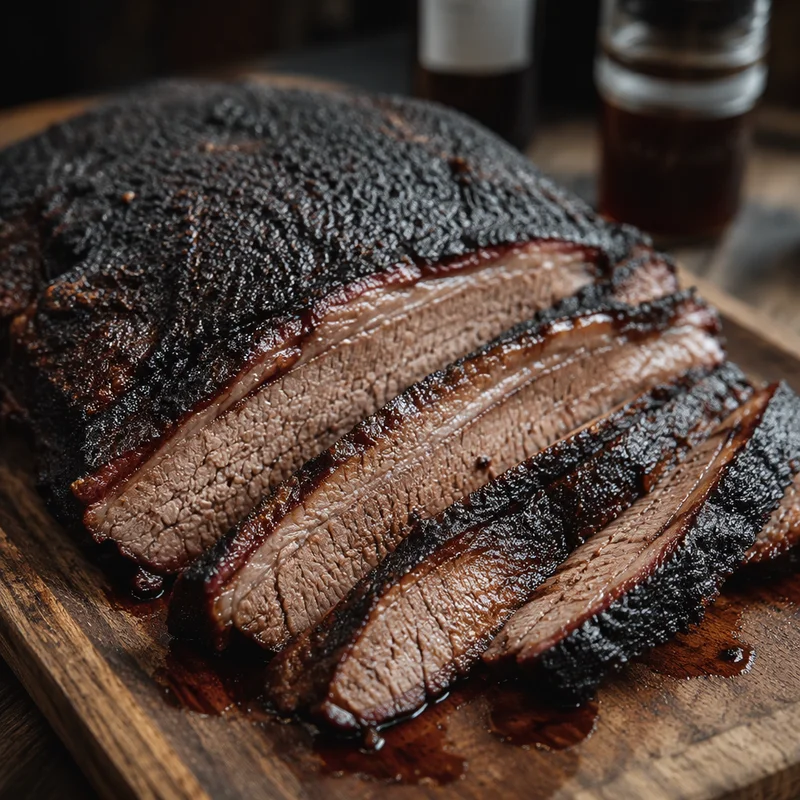
A full barbecue-joint brisket built entirely in your oven: a coarse salt-and-pepper crust, a liquid smoke rub that soaks in overnight, and a patient 250°F wrap-and-rest schedule that turns a lean flat into sliceable, juicy beef with a real dark bark. The payoff step is the slicing lesson — mark the grain before it ever goes in the oven, then cut pencil-thick slices straight across it.
Ingredients
Brisket and dry brine
- 5 1/2 lb beef brisket flat, fat cap attached
- 2 tbsp liquid smoke (hickory or mesquite)
- 1 tbsp Worcestershire sauce
- 2 tsp yellow mustard
Rub
- 3 tbsp coarse ground black pepper (16 mesh if available)
- 2 1/2 tbsp kosher salt
- 2 tsp granulated garlic
- 2 tsp onion powder
- 1 tsp smoked paprika
- 1/2 tsp ground cumin
Wrap and spritz
- 1 cup low-sodium beef broth
- 2 tbsp cider vinegar
- 1 tsp liquid smoke
- 3 tbsp beef tallow or unsalted butter
Quick pan sauce (optional)
- 1/2 cup reserved brisket drippings, fat skimmed
- 1/3 cup ketchup
- 2 tbsp dark brown sugar
- 1 tbsp cider vinegar
- 1/2 tsp liquid smoke
Instructions
- Find the grain first. Set the brisket flat on a board and look at the surface of the lean meat: the muscle fibers all run in one long direction, usually parallel to the longest edge. Slice off one corner at a 90-degree angle to those fibers — a small squared-off notch about 2 inches long. That cut edge is your permanent map: after cooking, every slice will run parallel to it.
- Trim the fat cap down to an even 1/4 inch thick, shaving off any hard, waxy fat and silverskin on the lean side. Leave the meat in one piece; a flat that's thinner than 1 inch at one end can be folded under later to even out cooking.
- Whisk the 2 tablespoons liquid smoke with the Worcestershire and mustard and rub it over every surface of the brisket, massaging it in for a full minute. Combine all the rub ingredients and coat the brisket heavily on all sides — you want a visible, even layer, not a dusting. Set it fat-cap up on a rack over a sheet pan and refrigerate uncovered 12 to 24 hours. The salt penetrates, and the surface dries so a bark can form.
- Pull the brisket out and let it sit at room temperature for 1 hour. Heat the oven to 250°F with a rack in the lower third. Pour 2 cups of water into the sheet pan under the rack for humidity, and set the brisket fat-cap up on the rack.
- Roast uncovered at 250°F for 4 to 5 hours, until the bark is dark mahogany, dry to a fingertip touch, and the internal temperature in the thickest part reads 165°F to 170°F. Meanwhile combine the beef broth, cider vinegar, and 1 teaspoon liquid smoke in a spray bottle or small bowl; starting at hour 2, spritz or brush the top lightly every 45 minutes so the crust colors without cracking.
- Wrap it. Lay out two overlapping 24-inch sheets of heavy-duty foil (or pink butcher paper set inside foil). Put the brisket in fat-cap up, dot with the tallow or butter, pour 1/3 cup of the remaining spritz liquid around it, and wrap tight in two layers so nothing leaks. Return to the 250°F oven.
- Cook wrapped another 2 1/2 to 4 hours. Start probing at 195°F: slide an instant-read thermometer or a wooden skewer into the thickest part of the flat. It's done when the probe slides in and out with no resistance, like room-temperature butter, typically 200°F to 205°F. Temperature alone is not the test — feel is. If it's still firm at 203°F, keep going in 20-minute checks.
- Rest, seriously. Vent the wrap for 10 minutes to stop the carryover cooking, then re-seal, wrap the whole package in a bath towel, and rest in a turned-off oven or a small cooler for 1 to 2 hours. Internal temperature should fall to about 150°F to 160°F before slicing. Skipping this step is the single most common reason home brisket runs dry.
- Unwrap over a bowl and reserve the drippings. For the optional sauce, skim the fat, then simmer 1/2 cup drippings with the ketchup, brown sugar, vinegar, and liquid smoke for 5 minutes until lightly syrupy.
- Slice against the grain. Set the brisket on a board with your squared-off notch facing you, then cut straight down parallel to that cut edge, making slices about 1/4 inch thick — roughly the width of a pencil. Each slice should hold together when lifted from one end but pull apart with a gentle tug. Slice only what you're serving, spoon over warm drippings, and serve the rest of the sauce alongside.
Chef's tips
- Buy a flat (first cut) for clean slices, or a whole packer if your oven fits it — with a packer, cook to the same probe-tender feel, then separate the point from the flat along the fat seam and cube the point for burnt ends.
- Liquid smoke is potent: 2 tablespoons for a 5 1/2-pound brisket reads as barbecue, while double that tastes like an ashtray. Measure, don't eyeball.
- No probe-tender feel yet at 8 hours? The stall is real but it's already wrapped, so it's simply not done. Trust the skewer, not the clock.
- If your brisket is thin and tapered at one end, fold the thin tail underneath before roasting so it doesn't dry out ahead of the thick end.
- Leftovers: keep slices in the drippings, refrigerate up to 4 days, and reheat covered at 300°F with a splash of broth for 20 minutes. Never microwave uncovered.
- For a smokier crust without more liquid smoke, add 1/2 teaspoon of finely ground chipotle powder to the rub.
- Chilling the cooked brisket whole overnight, then slicing it cold and reheating the slices in drippings, gives you the cleanest, most restaurant-looking cuts.
Nutrition (per serving, estimated)
620calories
58gprotein
8gcarbs
38gfat
Estimates only — values vary with brands and portions.
Made with Sprig
Oven-Smoked Beef Brisket, No Smoker Needed was created in Sprig — the AI chef that turns any craving into a complete recipe, plans your week, and shops with one smart list.
Free to start · 14-day Pro trial · cancel anytime
Not ready yet? Get the occasional recipe worth cooking — a couple a month at most.
You're on the list — check your inbox!
Unsubscribe anytime. Privacy Policy
More from Sprig Originals
Are you this recipe's original author or publisher? Report a problem