Sprig Originals's kitchen / Layered Kerala Parotta (Flaky Griddle Flatbread)
Layered Kerala Parotta (Flaky Griddle Flatbread)
 By Sprig Originals · cooked up in Sprig
Worked out from this recipe's ingredients. If you're cooking for an allergy, always read the full ingredient list.
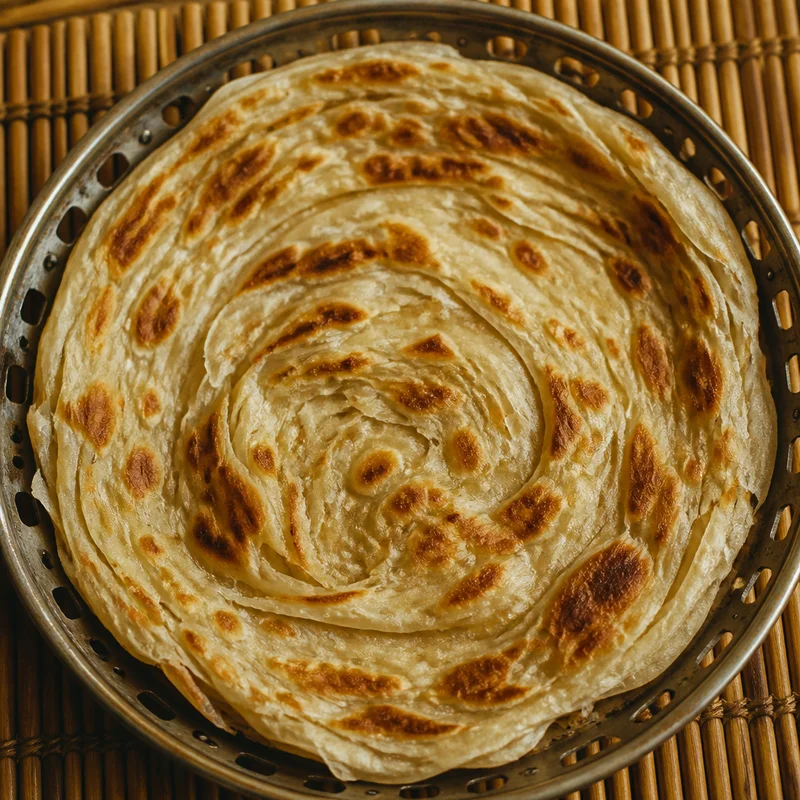
The South Indian street-cart flatbread built entirely out of layers: a soft, well-slapped white-flour dough rested until slack, oiled and stretched paper-thin, then pleated and coiled into a snail so it fries into dozens of shattery leaves. Working with smaller dough balls makes the stretch achievable on a home counter, and the final trick — clapping the hot parotta between your palms — pops the layers apart so you can see every one.
Ingredients
Dough
- 3 cups all-purpose flour (maida), plus more for dusting
- 1 1/2 tsp fine sea salt
- 2 tsp sugar
- 1 large egg, lightly beaten (optional, for softness)
- 1/2 cup whole milk, room temperature
- 1/2 cup warm water, plus 2–4 tbsp as needed
- 3 tbsp neutral oil, such as sunflower or canola
Laminating and griddling
- 1/2 cup neutral oil, for coating and stretching
- 3 tbsp ghee, melted (or more oil)
- 2 tbsp all-purpose flour, for light dusting
Instructions
- Whisk 3 cups flour, the salt and sugar in a large bowl. Add the beaten egg (if using), milk and 1/2 cup warm water. Mix with your hand until a shaggy mass forms, then add water 1 tablespoon at a time until there is no dry flour left. The dough should be noticeably wetter and stickier than a chapati dough.
- Turn the dough onto an unfloured counter and knead hard for 8–10 minutes. Instead of pushing, lift the dough and slap it down on the counter, fold it over, and repeat — this is how street cooks build gluten fast. It will go from ragged to smooth and tacky. Drizzle over 3 tablespoons oil and knead 2 minutes more until the oil is fully absorbed and the dough feels satiny and stretches without tearing when you pull a corner.
- Coat the dough ball in a thin film of oil, cover the bowl tightly, and rest at room temperature for at least 2 hours, up to 4 (or refrigerate overnight and let it come back to room temperature for 1 hour). This long rest is not optional: a relaxed dough is what lets you stretch it thin enough to laminate.
- Divide the dough into 6 equal pieces, about 3 oz / 85 g each — deliberately smaller than restaurant portions so you can stretch each one on a standard counter. Roll each into a tight ball, set them on an oiled plate, coat generously with oil, cover, and rest another 20 minutes.
- Wipe your countertop with 1 teaspoon oil (do not flour it — you want the dough to slide, not grip). Press one ball flat and roll it out with an oiled rolling pin as thin as you can, about 10 inches across. Then work with oiled fingertips: slide your hands under the sheet and stretch outward from the center, walking around the edges, until it is 14–16 inches wide and translucent enough to read through in places. A few small tears are fine; do not try to patch them.
- Brush the whole sheet with oil and dust it very lightly with flour — this thin layer of fat plus flour is what keeps the leaves separate. Starting at one long edge, pleat the sheet into a long accordion ribbon with folds about 1 inch wide, like gathering a curtain. Pick up the ribbon and gently stretch it lengthwise by 3–4 inches to thin the pleats.
- Coil the ribbon into a tight snail, tucking the end underneath and pinching it to the base. Set the coil on an oiled tray and repeat with the remaining balls. Rest the coils, covered, for 20–30 minutes so they will flatten without springing back or unraveling.
- Press each coil down with your palm, then roll it out gently and evenly to a 6–7 inch round, no thinner than 1/4 inch. Roll from the center outward with light pressure and stop as soon as it reaches size — pressing hard here crushes the layers you just built.
- Heat a cast-iron griddle or heavy skillet over medium heat until a drop of water sizzles and skates, about 5 minutes (roughly 400°F). Lay on a parotta and cook 60–90 seconds until pale golden spots appear on the underside. Drizzle 1 teaspoon ghee around the edge, flip, and cook another 60–90 seconds. Flip once or twice more, pressing the center lightly with a folded towel or spatula for 5 seconds at a time to encourage puffing, until both sides are blistered deep golden brown and the edges look crisp and flaky, 3–4 minutes total.
- Move the hot parotta to a clean towel. Holding it at the edges with your fingertips (or bunching the towel around it), clap it briskly between your palms 3–4 times, or scrunch it inward from both sides. The layers will separate visibly and the parotta will fluff. Stack the finished breads in a covered towel-lined bowl while you cook the rest, and serve hot with any saucy curry, egg roast or kurma.
Chef's tips
- Wet dough, long rest, oiled counter: those three things do 90% of the work. If your sheet keeps snapping back when you stretch it, the dough needs another 30 minutes of rest, not more flour.
- Never dust the stretching surface with flour — use oil. Flour makes the dough grip the counter and tear before it gets thin enough to pleat.
- Coils can be shaped ahead: refrigerate them oiled and covered for up to 24 hours, or freeze on a tray, then bag. Thaw fully and rest 30 minutes before rolling out.
- If the griddle is too hot the outside browns before the inside layers steam and separate. Aim for medium heat and 3–4 minutes per parotta rather than a fast, dark sear.
- Leftovers revive well: sprinkle with a few drops of water and reheat on a dry griddle over medium for 1 minute per side, then clap again. Chopped leftover parotta stir-fried with egg, onion and chile becomes kothu parotta.
Nutrition (per serving, estimated)
487calories
8gprotein
55gcarbs
26gfat
Estimates only — values vary with brands and portions.
Made with Sprig
Layered Kerala Parotta (Flaky Griddle Flatbread) was created in Sprig — the AI chef that turns any craving into a complete recipe, plans your week, and shops with one smart list.
Free to start · 14-day Pro trial · cancel anytime
Not ready yet? Get the occasional recipe worth cooking — a couple a month at most.
You're on the list — check your inbox!
Unsubscribe anytime. Privacy Policy
More from Sprig Originals
South Louisiana Rice Dressing (Dirty Rice)
French Onion Patty Melts on Rye
Dark Roux Seafood Gumbo with Quick Shrimp Stock
Are you this recipe's original author or publisher? Report a problem