Sprig Originals's kitchen / Chicken Francese with Lemon-White Wine Butter Sauce
Chicken Francese with Lemon-White Wine Butter Sauce
 By Sprig Originals · cooked up in Sprig
Worked out from this recipe's ingredients. If you're cooking for an allergy, always read the full ingredient list.
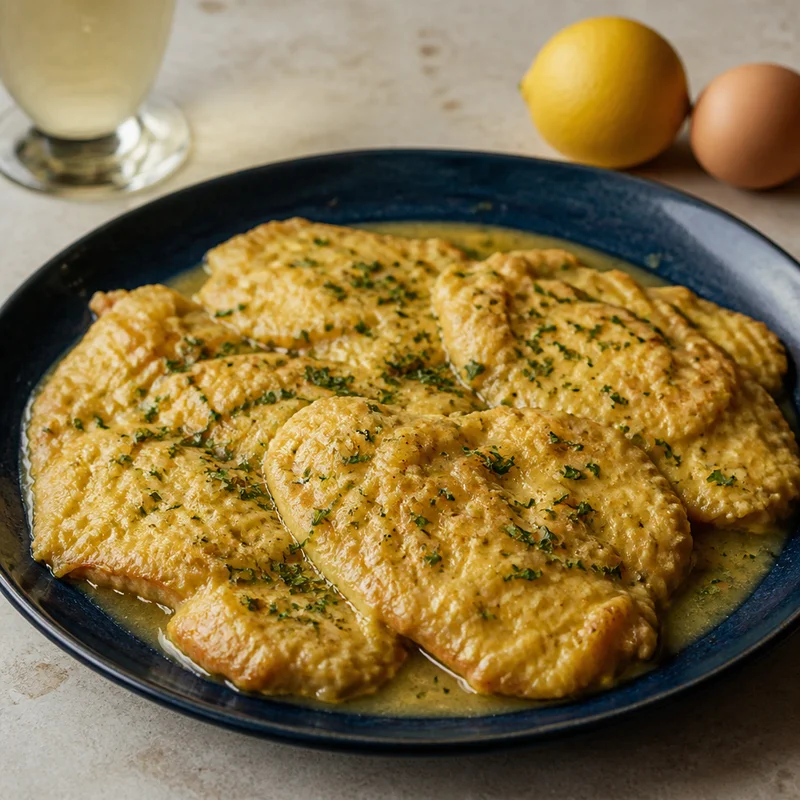
The soul of this Italian-American classic is the batter order: a whisper of seasoned flour, then a generous dunk in beaten egg, cooked over moderate heat so the coating puffs and sets into a soft golden blanket instead of a crisp crust. Pan drippings become a glossy lemon-wine butter sauce in about four minutes. Dinner-party worthy, weeknight fast.
Ingredients
Chicken and batter
- 2 large boneless skinless chicken breasts (about 1 1/2 lb total)
- 1 tsp kosher salt
- 1/2 tsp freshly ground black pepper
- 3/4 cup all-purpose flour
- 4 large eggs
- 3 tbsp finely grated Parmesan
- 2 tbsp chopped flat-leaf parsley
- 1 tbsp water
- 1/4 cup olive oil
- 2 tbsp unsalted butter
Lemon-wine butter sauce
- 1 small shallot, minced
- 2/3 cup dry white wine, such as Pinot Grigio
- 3/4 cup low-sodium chicken broth
- 1/3 cup fresh lemon juice (from 2 lemons)
- 1 tsp lemon zest
- 5 tbsp cold unsalted butter, cut into cubes
- 1 lemon, thinly sliced into rounds
- 2 tbsp chopped flat-leaf parsley
- kosher salt, to taste
Instructions
- Halve each chicken breast horizontally to make 4 flat pieces. Lay them between sheets of plastic wrap and pound with a mallet or heavy skillet to an even 1/4 inch thick. Pat completely dry with paper towels and season both sides with the 1 tsp salt and 1/2 tsp pepper. Let sit 10 minutes at room temperature.
- Set up two shallow dishes. In the first, spread the flour. In the second, whisk the 4 eggs with the Parmesan, 2 tbsp parsley, and 1 tbsp water until fully uniform and slightly foamy — no streaks of white, or the coating will cook unevenly.
- Heat the olive oil and 2 tbsp butter in a 12-inch nonstick or well-seasoned stainless skillet over medium heat. The oil should shimmer but never smoke; if it starts to smoke, pull the pan off the heat for 30 seconds. Moderate heat is what lets the egg set golden instead of browning too fast.
- Working with one cutlet at a time, dredge in flour and shake off every bit of excess — you want a barely visible dusting. Then lower it into the egg, turn to coat thickly, and lift so a generous curtain of egg clings to the surface.
- Lay 2 cutlets in the pan without crowding. Cook 3 to 4 minutes until the underside is set and evenly pale gold, spooning a little pan fat over the top to help the upper coating firm up. Flip once and cook 2 to 3 minutes more, until the chicken registers 160°F at the thickest point. Transfer to a plate.
- Wipe out any dark specks with a paper towel, add a splash more oil if the pan looks dry, and cook the remaining 2 cutlets the same way. Move all chicken to a plate and tent loosely with foil.
- Pour off all but about 1 tbsp of fat. Return the skillet to medium heat, add the minced shallot, and cook 1 minute until softened and fragrant.
- Pour in the white wine and scrape up the browned bits. Simmer 2 to 3 minutes, until reduced by about half. Add the chicken broth, lemon juice, and lemon zest and simmer 3 to 4 minutes more, until the sauce lightly coats a spoon and measures roughly 3/4 cup.
- Lower the heat to its lowest setting. Add the cold butter a few cubes at a time, swirling the pan constantly, adding more only when the previous cubes have nearly melted. The sauce should turn opaque and glossy. Do not let it boil once the butter is in or it will break. Taste and add salt as needed.
- Slide the cutlets and the lemon rounds into the sauce, spooning it over the top, and warm over low heat for 1 to 2 minutes. Scatter with the remaining 2 tbsp parsley and serve immediately, with extra sauce spooned over — angel hair pasta or crusty bread is ideal for catching it.
Chef's tips
- The flour layer is glue, not crust. Too much flour and the egg slides off in the pan; shake the cutlet twice before dipping.
- If the egg coating browns before 3 minutes, your pan is too hot. Lower the heat immediately — Francese should be pale gold, not deep brown.
- Nonstick is your friend here. The delicate egg coating is far more likely to tear when you flip it in stainless steel.
- Sauce broke into greasy pools? Take it off the heat, whisk in 1 tbsp of cold broth or water, and it will usually come back together.
- Everything but the sauce holds well: cook the cutlets up to an hour ahead, keep them on a rack in a 200°F oven, then build the sauce and reunite them just before serving.
Nutrition (per serving, estimated)
682calories
42gprotein
28gcarbs
39gfat
Estimates only — values vary with brands and portions.
Made with Sprig
Chicken Francese with Lemon-White Wine Butter Sauce was created in Sprig — the AI chef that turns any craving into a complete recipe, plans your week, and shops with one smart list.
Free to start · 14-day Pro trial · cancel anytime
Not ready yet? Get the occasional recipe worth cooking — a couple a month at most.
You're on the list — check your inbox!
Unsubscribe anytime. Privacy Policy
More from Sprig Originals
Are you this recipe's original author or publisher? Report a problem