Sprig Originals's kitchen / Crisp Highland Oatcakes with Butter & Flaky Salt
Crisp Highland Oatcakes with Butter & Flaky Salt
 By Sprig Originals · cooked up in Sprig
Worked out from this recipe's ingredients. If you're cooking for an allergy, always read the full ingredient list.
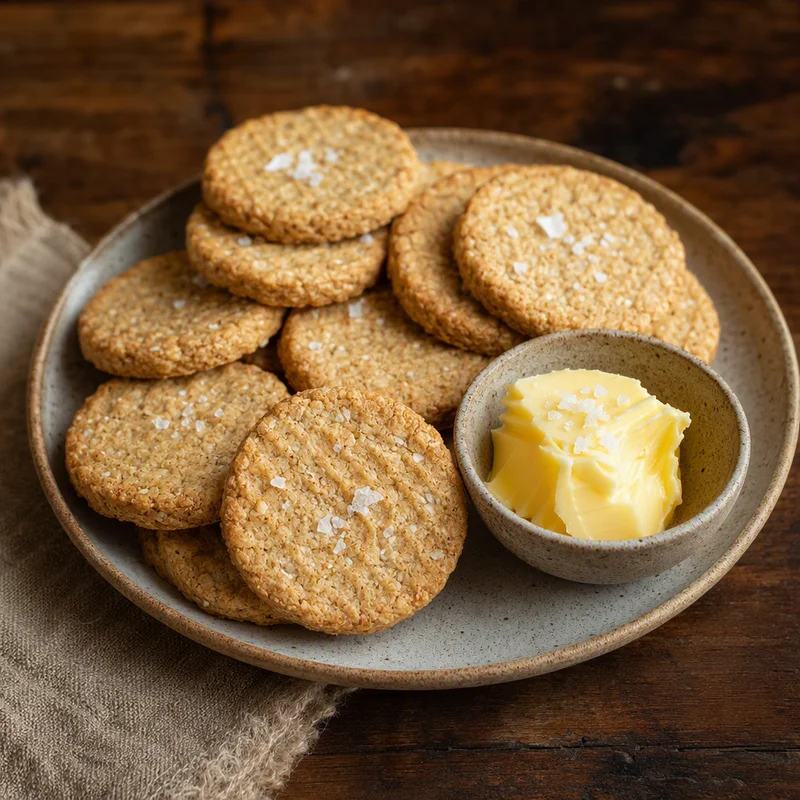
Toasty, nutty, sandy-crisp oat crackers built the old Scottish way: coarse oatmeal, a little butter, and boiling water worked into a warm dough that rolls out thin and bakes to a shattering snap. You grind your own oatmeal in a food processor, so the texture is coarse and craggy rather than dusty — the kind of cracker that stands up to sharp cheddar, smoked salmon, or nothing but a smear of good butter. One bowl, no yeast, no rest time, and they keep for two weeks in a tin.
Ingredients
Oat dough
- 2 cups old-fashioned rolled oats (200 g)
- 1/2 cup additional old-fashioned rolled oats, left whole
- 1/2 cup whole wheat flour (65 g)
- 1 tsp fine sea salt
- 1/2 tsp baking soda
- 5 tbsp unsalted butter, cut into cubes (70 g)
- 1 tsp honey (optional, for color)
- 2/3 cup boiling water, plus more as needed
Finishing
- 2 tsp flaky sea salt
- 2 tbsp rolled oats, for rolling out
- Freshly cracked black pepper (optional)
Instructions
- Heat the oven to 350°F (175°C) with racks in the upper-middle and lower-middle positions. Line two rimmed baking sheets with parchment.
- Put the 2 cups of rolled oats in a food processor and pulse in 1-second bursts, 15 to 20 times, until you have a coarse meal with the texture of fine breadcrumbs — some flour, some visible flecks of oat. Do not run it continuously into powder; the grit is what makes an oatcake taste like an oatcake.
- Transfer the ground oats to a large heatproof bowl and stir in the 1/2 cup whole rolled oats, whole wheat flour, fine sea salt, and baking soda.
- Melt the butter with the honey and the 2/3 cup boiling water in a small saucepan or in the microwave (about 60 seconds) until the butter is fully liquid and the mixture is steaming hot.
- Pour the hot butter-water over the oat mixture all at once and stir hard with a sturdy spoon for 30 seconds. Let it sit 5 minutes — the oats drink up the water and the dough firms noticeably. It should come together into a soft, moldable dough that holds a squeezed shape without cracking; if it still crumbles, add boiling water 1 tablespoon at a time (up to 3 tablespoons).
- Scatter the 2 tablespoons of rolling oats on a work surface. Divide the dough in half. Working while it is still warm, press one half into a disc, then roll to a scant 1/8 inch (3 mm) thick, patching any cracked edges with your fingers as you go. Rolling between two sheets of parchment makes this easier and keeps the dough from sticking.
- Cut out 2 1/2-inch rounds with a cookie cutter or a glass and lift them onto a prepared sheet with a thin spatula, spacing them 1/2 inch apart — they barely spread. Gather scraps, press together, and re-roll once. Repeat with the second half of the dough. You should get 22 to 26 oatcakes.
- Sprinkle the tops lightly with flaky salt and black pepper if using, pressing it in with your fingertips so it sticks.
- Bake 24 to 28 minutes, swapping and rotating the pans at the 14-minute mark, until the oatcakes are dry to the touch, sandy-firm, and speckled golden at the edges. The centers should be pale gold, not brown; a thin oatcake that looks barely done will still be leathery, so give the thickest ones an extra 2 to 3 minutes.
- Slide the parchment onto a wire rack and cool completely, at least 20 minutes. They crisp dramatically as they cool — test one only after it is fully at room temperature. If any are still bendy, return them to a 300°F oven for 5 to 8 minutes.
- Serve with cold butter, a wedge of sharp aged cheddar, or smoked salmon and a squeeze of lemon. Store airtight at room temperature for up to 2 weeks.
Chef's tips
- Steel-cut oats are the traditional starting point but grind unevenly and stay hard; rolled oats pulsed in the processor give you authentic coarse oatmeal texture with reliable results.
- Work fast while the dough is warm. Once it cools it turns stiff and cracks at the edges when rolled — if that happens, knead in a teaspoon of boiling water to loosen it back up.
- Thickness matters more than time. Roll thinner than feels safe (you should almost see the counter through the dough) for the shattering snap; thicker dough bakes into a soft biscuit.
- For savory variations, add 1/2 cup finely grated aged cheddar plus 1/4 teaspoon mustard powder, or 1 teaspoon toasted caraway or fennel seed, to the dry mix.
- Skip the round cutter if you like: score the rolled sheet into rough squares or wedges with a bench scraper, bake as one slab, and snap it apart when cool.
- They soften in humid weather. Re-crisp at 300°F for 6 minutes and cool before serving — as good as day one.
Nutrition (per serving, estimated)
201calories
6gprotein
27gcarbs
9gfat
Estimates only — values vary with brands and portions.
Made with Sprig
Crisp Highland Oatcakes with Butter & Flaky Salt was created in Sprig — the AI chef that turns any craving into a complete recipe, plans your week, and shops with one smart list.
Free to start · 14-day Pro trial · cancel anytime
Not ready yet? Get the occasional recipe worth cooking — a couple a month at most.
You're on the list — check your inbox!
Unsubscribe anytime. Privacy Policy
More from Sprig Originals
French Onion Patty Melts on Rye

Dark Roux Seafood Gumbo with Quick Shrimp Stock
One-Skillet Blackened Cajun Chicken Pasta
Are you this recipe's original author or publisher? Report a problem