Overnight No-Knead Sourdough Boule
 By Sprig Originals · cooked up in Sprig
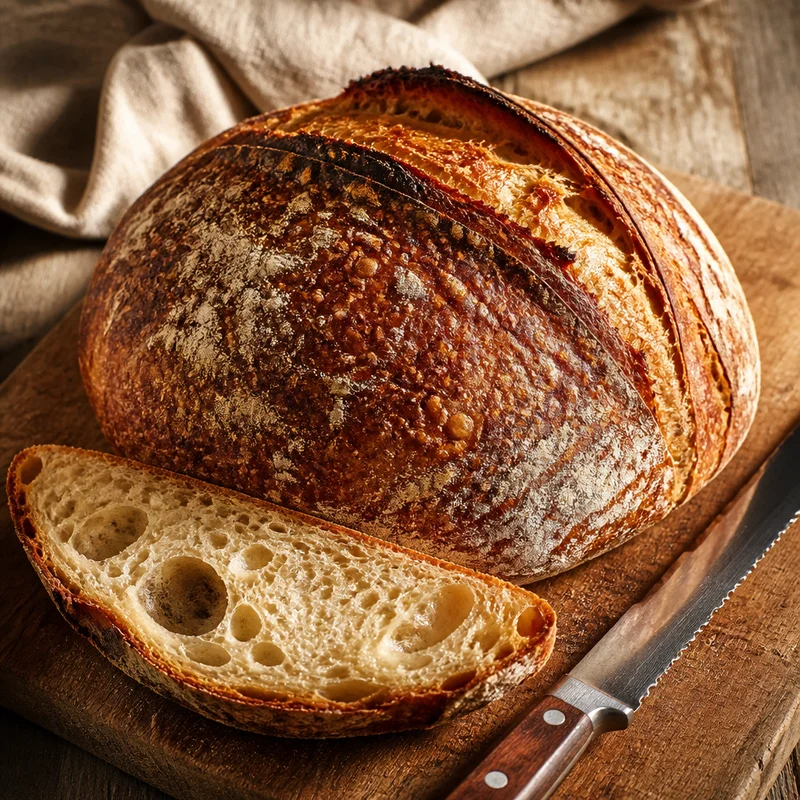
A bakery-style round loaf with a blistered, deep-mahogany crust and an open, custardy crumb — built on a long overnight fermentation and baked in a screaming-hot Dutch oven for dramatic oven spring. Only four ingredients and no stand mixer required: a series of gentle stretch-and-folds does all the work your hands would have. No starter? A same-day version using instant yeast and a splash of yogurt for tang is included at the bottom, and it bakes in the same pot on the same day you decide you want bread.
Ingredients
- 2 tbsp active sourdough starter (bubbly, recently fed)
- 50 g bread flour
- 50 g warm water (80°F)
- 450 g bread flour (about 3 1/2 cups)
- 50 g whole wheat flour (about 1/3 cup)
- 350 g water (85°F), divided
- 11 g fine sea salt (about 2 tsp)
- 100 g levain from above
- 2 tbsp rice flour, for dusting (or extra bread flour)
- Cornmeal or parchment, for the pot
- 500 g bread flour (about 3 3/4 cups)
- 1 tsp instant yeast
- 11 g fine sea salt (about 2 tsp)
- 330 g water (95°F)
- 60 g plain whole-milk yogurt (about 1/4 cup)
- 1 tsp distilled white vinegar or lemon juice
Instructions
- THE NIGHT BEFORE — BUILD THE LEVAIN: In a clean jar or small bowl, stir together 2 tablespoons active starter, 50 g bread flour, and 50 g warm water until no dry flour remains. Cover loosely and leave at room temperature (68–74°F) for 8–12 hours, until doubled, domed, and webbed with bubbles. It should float when a spoonful is dropped in water — that's your go signal.
- MORNING — AUTOLYSE: In a large bowl, whisk together 450 g bread flour and 50 g whole wheat flour. Add 320 g of the water (hold back 30 g) and mix with a stiff spatula or your hand until a shaggy, sticky mass forms with no dry patches. Cover and rest 45 minutes at room temperature. This hydration rest builds gluten with zero kneading.
- MIX IN LEVAIN AND SALT: Add 100 g of the ripe levain to the dough. Wet one hand and squeeze and fold the dough repeatedly for 2–3 minutes until the levain disappears. Sprinkle the 11 g salt over the top, add the reserved 30 g water, and squeeze again for 2 minutes until fully incorporated and the dough feels cohesive and slightly slack. Cover.
- BULK FERMENT WITH STRETCH-AND-FOLDS (4–5 hours at 74–78°F): Every 30 minutes for the first 2 1/2 hours (5 sets total), wet your hand, reach under one side of the dough, stretch it up until it resists, and fold it over the center. Rotate the bowl a quarter turn and repeat 3–4 times per set. The dough will go from soupy to smooth, jiggly, and strong. After the last set, cover and leave undisturbed.
- JUDGE THE BULK BY LOOK, NOT THE CLOCK: Bulk is finished when the dough has risen 50–75% in volume, the surface is domed and dotted with bubbles, and it wobbles like set custard when you shake the bowl. In a 76°F kitchen this is usually 4–5 hours total from mixing; in a cool 68°F kitchen it can take 6–7. Do not wait for a doubling — over-fermented no-knead dough spreads flat.
- PRE-SHAPE: Scrape the dough onto a lightly floured counter. Using a bench scraper, fold the edges into the center to form a rough round, then flip it seam-side down and drag it in small circles to tighten the surface. Rest uncovered 25 minutes so the gluten relaxes.
- FINAL SHAPE: Dust the top lightly with flour and flip the round seam-side up. Stretch it into a rough square. Fold the bottom third up, fold the left and right sides over each other like a letter, then roll it away from you into a tight ball, sealing the seam. Cup your hands around it and drag once or twice to build tension. Line a bowl or banneton with a clean tea towel dusted generously with rice flour and set the loaf in seam-side up.
- COLD RETARD: Cover the bowl with a plate or plastic and refrigerate 12–16 hours (overnight is ideal, up to 20 hours works). The cold proof deepens the sour flavor and makes the loaf far easier to score and load.
- PREHEAT HARD: At least 45 minutes before baking, place a 5- to 7-quart Dutch oven with its lid on a rack in the lower third of the oven and heat to 500°F. The pot must be fully saturated with heat — this is where oven spring comes from.
- SCORE AND LOAD: Cut a 12-inch square of parchment. Turn the cold loaf out onto it seam-side down, dust off excess rice flour, and slash a single confident 1/2-inch-deep arc or cross across the top with a razor blade or very sharp paring knife. Carefully lift the parchment and loaf into the ripping-hot pot (use dry, heavy mitts), cover, and return to the oven.
- BAKE: Bake covered at 500°F for 20 minutes, then reduce the oven to 450°F and bake 5 more minutes covered. Remove the lid — the loaf should be pale and fully sprung — and bake uncovered 20–25 minutes more, until the crust is deep reddish-brown, almost mahogany at the score, and the internal temperature reads 207–210°F. If your kitchen runs hot, tent loosely with foil for the last 5 minutes.
- COOL COMPLETELY: Transfer to a wire rack and cool at least 2 hours before slicing — the crumb is still setting, and cutting early gives you a gummy interior. You'll hear the crust crackle as it cools. That's the sound of a good loaf.
- SAME-DAY YEASTED SHORTCUT (no starter): Whisk 500 g bread flour, 1 tsp instant yeast, and 11 g salt in a large bowl. Whisk 330 g water (95°F), 60 g yogurt, and 1 tsp vinegar together, pour into the flour, and mix with a spatula until shaggy. Rest 20 minutes, then do 3 sets of stretch-and-folds 20 minutes apart. Cover and let rise at room temperature 2 to 2 1/2 hours, until nearly doubled and bubbly.
- SHORTCUT SHAPE AND BAKE: Shape as in steps 6 and 7, place seam-side up in a rice-floured towel-lined bowl, and proof 45–60 minutes at room temperature (or 1 hour in the fridge for easier handling) while the Dutch oven preheats at 500°F. Turn out onto parchment, score, and bake covered 20 minutes at 500°F, then uncovered 20–22 minutes at 450°F to an internal 205–208°F. Cool 90 minutes before slicing.
Chef's tips
- Temperature is the real ingredient. A 78°F dough ferments nearly twice as fast as a 68°F one. If your kitchen is cold, set the bowl in your oven with only the light on, or in a picnic cooler with a mug of warm water.
- The poke test for bulk: press a floured finger 1/2 inch into the dough. If the dent springs back slowly and partially, you're ready. Instant springback means keep going; no springback at all means you've gone too far — shape and bake it right away as a flatter but still delicious loaf.
- Rice flour does not absorb moisture the way wheat flour does, so a rice-floured towel releases a sticky proofed loaf cleanly every time. It's the single cheapest fix for stuck dough.
- For a blistered, glossy crust, toss 2 ice cubes onto the parchment beside the loaf right before covering the pot. The extra steam keeps the surface elastic longer for more spring.
- No Dutch oven? Bake on a preheated heavy sheet pan with a large stainless bowl inverted over the loaf for the first 20 minutes, then remove the bowl to finish.
- Store cut-side down on a board for 2 days, or slice the whole loaf, freeze in a zip-top bag, and toast slices straight from frozen. Never refrigerate bread — it stales fastest at fridge temperature.
Nutrition (per serving, estimated)
Made with Sprig
Overnight No-Knead Sourdough Boule was created in Sprig — the AI chef that turns any craving into a complete recipe, plans your week, and shops with one smart list.
More from Sprig Originals

Are you this recipe's original author or publisher? Report a problem