Sprig Originals's kitchen / Neapolitan Sunday Ragù with Braciole and Pork Ribs
Neapolitan Sunday Ragù with Braciole and Pork Ribs
 By Sprig Originals · cooked up in Sprig
Worked out from this recipe's ingredients. If you're cooking for an allergy, always read the full ingredient list.
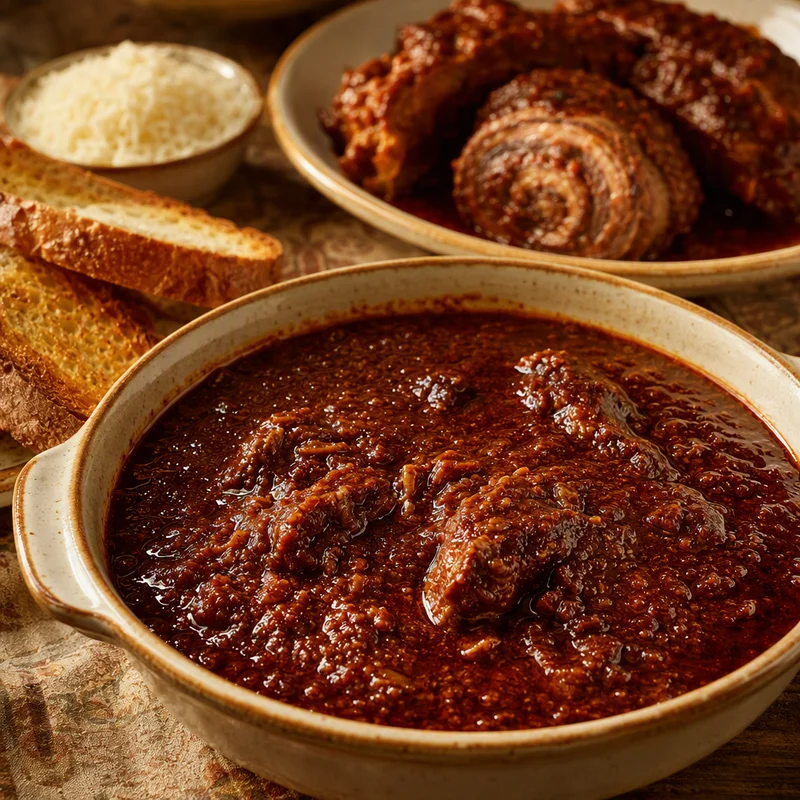
The Sunday sauce of Naples: whole cuts of pork and stuffed beef braciole barely bubbling in tomato for five hours until the meat surrenders and the sauce turns dark, glossy and sweet. You dress paccheri or ziti with the sauce first, then serve the meat as a second course. Almost all of the work is at the start — after that it's a lazy stove-top vigil.
Ingredients
Braciole (stuffed beef rolls)
- 1 lb beef top round or flank, cut into 4 thin slices about 1/4 inch thick
- 1/3 cup grated pecorino romano
- 3 tbsp chopped flat-leaf parsley
- 2 cloves garlic, minced
- 2 tbsp raisins
- 2 tbsp pine nuts
- 1/2 tsp freshly ground black pepper
- kitchen twine or toothpicks
The ragù
- 1 1/2 lb bone-in pork spareribs or country-style ribs, cut into 3-inch pieces
- 3/4 lb sweet Italian sausage links
- 1/4 cup extra-virgin olive oil
- 2 tbsp lard (optional, for depth)
- 2 large yellow onions, halved and thinly sliced
- 6 oz tomato paste (double-concentrated if you have it)
- 1 cup dry red wine such as Aglianico or Montepulciano (or 1 cup beef broth plus 1 tbsp red wine vinegar)
- 2 28-oz cans whole peeled San Marzano tomatoes
- 2 cups water, plus more as needed
- 1 large sprig fresh basil
- 1 pinch crushed red pepper flakes
- kosher salt
To serve
- 1 1/2 lb paccheri, ziti, or rigatoni
- 1 cup grated parmigiano reggiano or pecorino romano
- torn fresh basil, for finishing
Instructions
- Make the braciole: lay the beef slices between plastic wrap and pound gently with a heavy pan or mallet to an even 1/8 inch. Season lightly with salt. Scatter each slice with pecorino, parsley, garlic, raisins, pine nuts and black pepper, leaving a 1/2-inch border. Roll up tightly from the short end, tucking the sides in, and tie with two loops of twine (or pin with toothpicks). Refrigerate until needed.
- Open the tomatoes and pass them through a food mill, or crush them thoroughly by hand into a bowl, discarding any hard cores. Set aside — this is the sauce's whole body, so no chunks bigger than a pea.
- Heat the olive oil and lard in a wide 7- to 8-quart Dutch oven over medium-high heat. Pat the ribs dry, season with salt, and brown them in a single layer for 4 to 5 minutes per side until deeply crusted. Transfer to a plate. Brown the sausages whole, about 6 minutes total, then the braciole, about 5 minutes, turning until browned all over. Remove all the meat.
- Lower the heat to medium-low. Add the sliced onions and a big pinch of salt to the fat left in the pot. Cook 20 to 25 minutes, scraping up the browned bits, until the onions are completely soft, jammy and pale gold — do not rush this and do not let them scorch.
- Add the tomato paste and stir constantly for 6 to 8 minutes over medium-low heat. It should darken from bright red to brick and smell sweet rather than raw; this toasting step is what gives Neapolitan ragù its color.
- Pour in the red wine and raise the heat to medium. Simmer 4 to 5 minutes, stirring, until the pot smells of wine but not alcohol and the mixture is thick again.
- Add the milled tomatoes, 2 cups water, the basil sprig, red pepper flakes and 2 teaspoons salt. Return all the meat and any collected juices to the pot. Bring to a bare simmer.
- Set the heat as low as your burner goes and partially cover, leaving a 2-inch gap. You want what Neapolitans call pippiare — a lazy plop of a bubble every few seconds, never a rolling boil. Cook 4 1/2 to 5 hours, stirring gently every 30 to 40 minutes with a wooden spoon and adding 1/2 cup hot water any time the sauce looks tight or catches on the bottom.
- At about the 3-hour mark, pull the sausages and braciole out to a plate if they are fully tender, and keep the ribs going. The sauce is done when it is dark rust-red, glossy, and thick enough that a spoon dragged through the bottom leaves a track that fills in slowly. Taste and adjust the salt.
- Lift out the ribs, remove the twine from the braciole, and set all the meat on a warm platter with a ladle of sauce spooned over. Skim the orange fat from the surface of the sauce with a wide spoon, or refrigerate overnight and lift the solid cap off cold.
- Bring 6 quarts of water to a boil, salt it with 2 tablespoons kosher salt, and cook the pasta 2 minutes shy of the package time. Reserve 1 cup pasta water and drain.
- Return the pasta to its pot with 3 cups of the sauce and 1/4 cup pasta water. Cook over medium heat for 1 to 2 minutes, tossing hard, until every tube is coated and the sauce clings. Off the heat, stir in 1/2 cup of the grated cheese, finish with torn basil, and serve with more sauce and cheese at the table. Bring out the meat platter as a second course.
Chef's tips
- Never let it boil. A hard simmer emulsifies the fat into the sauce and turns it greasy and dull instead of dark and glossy. If your smallest burner still runs hot, use a flame tamer or slide the pot into a 275°F oven, partially covered, for the same 4 1/2 to 5 hours.
- Made a day ahead, this is measurably better: the flavors settle and the fat lifts off in one solid disc straight from the fridge.
- No time for braciole? Substitute 1 1/2 pounds of beef chuck cut into 2-inch chunks and brown it the same way — the sauce loses the stuffing's sweet-salty accent but nothing else.
- The recipe deliberately makes more sauce than you need for 1 1/2 pounds of pasta. Freeze the extra in 2-cup portions for up to 3 months; it reheats beautifully with a splash of water.
- Whole peeled San Marzano tomatoes milled at home taste far cleaner than pre-crushed cans, which are often heavier on puree and citric acid.
Nutrition (per serving, estimated)
1350calories
73gprotein
112gcarbs
65gfat
Estimates only — values vary with brands and portions.
Made with Sprig
Neapolitan Sunday Ragù with Braciole and Pork Ribs was created in Sprig — the AI chef that turns any craving into a complete recipe, plans your week, and shops with one smart list.
Free to start · 14-day Pro trial · cancel anytime
Not ready yet? Get the occasional recipe worth cooking — a couple a month at most.
You're on the list — check your inbox!
Unsubscribe anytime. Privacy Policy
More from Sprig Originals
Are you this recipe's original author or publisher? Report a problem