Sprig Originals's kitchen / Strawberry–Apple Fruit Leather with Vanilla and Lemon
Strawberry–Apple Fruit Leather with Vanilla and Lemon
 By Sprig Originals · cooked up in Sprig
Worked out from this recipe's ingredients. If you're cooking for an allergy, always read the full ingredient list.
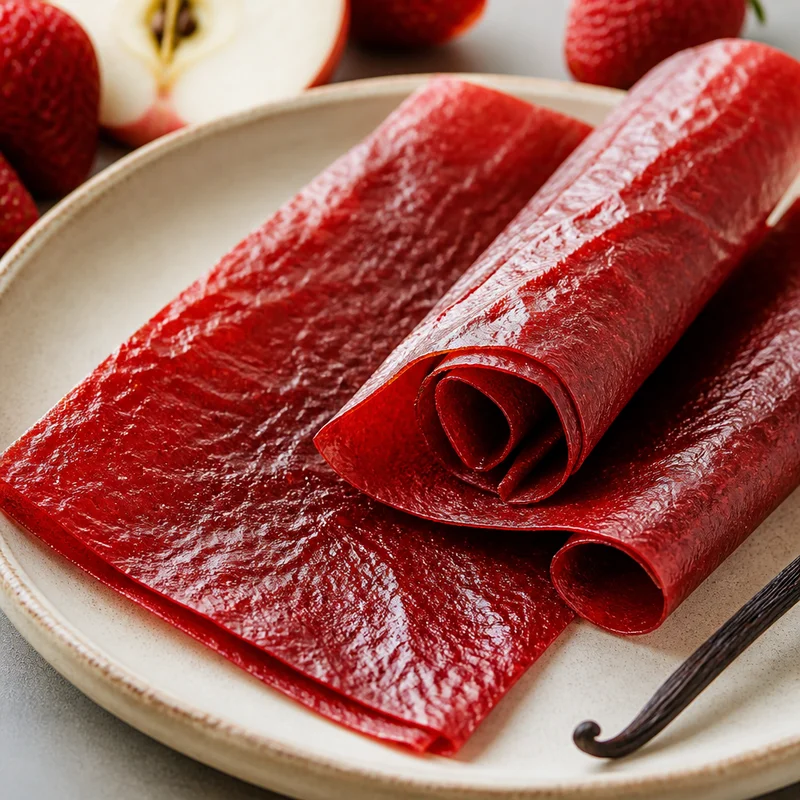
Two pounds of ripe strawberries and a grated apple cooked down into a glossy, intensely fruity purée, then dried low and slow in the oven until it peels off the parchment in one flexible sheet. The apple brings natural pectin, so the leather stays pliable instead of brittle, and a scrape of vanilla plus a squeeze of lemon keeps the flavor tasting like fresh fruit rather than jam. No dehydrator, no pectin powder, no corn syrup — just fruit, patience, and a very low oven.
Ingredients
Fruit base
- 2 lb ripe strawberries, hulled and quartered
- 1 medium sweet-tart apple such as Gala or Braeburn, peeled and coarsely grated
- 3 tbsp honey or maple syrup, or more to taste
- 1 tbsp fresh lemon juice
- 1/2 tsp vanilla bean paste, or seeds from 1/2 vanilla bean
- 1 pinch fine sea salt
Optional finishing
- 1 tsp finely grated lemon zest
- neutral oil, for wiping the parchment
- flaky sea salt or chili-lime seasoning, for sprinkling
Instructions
- Set an oven rack in the center position and heat the oven to its lowest setting, ideally 170°F (or 150°F if your oven goes that low). Verify with an oven thermometer if you have one — anything above 200°F will cook the leather to a crisp instead of drying it. Line a rimmed half sheet pan (13x18 inches) with parchment paper, letting it come up the sides, and wipe the parchment with a barely oiled paper towel.
- Combine the strawberries, grated apple, honey, lemon juice, vanilla, and salt in a wide 3- to 4-quart saucepan. Set over medium heat and cook, stirring often and mashing the berries against the pan with a wooden spoon, until the fruit collapses and releases its juice, 8 to 10 minutes.
- Reduce the heat to medium-low and simmer, stirring every few minutes and scraping the bottom, for 15 to 20 minutes more, until the mixture has thickened noticeably and a spoon dragged across the pan leaves a track that closes slowly. You want a thick, jammy purée reduced to about 3 cups. Taste and add another spoonful of honey if the berries were tart; stir in the lemon zest now if using.
- Purée until completely smooth with an immersion blender directly in the pot, or transfer to a regular blender in two batches (vent the lid and blend carefully — it is hot). Smooth purée is what gives fruit leather its glossy, uniform texture, so blend a full 45 to 60 seconds. Let it cool for 10 minutes so it stops steaming.
- Pour the purée onto the lined sheet pan and spread it with an offset spatula into an even rectangle about 1/8 inch thick, leaving a 1-inch border around the edges. Hold the pan up to eye level and check for thin spots — anywhere too thin will turn crackly and anywhere too thick will stay tacky. Tap the pan on the counter a few times to settle the surface, then sprinkle with flaky salt or chili-lime seasoning if you like.
- Bake for 4 to 6 hours at 170°F, rotating the pan front to back every 2 hours. Prop the oven door open about 1 inch with a wooden spoon or a folded ball of foil for the first 2 hours to let moisture escape. The leather is done when the surface is no longer sticky to a light touch, the color has deepened to a translucent ruby, and you can peel a corner cleanly away from the parchment in one piece. The center is the last part to set — press it with a fingertip and if it dents wetly, give it another 30 minutes.
- Turn off the oven and let the sheet cool completely on the pan, at least 30 minutes. Slide the whole sheet of leather, still on its parchment, onto a cutting board.
- Cut through the leather and parchment together into 16 strips roughly 1 inch wide using a pizza wheel or a sharp knife. Roll each strip up with its parchment still attached so it does not stick to itself. Store the rolls in an airtight jar or zip-top bag at room temperature for up to 1 month, or refrigerate for up to 3 months.
Chef's tips
- Oven temperature is the whole game. If your oven's lowest setting is 200°F or higher, prop the door open with a wooden spoon for the entire drying time and start checking at the 3-hour mark — high heat browns the sugars and makes the leather snap rather than bend.
- Frozen strawberries work beautifully out of season and are often riper than fresh. Use 28 ounces frozen, thawed, and skip the initial 8-minute breakdown step — go straight to simmering and reducing.
- Don't skip the grated apple. Its pectin is what makes the sheet flexible and roll-able; a pure strawberry version cracks when you bend it.
- Same method, other fruit: swap in 2 pounds of ripe peaches or apricots (peeled), mango, or a mix of plums and raspberries. Keep the apple and adjust honey to the fruit's sweetness.
- If the finished leather feels slightly tacky after cooling, it needs more drying, not more sugar. Return it to the 170°F oven for 30-minute stretches until it passes the peel test — under-dried leather will mold in storage.
Nutrition (per serving, estimated)
35calories
0gprotein
9gcarbs
0gfat
Estimates only — values vary with brands and portions.
Made with Sprig
Strawberry–Apple Fruit Leather with Vanilla and Lemon was created in Sprig — the AI chef that turns any craving into a complete recipe, plans your week, and shops with one smart list.
Free to start · 14-day Pro trial · cancel anytime
Not ready yet? Get the occasional recipe worth cooking — a couple a month at most.
You're on the list — check your inbox!
Unsubscribe anytime. Privacy Policy
More from Sprig Originals
French Onion Patty Melts on Rye

Dark Roux Seafood Gumbo with Quick Shrimp Stock

One-Skillet Blackened Cajun Chicken Pasta
Are you this recipe's original author or publisher? Report a problem