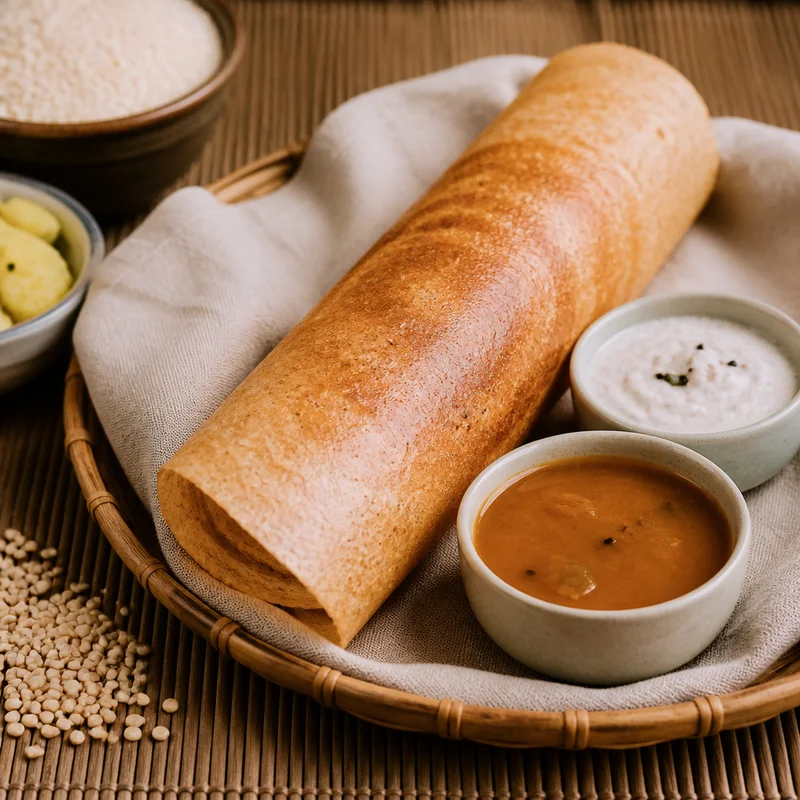
Two-Day Fermented Masala Dosa with Coconut Chutney and Sambar
 By Sprig Originals · cooked up in Sprig
A proper South Indian dosa built the slow way: parboiled rice and urad dal soaked separately, ground until the dal is fluffy and the rice is faintly gritty, then fermented overnight until the batter smells sour and lifts like a sponge. The payoff is a crackly, lace-edged crepe you can only get from real fermentation and a well-managed pan. Wrapped around soft turmeric potatoes and served with coconut chutney and a fast tamarind sambar. A store-bought batter shortcut is built in for weeknights.
Ingredients
- 2 cups idli rice or other parboiled short-grain rice
- 1/2 cup whole skinless urad dal (split black gram)
- 1/4 cup thick poha (flattened rice)
- 1/2 tsp fenugreek seeds
- 1 1/2 tsp fine sea salt
- filtered or bottled water for soaking and grinding (about 3 cups total)
- 1/4 cup sesame oil or ghee, for cooking
- 32 oz refrigerated dosa batter (from an Indian grocer)
- 1/2 cup water, for thinning
- 1/2 tsp fine sea salt, if needed
- 1 1/2 lb Yukon Gold potatoes
- 3 tbsp coconut oil or ghee
- 1 tsp black mustard seeds
- 1 tsp split chana dal
- 1 tsp urad dal
- 12 fresh curry leaves
- 2 dried red chiles, broken
- 1 large yellow onion, thinly sliced
- 2 green chiles (serrano), slit
- 1 tbsp minced fresh ginger
- 3/4 tsp ground turmeric
- 1 1/4 tsp salt
- 1/3 cup chopped cilantro
- 1 tbsp lime juice
- 1 1/2 cups frozen grated coconut, thawed (or unsweetened shredded coconut)
- 3 tbsp roasted chana dal (dalia)
- 1 green chile, stemmed
- 1 tsp chopped ginger
- 1 tbsp tamarind paste or lime juice
- 3/4 tsp salt
- 1/2 cup cold water, plus more as needed
- 1 tbsp coconut oil
- 1 tsp black mustard seeds
- 8 fresh curry leaves
- 1 dried red chile, broken
- 3/4 cup toor dal (split pigeon peas), rinsed
- 3 cups water
- 1/2 tsp ground turmeric
- 1 tbsp tamarind paste
- 1 small onion, cut into wedges
- 1 medium tomato, chopped
- 1 cup chopped carrot and green beans
- 2 tbsp sambar powder
- 1 1/4 tsp salt
- 2 tbsp coconut oil or ghee
- 1 tsp black mustard seeds
- 1/4 tsp asafoetida (hing)
- 10 fresh curry leaves
- 2 tbsp chopped cilantro
Instructions
- DAY 1, MORNING — SOAK: In one bowl, combine the urad dal and fenugreek seeds; in a second bowl, the parboiled rice. Rinse each 3 to 4 times in cool water until the water runs nearly clear, then cover each with 3 inches of filtered water. Soak at room temperature for 6 hours. In the last 30 minutes, soak the poha in 1/2 cup water in a small bowl.
- DAY 1, EVENING — GRIND: Drain the urad dal, reserving its soaking water. Grind the dal in a blender with 1/2 cup ice-cold water, scraping down often and adding water 1 tablespoon at a time, for 4 to 5 minutes, until it is bright white, silky, and doubled in volume — it should hold a soft peak on a spoon. Scrape into a very large bowl (the batter will double, so use at least a 4-quart bowl).
- Drain the rice. Grind the rice with the soaked poha and about 3/4 cup cold water for 3 to 4 minutes, until smooth but with a faint sandy grit like fine semolina between your fingers. Add to the urad dal.
- Add the salt and mix with your clean hand for a full minute, lifting and folding — the warmth and bacteria on your hand genuinely help fermentation. The batter should be the consistency of thick pancake batter; add water a splash at a time if it is stiff. Cover loosely and ferment in a warm spot (80–85°F / 27–29°C) for 10 to 14 hours. An oven with only the light on, or an Instant Pot on Yogurt setting for 10 hours, works well.
- DAY 2 — CHECK: The batter is ready when it has risen by 50 to 100 percent, is domed and bubbly on top, and smells pleasantly sour, like sourdough starter. Stir it down gently, then refrigerate for at least 3 hours (this firms it up and improves the flavor). Do not beat air out of it aggressively.
- FALLBACK: Skip all fermentation and use 32 oz refrigerated store-bought dosa batter. Let it sit out for 1 hour to wake up, whisk in water 2 tablespoons at a time until it flows off a spoon in a smooth ribbon, taste, and add salt if needed. Proceed from the cooking step.
- POTATO MASALA: Boil the potatoes whole in salted water for 20 to 25 minutes, until a knife slides through easily. Drain, cool 10 minutes, peel, and break into rough 3/4-inch chunks with your hands — do not mash smooth.
- Heat 3 tablespoons coconut oil in a large skillet over medium. Add the mustard seeds and cover until they finish popping, about 30 seconds. Add the chana dal and urad dal and fry 1 minute until golden, then the curry leaves and dried chiles for 10 seconds. Add the onion, green chiles, and ginger and cook 8 to 10 minutes, stirring, until the onion is very soft and sweet but not browned.
- Stir in the turmeric and salt, then 1/2 cup water. Add the potatoes and mash a quarter of them against the pan to thicken. Simmer 3 to 4 minutes until it is scoopable and moist, not runny. Off heat, fold in the cilantro and lime juice. Keep warm.
- COCONUT CHUTNEY: Blend the coconut, roasted chana dal, green chile, ginger, tamarind paste, salt, and 1/2 cup cold water for 2 minutes until thick and creamy, adding water a tablespoon at a time to reach a spoonable dip. Scrape into a bowl. Heat the coconut oil in a small pan over medium-high, pop the mustard seeds 30 seconds, add the curry leaves and dried chile for 10 seconds, then pour the whole sizzling tempering over the chutney.
- SAMBAR: Combine the toor dal, 3 cups water, and turmeric in a saucepan. Bring to a boil, skim the foam, reduce to a lively simmer, and cook partly covered 35 to 40 minutes until the dal collapses; whisk smooth. (Pressure cooker: 12 minutes high, natural release.)
- Add the tamarind paste, onion, tomato, carrot, and green beans plus 1 cup water. Simmer 12 minutes until the vegetables are tender. Stir in the sambar powder and salt and simmer 5 more minutes so the spices lose their raw edge. In a small pan, heat the coconut oil, pop the mustard seeds, add the asafoetida and curry leaves for 10 seconds, and pour into the sambar. Finish with cilantro.
- PAN TEMPERATURE — the make-or-break step: Set a well-seasoned carbon steel or cast-iron skillet, or a flat nonstick dosa tawa, over medium-high for 4 to 5 minutes. It is ready when a few drops of water flicked on the surface skitter and vanish in 2 seconds (roughly 425–450°F / 220–230°C). If the water sits and steams, it is too cool; if it explodes instantly, it is too hot.
- SEASON AND SPREAD: Rub the hot pan with a halved onion dipped in sesame oil, then wipe with a paper towel — the surface should look barely oiled, not wet. Lower the heat to medium. Pour 1/3 cup batter into the center and, using the flat bottom of the ladle, spread it outward in a continuous spiral to a 9-inch circle in about 8 seconds. Do not go back over set batter.
- COOK: Drizzle 1/2 teaspoon oil around the rim and over the top. Cook undisturbed 2 to 3 minutes, until the surface loses its wet sheen, lace holes open up, and the edges lift and turn deep golden. For a crisp dosa, do not flip: spoon 1/3 cup potato masala down the center, fold the two sides over, and slide onto a plate. For plain dosa, flip and cook 30 seconds.
- BETWEEN DOSAS: Wipe the pan with a damp paper towel held in tongs and let it re-heat for 20 to 30 seconds — cooling the pan slightly between dosas is what keeps the spread even. Regulate the heat constantly: if a dosa is spotty and pale it is too hot to spread; if it sticks and tears it is too cool. Repeat with the remaining batter, serving each dosa immediately with warm sambar and coconut chutney.
Chef's tips
- Parboiled idli rice is not optional if you want a crisp dosa — regular basmati or jasmine ferments poorly and yields a soft, bready crepe. Look for bags labeled idli rice, or use half parboiled rice and half raw sona masoori.
- Cold kitchens are the number one cause of failed fermentation. If your house runs below 72°F, use the oven light, a proofing setting, or set the bowl on a heating pad on low with a towel between.
- Over-fermented batter (very sour, flat, watery) still makes excellent uttapam: pour thick, top with onion and tomato, and cook covered — do not try to spread it thin.
- Batter keeps 5 days refrigerated and improves through day 3. Always thin it with water before each session, since it thickens as it chills.
- A pan that has only ever cooked dosas is the secret in South Indian homes. If yours sticks, heat it with 2 tablespoons oil and a handful of onion skins over medium for 10 minutes, then wipe clean and never scrub it with soap.
- Make the sambar and chutney while the batter ferments — both keep 3 days refrigerated, so dosa morning becomes a 20-minute job.
Nutrition (per serving, estimated)
Made with Sprig
Two-Day Fermented Masala Dosa with Coconut Chutney and Sambar was created in Sprig — the AI chef that turns any craving into a complete recipe, plans your week, and shops with one smart list.
More from Sprig Originals

Are you this recipe's original author or publisher? Report a problem