Short Rib Ragu
 By Ben · cooked up in Sprig
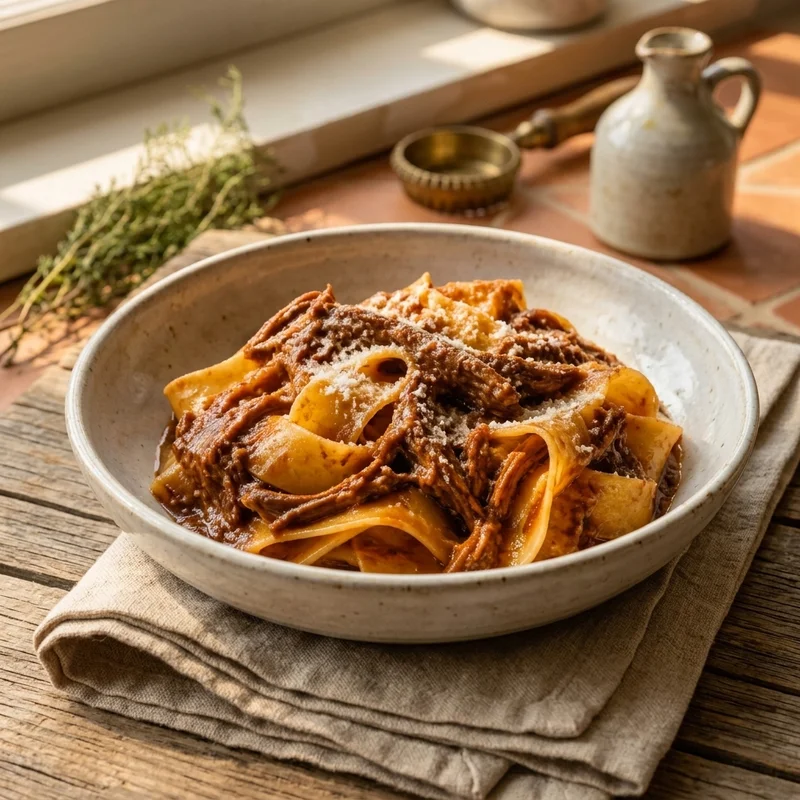
Three hours in a low oven transforms bone-in short ribs and a full bottle of Barolo into something that barely resembles the raw ingredients you started with — the meat collapses into long, silky shreds and the braising liquid reduces to a glossy, deeply savory sauce that coats every ribbon of pappardelle. The aromatics are built in layers: a proper soffritto of carrot, celery, and onion, plus a whole head of roasted garlic, a handful of fresh thyme, and a parmesan rind that melts invisibly into the sauce and adds a quiet, nutty richness you can't quite name. When you lift the lid after the final reduction, the smell alone stops conversation. This is the dish for the dinner party where you want the kitchen to do the talking — set it up that afternoon and walk to the table relaxed.
Ingredients
- 4 pounds bone-in beef short ribs, English cut
- 2 teaspoons kosher salt, plus more to taste
- 1 teaspoon freshly ground black pepper
- 3 tablespoons extra-virgin olive oil
- 1 large yellow onion, finely diced
- 3 medium carrots, finely diced
- 3 stalks celery, finely diced
- 1 whole head of garlic, top quarter sliced off to expose cloves
- 3 tablespoons tomato paste
- 1 bottle (750ml) Barolo or other full-bodied dry red wine such as Nebbiolo or Chianti Classico
- 1 can (28 ounces) whole San Marzano tomatoes, crushed by hand
- 2 cups beef stock, preferably homemade or low-sodium
- 6 sprigs fresh thyme
- 2 sprigs fresh rosemary
- 2 dried bay leaves
- 1 parmesan rind (about 3 inches)
- 1 tablespoon unsalted butter
- 1½ pounds fresh or dried pappardelle pasta
- 2 tablespoons kosher salt for pasta water
- 2 ounces Parmigiano-Reggiano, freshly grated, plus more at the table
- ¼ cup fresh flat-leaf parsley leaves, roughly chopped
- 1 teaspoon lemon zest, finely grated
- 2 tablespoons high-quality extra-virgin olive oil for finishing
Instructions
- Remove the short ribs from the refrigerator 45 minutes before cooking to bring them closer to room temperature. Pat every surface completely dry with paper towels — moisture is the enemy of a proper sear. Season aggressively on all sides with kosher salt and freshly ground black pepper.
- Preheat your oven to 325°F. In a large Dutch oven (at least 6-quart capacity) set over medium-high heat, warm the olive oil until it just begins to smoke. Working in two batches to avoid crowding, sear the short ribs on all four sides until deeply browned, about 3 to 4 minutes per side. You are building the foundational flavor here — resist the urge to rush. Transfer seared ribs to a plate and set aside.
- Reduce the heat to medium. Drain all but 2 tablespoons of fat from the Dutch oven. Add the diced onion, carrots, and celery. Cook, stirring occasionally and scraping up the browned bits from the bottom, for 8 to 10 minutes until the vegetables are fully softened and lightly caramelized. Season lightly with salt.
- Add the tomato paste and stir it into the soffritto. Cook, pressing the paste against the bottom of the pot, for 3 to 4 minutes until it deepens to a brick-red color and smells slightly sweet and toasted. This step removes raw bitterness and concentrates the umami.
- Pour in the entire bottle of red wine. Increase the heat to high and bring to a vigorous boil, scraping the bottom of the pan continuously. Let the wine reduce by half, about 10 to 12 minutes — the alcohol must cook off and the wine must concentrate before you add any other liquid.
- Add the crushed San Marzano tomatoes and beef stock. Nestle the seared short ribs back into the pot, along with any accumulated juices from the resting plate. Tuck in the whole head of garlic (cut side down), the thyme sprigs, rosemary sprigs, bay leaves, and parmesan rind. The liquid should come about two-thirds of the way up the ribs; add a splash more stock if needed.
- Bring to a gentle simmer, then cover the Dutch oven tightly with its lid and transfer to the oven. Braise at 325°F for 3 to 3½ hours, or until the meat is completely tender and pulls away from the bone with no resistance when prodded with a fork. Check once halfway through, skimming any foam from the surface.
- Carefully remove the Dutch oven from the oven. Using tongs, transfer the short ribs to a cutting board and let them rest for 10 minutes. Remove and discard the herb sprigs, bay leaves, and parmesan rind. Squeeze the softened garlic cloves from the roasted head directly into the braising liquid, discarding the papery skin.
- Using an immersion blender or a ladle to transfer batches to a countertop blender, partially blend the braising liquid — you want the vegetables and garlic fully incorporated but the sauce to still have body, not be perfectly smooth. Return the sauce to the Dutch oven and set over medium heat.
- Skim the fat from the surface of the sauce using a wide spoon. Bring the sauce to a steady simmer and reduce, uncovered, for 15 to 20 minutes until it thickens to a consistency that coats the back of a spoon. Taste carefully and adjust seasoning with salt and pepper.
- While the sauce reduces, remove the bones from the short ribs. Using two forks, shred the beef into long, irregular pieces — some larger chunks are welcome for texture. Avoid shredding too fine; you want the meat to feel substantial in the final dish. Fold the shredded meat back into the reduced sauce. Add the tablespoon of butter and stir gently until melted and incorporated. Keep warm over low heat.
- Bring a very large pot of water to a rolling boil. Add the kosher salt — the water should taste as salty as the sea. Cook the pappardelle until just al dente, about 2 to 3 minutes for fresh pasta or according to package directions for dried, erring on the shorter side. Reserve 1½ cups of the starchy pasta cooking water before draining.
- Using tongs, transfer the cooked pappardelle directly from the boiling water into the ragu sauce. Do not rinse the pasta. Toss vigorously over medium heat, adding reserved pasta water a few tablespoons at a time as needed, until the sauce clings to every ribbon of pasta and the mixture is glossy and cohesive, about 1 to 2 minutes.
- Remove from the heat. Add half the freshly grated Parmigiano-Reggiano and a drizzle of the finishing olive oil. Toss once more. Divide among six warmed wide-rimmed pasta bowls, twisting and mounding the pappardelle with tongs to create height. Spoon any extra ragu from the pan over the top. Finish each bowl with more Parmigiano-Reggiano, a scattering of flat-leaf parsley, a pinch of finely grated lemon zest, and a final thread of your best olive oil. Serve immediately.
Chef's tips
- For maximum depth of flavor, braise the short ribs a full day ahead. Once cooled, refrigerate the ribs in the sauce overnight. The fat will solidify on the surface and can be lifted off cleanly with a spoon — far easier than trying to skim warm liquid. The flavors will also meld and intensify significantly by the next day. Simply reheat gently, shred the meat, and proceed from step four of the finishing section.
- The parmesan rind is non-negotiable — save them in a zip-lock bag in the freezer every time you finish a wedge of Parmigiano-Reggiano. It dissolves slowly into the braising liquid, lending a savory, almost creamy undercurrent that you cannot achieve any other way. If you don't have one, a one-inch knob of whole butter stirred in at the very end will partially substitute.
- The lemon zest scattered at the very end is not decoration — it is a structural element. Braised beef ragu is inherently rich and can become one-dimensional without a hit of acidity. The zest provides brightness without the liquid intrusion of lemon juice, which can break the sauce's texture. Add it only after plating, never during cooking, so it remains aromatic and vivid.
Nutrition (per serving, estimated)
Made with Sprig
Short Rib Ragu was created in Sprig — the AI chef that turns any craving into a complete recipe, plans your week, and shops with one smart list.
More from Ben
Are you this recipe's original author or publisher? Report a problem