Sprig Originals's kitchen / Dark Chocolate Cheesecake with a Cookie Crust
Dark Chocolate Cheesecake with a Cookie Crust
 By Sprig Originals · cooked up in Sprig
Worked out from this recipe's ingredients. If you're cooking for an allergy, always read the full ingredient list.
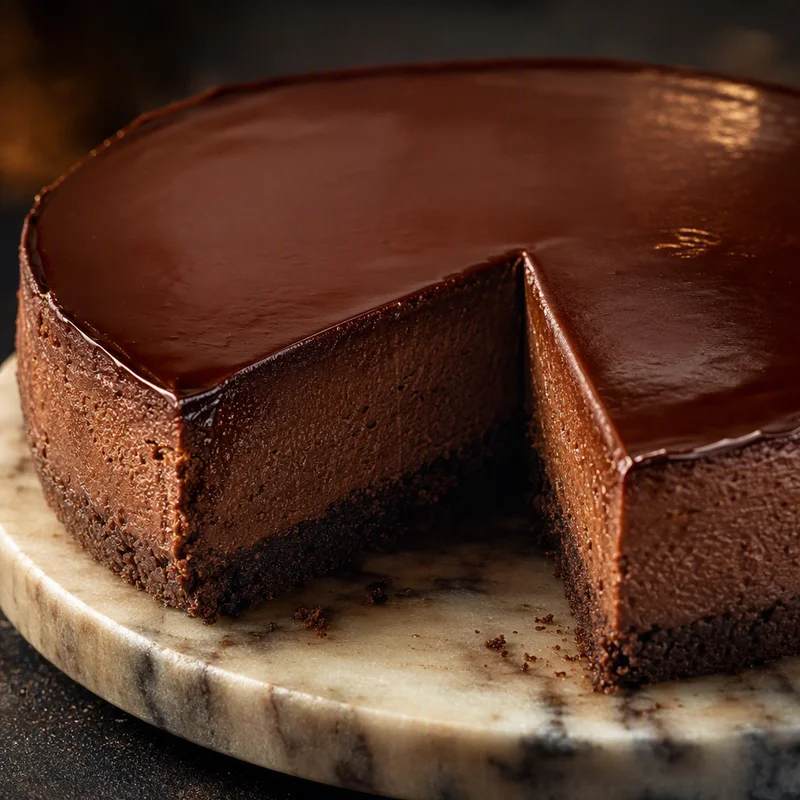
A restaurant-dessert-course cheesecake: eight ounces of real melted dark chocolate folded into a barely-beaten cream cheese batter, poured over a pressed chocolate cookie crust, and baked low and slow in a water bath so the texture stays truffle-dense and the top never cracks. Finished with a thin mirror of ganache and chilled overnight.
Ingredients
Cookie crust
- 24 chocolate sandwich cookies (about 9 oz / 255 g), filling included
- 4 tbsp unsalted butter, melted
- 1/4 tsp fine sea salt
Chocolate filling
- 8 oz good bittersweet chocolate (60–70%), chopped
- 2 lb full-fat block cream cheese (four 8-oz packages), room temperature
- 1 1/4 cups granulated sugar
- 3 tbsp Dutch-process cocoa powder
- 1 tsp instant espresso powder (optional)
- 1/2 tsp fine sea salt
- 1 cup full-fat sour cream, room temperature
- 2 tsp vanilla extract
- 4 large eggs, room temperature
Ganache glaze
- 4 oz bittersweet chocolate, finely chopped
- 1/2 cup heavy cream
- 1 tbsp light corn syrup (for shine)
- Flaky sea salt, for serving
Instructions
- Heat the oven to 350°F. Wrap the outside of a 9-inch springform pan with two overlapping layers of heavy-duty foil, pressing it snugly up the sides to just below the rim so no water can seep in. Butter the inside of the pan lightly.
- Pulse the cookies in a food processor to fine crumbs (about 2 cups). Add the melted butter and 1/4 teaspoon salt and pulse until the crumbs look like wet sand. Press firmly into the bottom of the pan and about 1 inch up the sides, using a flat-bottomed measuring cup to compact it. Bake 10 minutes, then cool on a rack while you make the filling. Reduce the oven to 300°F and put a kettle of water on to boil.
- Melt the 8 oz chopped chocolate in a heatproof bowl set over barely simmering water (or in the microwave at 50% power in 20-second bursts), stirring until smooth. Set aside to cool to just barely warm, about 100–105°F — warm enough to stay fluid, cool enough that it won't seize or scramble eggs.
- In a stand mixer with the paddle (or a large bowl with a hand mixer), beat the room-temperature cream cheese on medium-low for 2 minutes until completely smooth, scraping the bowl and paddle twice. Lumps must go now — you cannot beat them out later without whipping air into the batter.
- Sift in the sugar, cocoa powder, espresso powder, and 1/2 teaspoon salt. Beat on low just until combined and glossy, about 1 minute. Add the sour cream and vanilla and mix on low 30 seconds.
- Add the eggs one at a time on the lowest speed, mixing just until each disappears, roughly 15 seconds apiece. Stop the mixer. Pour in the melted chocolate and fold it in by hand with a flexible spatula until the batter is one uniform deep-brown color with no streaks. Keep the mixing slow and minimal: air bubbles are what make cheesecakes puff, then crack.
- Pour the batter over the cooled crust and smooth the top. Tap the pan gently on the counter 5 or 6 times to release bubbles, and pop any that surface with a toothpick.
- Set the foil-wrapped pan inside a roasting pan and pour boiling water into the roasting pan to come 1 inch up the sides. Bake at 300°F for 80 to 95 minutes. It is done when the outer 2 inches are set and the center 3 inches still jiggle as one soft unit when nudged — an instant-read thermometer 1 inch from the center should read 150°F. The top will look matte, not dry.
- Turn the oven off, prop the door open a few inches, and leave the cheesecake in its water bath for 1 hour. This slow cool-down is the second half of the crack insurance.
- Lift the pan out of the water, peel off the foil, and cool on a rack to room temperature, about 1 1/2 hours. Run a thin knife around the edge, then cover loosely and refrigerate at least 8 hours or overnight — the texture only becomes truly dense and sliceable once fully chilled.
- For the glaze, heat the cream until it just steams, pour it over the chopped chocolate with the corn syrup, wait 2 minutes, then stir from the center out until glossy. Cool 10 minutes, pour onto the chilled cheesecake, and tilt the pan to spread it to the edges. Chill 30 minutes to set.
- Release the springform ring. Slice with a long thin knife dipped in hot water and wiped dry between every cut. Finish each plate with a few flakes of sea salt and serve cool, not cold — about 15 minutes out of the fridge.
Chef's tips
- Everything in the filling must be at room temperature (cream cheese, sour cream, eggs). Cold cream cheese forces you to overbeat, and overbeaten batter cracks.
- No roasting pan big enough? Set the wrapped springform directly on the oven rack and put a broiler pan or 9x13 dish of boiling water on the rack below. You lose a little insulation, so check for doneness at 75 minutes.
- If your chocolate is hotter than about 110°F when it hits the batter it can curdle the eggs and streak the cheesecake. Test it against your lip: it should feel neutral, not hot.
- A tiny surface crack is cosmetic — the ganache hides it completely. Don't chase it by overbaking.
- Bake it two days ahead if you can. Chocolate cheesecake tastes deeper and cuts cleaner on day two. It keeps 5 days covered in the fridge, or freeze whole slices wrapped tightly for 2 months.
Nutrition (per serving, estimated)
533calories
10gprotein
46gcarbs
38gfat
Estimates only — values vary with brands and portions.
Made with Sprig
Dark Chocolate Cheesecake with a Cookie Crust was created in Sprig — the AI chef that turns any craving into a complete recipe, plans your week, and shops with one smart list.
Free to start · 14-day Pro trial · cancel anytime
Not ready yet? Get the occasional recipe worth cooking — a couple a month at most.
You're on the list — check your inbox!
Unsubscribe anytime. Privacy Policy
More from Sprig Originals
Frozen Chocolate–Caramel Peanut Nougat Bars
Blueberry Peach Buckle with Almond Streusel
Creole Cream Cheese Cheesecake with Salted Caramel and Dark Chocolate
Are you this recipe's original author or publisher? Report a problem