French Macarons with Pistachio & Raspberry Buttercream
 By Sprig Originals · cooked up in Sprig
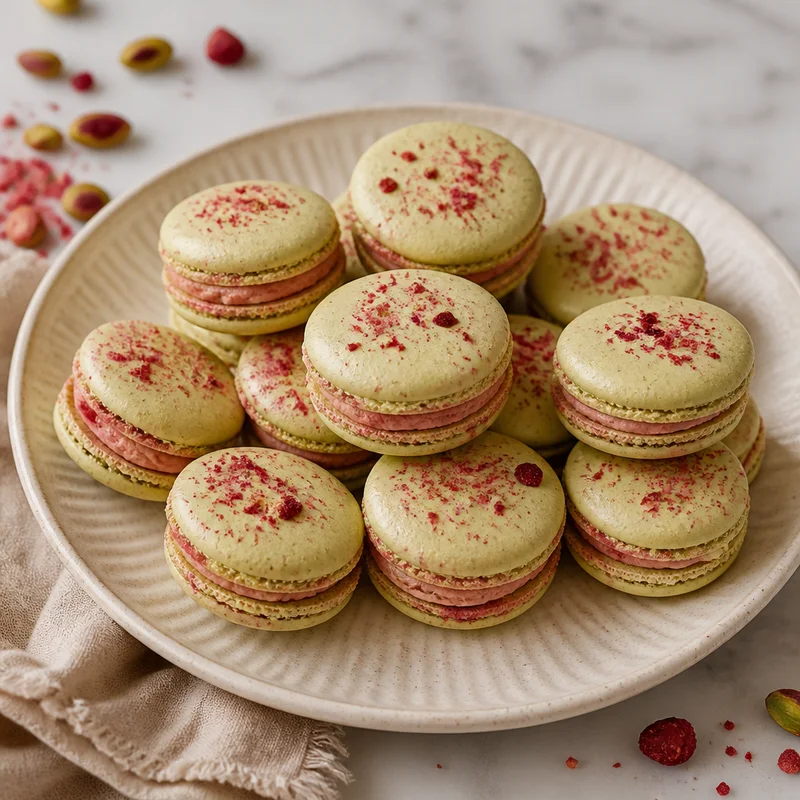
A gram-by-gram macaron recipe that treats the hard parts like skills instead of luck. You'll learn what correctly folded batter actually looks and sounds like, why the shells need to sit until they feel dry to a fingertip, and how that pause is what gives you ruffled feet in the oven. One batch of French meringue shells, one batch of silky buttercream split two ways: toasted pistachio and bright freeze-dried raspberry. Bakery-case results for a fraction of the $4.50-a-cookie price.
Ingredients
- 100 g super-fine blanched almond flour
- 100 g powdered sugar
- 75 g egg whites (from about 2 large eggs), room temperature
- 75 g granulated sugar
- 1/8 tsp cream of tartar
- 1 pinch fine salt
- 1/2 tsp vanilla extract
- gel food coloring, pale green and pink (optional)
- 225 g unsalted butter, softened to 65°F
- 240 g powdered sugar, sifted
- 1/4 tsp fine salt
- 2 tbsp heavy cream
- 60 g shelled unsalted pistachios, plus a few chopped for garnish
- 1 tsp neutral oil
- 1/4 tsp almond extract
- 15 g freeze-dried raspberries
- 2 tsp seedless raspberry jam
- 1/2 tsp lemon juice
Instructions
- Set up first: line two heavy, flat baking sheets with parchment (not silicone mats, which insulate and can flatten feet). Trace 1½-inch circles 1 inch apart on the back of the parchment if you want a guide, then flip the paper pencil-side down. Fit a piping bag with a ½-inch round tip. Wipe the mixing bowl and whisk with a splash of white vinegar on a paper towel to strip any grease — this is the single most common cause of a meringue that won't hold.
- Weigh 100 g almond flour and 100 g powdered sugar into a bowl and whisk to combine, then sift the mixture through a medium-mesh sieve into a second bowl. Press any stubborn almond bits through with a spoon; discard no more than a teaspoon of coarse crumbs. If more than that is left behind, pulse the mixture in a food processor for 10 seconds and sift again.
- In the clean stand mixer bowl, beat the 75 g egg whites with the cream of tartar and pinch of salt on medium speed until foamy and opaque, about 1 minute. With the mixer running, add the 75 g granulated sugar 1 tablespoon at a time over 2 minutes. Raise speed to medium-high and beat 3 to 5 minutes more until the meringue is glossy and thick and pulls into a stiff peak with only a tiny hook at the tip. Rub a bit between your fingers — it should feel smooth, not gritty. Beat in the vanilla for 10 seconds.
- Divide the meringue between two bowls if you're making two colors, then tint each with a toothpick's worth of gel coloring, folding just to blend. Divide the sifted dry mixture between the bowls too (about 100 g each) — a kitchen scale makes this painless.
- Now macaronage, the step that makes or breaks the batch. Fold with a flexible spatula: cut down through the center, scrape up the side of the bowl, and smear the batter against the bowl wall to knock out air. Repeat, rotating the bowl. After 25 to 40 strokes the batter loosens visibly and starts to flow off the spatula in a thick, unbroken ribbon. Test it: lift the spatula and let batter fall — it should form a slowly sinking figure-8 that melts back into the surface in 10 to 20 seconds. Under-mixed batter breaks into blobs and holds peaks; over-mixed batter runs off like syrup and will spread into flat, footless discs. Stop at the first correct figure-8.
- Transfer to the piping bag. Hold the tip ¼ inch above the parchment, perpendicular, and pipe 1¼-inch mounds using steady pressure, releasing and flicking sideways to cut the flow. The batter will spread to about 1½ inches. Rap each sheet firmly against the counter 5 or 6 times, rotate 90 degrees, and rap again to release trapped air. Pop any surface bubbles with a toothpick and drag away any peaks.
- Rest the trays uncovered at room temperature until a skin forms: 30 to 60 minutes in a dry kitchen, up to 90 in a humid one. The shells are ready when you can touch one lightly with a dry fingertip and no batter transfers and the surface feels matte and papery. Don't shortcut this — the skin is what forces the rising batter out sideways at the base, which is exactly what a foot is.
- Meanwhile, heat the oven to 300°F with a rack in the lower third, and let it preheat a full 20 minutes so the temperature is truly stable. Toast the 60 g pistachios on a small tray for 6 to 7 minutes until fragrant, then cool completely.
- Bake one sheet at a time, 14 to 16 minutes, rotating the tray front-to-back at 8 minutes. Feet should rise within the first 6 minutes. Doneness test: nudge the top of a shell with a fingertip — it should feel set and shift no more than a hair against its foot. If the top slides, give it 1 to 2 minutes more. Cool the shells completely on the parchment, 20 minutes, then peel them away. Bake the second tray the same way.
- For the buttercream base, beat the 225 g butter alone on medium-high for 3 minutes until pale and creamy. Add the sifted 240 g powdered sugar and the salt in three additions on low, then the cream, then whip on medium-high for 2 minutes until light. Divide equally into two bowls, about 250 g each.
- Pistachio: grind the cooled toasted pistachios with the neutral oil in a small food processor for 2 to 3 minutes, scraping down often, until you have a thick, slightly loose paste. Beat the paste and the almond extract into one bowl of buttercream for 1 minute. Raspberry: crush the freeze-dried raspberries to a fine powder in a bag with a rolling pin, sift out the seeds, and beat the powder, jam, and lemon juice into the second bowl for 1 minute.
- Match shells into same-size pairs. Pipe a nickel-sized mound of filling onto the flat side of one shell, leaving a ⅛-inch border, and press the partner on with a gentle twist until the filling just reaches the edge. Fill roughly half with pistachio and half with raspberry; press a few chopped pistachios into the exposed filling of the green ones.
- Mature the macarons in an airtight container in the refrigerator for at least 24 hours — this is not optional if you want the classic texture, as moisture migrates from the filling into the shell and turns it crisp-outside, chewy-inside. Bring to room temperature 20 to 30 minutes before serving.
Chef's tips
- Volume measures do not work here. A 10 g swing in almond flour changes the whole batter, so weigh every component including the egg whites.
- Aging whites helps: separate them a day ahead, keep them covered in the fridge, then bring to room temperature. Loosened whites whip to a more stable meringue.
- Hollow shells almost always mean under-baked or over-whipped meringue. Try an extra 90 seconds in the oven and stop whipping the meringue the moment it holds a stiff peak with a small hook.
- Cracked tops with no feet mean the skin never formed — either the rest was too short or the kitchen is humid. Run the oven or a dehumidifier nearby and extend the rest.
- Use gel or powdered color only. Liquid food coloring adds water and thins the batter past the point of no return.
- Shells freeze beautifully unfilled for up to a month in a rigid airtight container; thaw at room temperature for 15 minutes before filling. Filled macarons keep 5 days refrigerated.
Nutrition (per serving, estimated)
Made with Sprig
French Macarons with Pistachio & Raspberry Buttercream was created in Sprig — the AI chef that turns any craving into a complete recipe, plans your week, and shops with one smart list.
More from Sprig Originals
Are you this recipe's original author or publisher? Report a problem