Sprig Originals's kitchen / Baked Strawberry Cheesecake with Fresh Berry Glaze
Baked Strawberry Cheesecake with Fresh Berry Glaze
 By Sprig Originals · cooked up in Sprig
Worked out from this recipe's ingredients. If you're cooking for an allergy, always read the full ingredient list.
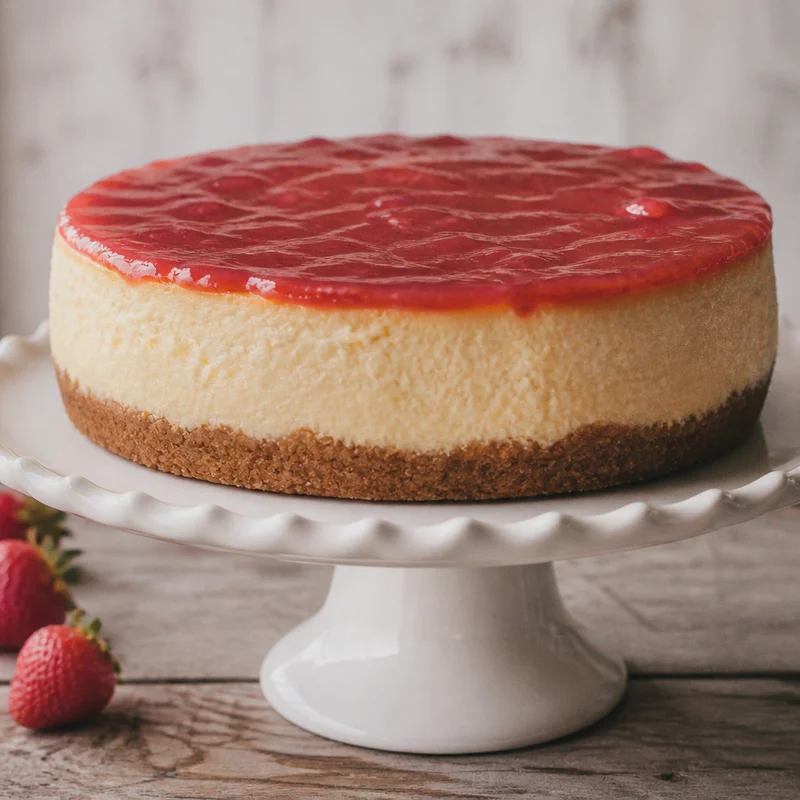
A tall, dense-but-silky New York-style cheesecake baked low and slow with no water bath, no foil-wrapped springform and no leaks. The topping is the whole point: a pound of ripe strawberries macerated in sugar and lemon, their juices reduced to a glossy syrup and spooned back over fresh halved berries — all shine and real fruit flavor, no gelatin, no canned glaze.
Ingredients
Graham Crust
- 9 whole graham crackers (about 1 1/2 cups crumbs)
- 3 tbsp granulated sugar
- 1/4 tsp fine sea salt
- 6 tbsp unsalted butter, melted
Cheesecake Filling
- 32 oz full-fat cream cheese (4 blocks), fully softened
- 1 1/3 cups granulated sugar
- 2 tbsp cornstarch
- 1/2 tsp fine sea salt
- 1 cup sour cream, room temperature
- 1 tbsp vanilla extract
- 2 tsp finely grated lemon zest
- 4 large eggs, room temperature
- 1 large egg yolk, room temperature
Macerated Strawberry Glaze
- 2 lb ripe strawberries, hulled
- 1/2 cup granulated sugar
- 2 tsp fresh lemon juice
- 1 tsp balsamic vinegar (optional)
- 1 pinch fine sea salt
Instructions
- Take the cream cheese, sour cream and eggs out of the fridge at least 2 hours ahead — genuinely room-temperature dairy is what keeps a no-water-bath cheesecake smooth and crack-free. Position a rack in the lower third of the oven and heat to 325°F.
- Butter a 9-inch springform pan and line the bottom with a parchment round. Break the graham crackers into a food processor and pulse to fine crumbs (or crush in a zip-top bag with a rolling pin). Pulse in the sugar and salt, then the melted butter until the crumbs look like damp sand.
- Press the crumbs firmly into the bottom and 1 inch up the sides of the pan, using the flat bottom of a measuring cup to compact them. Bake 10 minutes, until fragrant and just set. Cool on a rack while you make the filling. Reduce the oven to 300°F.
- In a stand mixer with the paddle (or a large bowl with a hand mixer) beat the cream cheese alone on medium-low for 2 minutes, scraping the bowl twice, until completely smooth with no lumps. Whisk the sugar, cornstarch and salt together, then add and beat 2 minutes more on medium-low.
- Beat in the sour cream, vanilla and lemon zest until uniform. Add the eggs and yolk one at a time on the lowest speed, mixing only until each disappears — about 15 seconds each. Overbeating whips in air, which is what makes cheesecakes puff, crack and sink. Scrape the bowl and fold a few times by hand.
- Pour the batter over the cooled crust and smooth the top. Rap the pan firmly on the counter 5 or 6 times to release air bubbles, popping any that surface with a toothpick. Set the springform on a rimmed baking sheet (insurance against butter drips, no foil or water needed).
- Bake at 300°F for 75 to 85 minutes. The cheesecake is done when the outer 2 inches are set and matte and the center 3-inch circle still jiggles as one soft mass when nudged; an instant-read thermometer 1 inch from the center should read 150-155°F.
- Turn the oven off, prop the door open with a wooden spoon, and leave the cheesecake inside for 1 hour. This slow cool-down is the water bath's real job and prevents the surface from cracking. Then transfer to a rack and cool to room temperature, about 2 hours.
- Run a thin knife around the rim, cover the pan loosely, and refrigerate at least 8 hours or overnight. Do not unmold warm.
- Make the glaze at least 2 hours before serving: halve (or quarter, if large) 1 pound of the strawberries and toss in a bowl with the sugar, lemon juice and pinch of salt. Let sit at room temperature 45 minutes, stirring once or twice, until they release a pool of ruby juice.
- Set a sieve over a small saucepan and drain the macerated berries, pressing gently — you want about 3/4 cup of juice. Reserve the drained berries. Add the balsamic to the juice and simmer over medium heat for 6 to 9 minutes, swirling occasionally, until reduced to a scant 1/3 cup and thick enough to coat a spoon (it will read about 220°F and thicken further as it cools). Cool 20 minutes.
- Hull and halve the remaining 1 pound of strawberries. Combine them with the reserved macerated berries and fold in the cooled syrup until every piece is lacquered. Let stand 15 minutes.
- Release the springform ring, slide the cheesecake off the base onto a platter, and pile the glazed strawberries over the top, letting a little syrup run down the sides. Slice with a long thin knife dipped in hot water and wiped clean between every cut.
Chef's tips
- The number one cause of a cracked cheesecake is cold cream cheese: it stays lumpy, you beat harder to fix it, and you whip in air. If you forgot to set it out, unwrap the blocks, cut into cubes and let them sit 30 minutes, or microwave at 30% power in 15-second bursts to about 68°F.
- No food processor? A gallon zip-top bag and a rolling pin make excellent graham crumbs, and slightly coarse crumbs give the crust more crunch.
- Underripe or out-of-season strawberries won't give up enough juice to macerate. In winter, use 1 pound fresh for the topping and 1 pound frozen (thawed) for the syrup — frozen berries release juice generously.
- The reduced syrup should look like thin jam when cool. If it sets up too stiff in the fridge, warm it for 10 seconds and stir in a teaspoon of water.
- Glaze only the portion you'll serve that day. Store the naked cheesecake covered for up to 5 days and the berries separately for 2 days — glazed berries weep and soften the surface overnight.
- To freeze, chill fully, then wrap the unglazed cake in plastic and foil for up to 2 months. Thaw overnight in the refrigerator and top just before serving.
Nutrition (per serving, estimated)
561calories
8gprotein
55gcarbs
35gfat
Estimates only — values vary with brands and portions.
Made with Sprig
Baked Strawberry Cheesecake with Fresh Berry Glaze was created in Sprig — the AI chef that turns any craving into a complete recipe, plans your week, and shops with one smart list.
Free to start · 14-day Pro trial · cancel anytime
Not ready yet? Get the occasional recipe worth cooking — a couple a month at most.
You're on the list — check your inbox!
Unsubscribe anytime. Privacy Policy
More from Sprig Originals
Frozen Chocolate–Caramel Peanut Nougat Bars
Blueberry Peach Buckle with Almond Streusel
Creole Cream Cheese Cheesecake with Salted Caramel and Dark Chocolate
Are you this recipe's original author or publisher? Report a problem