Sprig Originals's kitchen / Single-Pan Red Velvet Cheesecake with Cream Cheese Frosting
Single-Pan Red Velvet Cheesecake with Cream Cheese Frosting
 By Sprig Originals · cooked up in Sprig
Worked out from this recipe's ingredients. If you're cooking for an allergy, always read the full ingredient list.
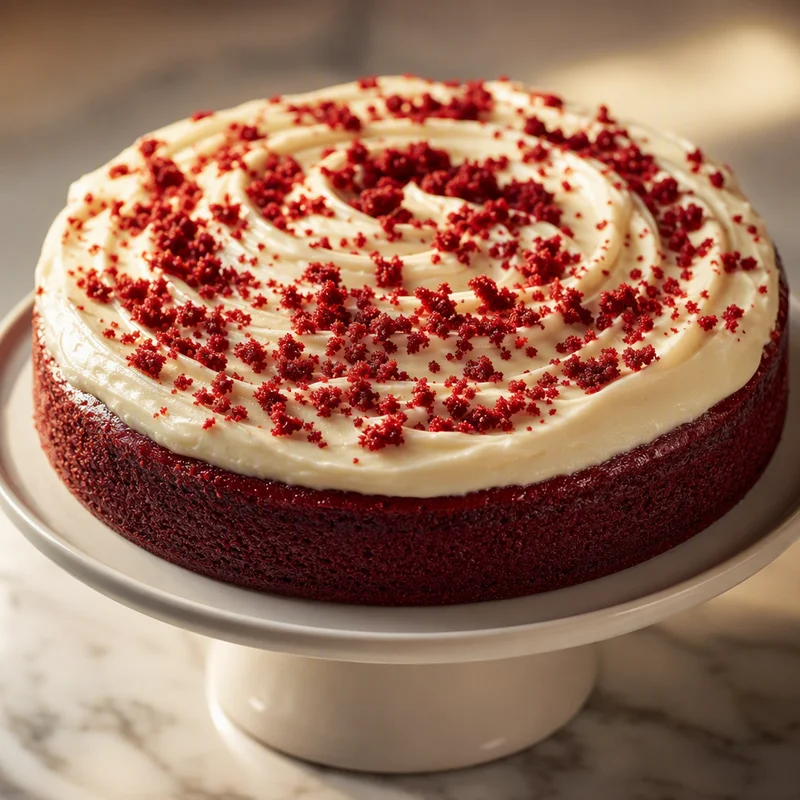
The steakhouse-dessert-cart showstopper, rebuilt for one springform pan and one afternoon. A thin, tender red velvet cake bakes first and becomes the base; a tangy vanilla cheesecake bakes right on top of it, so you get a clean red-and-white cross-section without stacking, torting or crumb-coating anything. A swirl of real cream cheese frosting and a scatter of red velvet crumbs finish it like the $38 restaurant slice it's modeled on.
Ingredients
Red Velvet Base
- 3/4 cup all-purpose flour (95 g)
- 2 tbsp unsweetened cocoa powder
- 1/2 tsp baking soda
- 1/4 tsp fine salt
- 1/2 cup granulated sugar
- 1/3 cup neutral oil
- 1 large egg, room temperature
- 1/4 cup buttermilk, room temperature
- 1 1/2 tsp red gel food coloring
- 1 tsp vanilla extract
- 1/2 tsp white vinegar
Cheesecake Layer
- 24 oz full-fat block cream cheese (3 packages), fully softened
- 1 cup granulated sugar
- 1 tbsp cornstarch
- 1/4 tsp fine salt
- 1/3 cup sour cream, room temperature
- 2 tsp vanilla extract
- 3 large eggs, room temperature
Cream Cheese Frosting
- 6 oz block cream cheese, softened
- 4 tbsp unsalted butter, softened
- 1 1/4 cups powdered sugar, sifted
- 1/2 tsp vanilla extract
- 1 pinch fine salt
- 2 tsp heavy cream, if needed
Instructions
- Heat the oven to 350°F. Grease a 9-inch springform pan, line the bottom with a parchment round, and grease the parchment. Wrap the outside bottom and sides with one sheet of heavy-duty foil to catch any leaks. Set the pan on a rimmed baking sheet.
- Make the red velvet batter: whisk the flour, cocoa, baking soda and 1/4 tsp salt in a small bowl. In a medium bowl, whisk the 1/2 cup sugar, oil, egg, buttermilk, food coloring, 1 tsp vanilla and vinegar until smooth and evenly red. Add the dry ingredients and whisk just until no streaks of flour remain — do not overmix.
- Scrape 2 tablespoons of batter onto a small parchment-lined plate or corner of the baking sheet in a thin smear (this becomes your garnish crumbs). Pour the rest into the springform and spread level with an offset spatula; it will be a thin 1/2-inch layer.
- Bake the base 14 to 16 minutes, until the center springs back when pressed lightly. The garnish smear will bake in about 8 to 10 minutes — pull it early and let it dry and crisp. Cool the cake layer in the pan on a rack for at least 30 minutes. Reduce the oven to 300°F.
- Make the cheesecake batter: beat the 24 oz cream cheese with a paddle or hand mixer on medium-low for 2 minutes, scraping the bowl twice, until completely smooth with no lumps. Add the 1 cup sugar, cornstarch and 1/4 tsp salt and beat 1 minute more on low. Beat in the sour cream and 2 tsp vanilla.
- Add the eggs one at a time on the lowest speed, mixing only until each disappears — about 15 seconds each. Stop as soon as the last egg is incorporated; whipped-in air is what cracks cheesecakes. Tap the bowl on the counter a few times to release bubbles.
- Pour the batter over the cooled red velvet layer and smooth the top. Set the foil-wrapped pan on the baking sheet, place a shallow metal pan of boiling water on the oven's lower rack for humidity, and bake at 300°F for 70 to 85 minutes.
- The cheesecake is done when the outer 2 inches are set and puffed, the center 3 inches still wobble as a single mass when nudged, and an instant-read thermometer inserted 1 inch from the center reads 150°F. Turn the oven off, crack the door open, and leave the cake inside for 1 hour.
- Move the pan to a rack and cool to room temperature, about 2 hours. Cover loosely and refrigerate at least 6 hours or overnight — this set is what gives you clean slices.
- Make the frosting: beat the 6 oz cream cheese and butter until smooth, add the powdered sugar, 1/2 tsp vanilla and pinch of salt, and beat on medium 2 minutes until fluffy. Loosen with heavy cream a teaspoon at a time only if it's too stiff to spread.
- Run a thin knife around the inside of the pan, release the ring, and transfer the cheesecake to a plate. Spread or pipe the frosting over the top, leaving the red edge exposed. Crumble the reserved baked red velvet scrap between your fingers and scatter the crumbs over the frosting.
- Slice with a long thin knife dipped in hot water and wiped clean between every cut. Serve cold, straight from the fridge.
Chef's tips
- Truly softened cream cheese is non-negotiable — leave the blocks out for 2 hours, or unwrap and microwave in 10-second bursts to about 68°F. Cold cream cheese is why cheesecakes get lumpy.
- Gel food coloring gives a deep red with far less liquid than the drugstore bottles; if using liquid coloring, use 1 tablespoon and cut the buttermilk by 2 teaspoons.
- No springform? Line a 9-inch cake pan with a parchment sling (two crossed strips hanging over the edges) and lift the chilled cake out by the handles.
- Bake it a day ahead. An overnight chill firms the cheesecake, sharpens the layer line and makes the cake taste noticeably better; frost within a few hours of serving.
- Cracks are cosmetic and they're going under the frosting anyway — but they usually come from overbaking, so trust the 150°F reading over the clock.
Nutrition (per serving, estimated)
588calories
11gprotein
55gcarbs
38gfat
Estimates only — values vary with brands and portions.
Made with Sprig
Single-Pan Red Velvet Cheesecake with Cream Cheese Frosting was created in Sprig — the AI chef that turns any craving into a complete recipe, plans your week, and shops with one smart list.
Free to start · 14-day Pro trial · cancel anytime
Not ready yet? Get the occasional recipe worth cooking — a couple a month at most.
You're on the list — check your inbox!
Unsubscribe anytime. Privacy Policy
More from Sprig Originals
Frozen Chocolate–Caramel Peanut Nougat Bars
Blueberry Peach Buckle with Almond Streusel
Creole Cream Cheese Cheesecake with Salted Caramel and Dark Chocolate
Are you this recipe's original author or publisher? Report a problem