Sprig Originals's kitchen / Lemon Meringue Cheesecake with Torched Swiss Meringue
Lemon Meringue Cheesecake with Torched Swiss Meringue
 By Sprig Originals · cooked up in Sprig
Worked out from this recipe's ingredients. If you're cooking for an allergy, always read the full ingredient list.
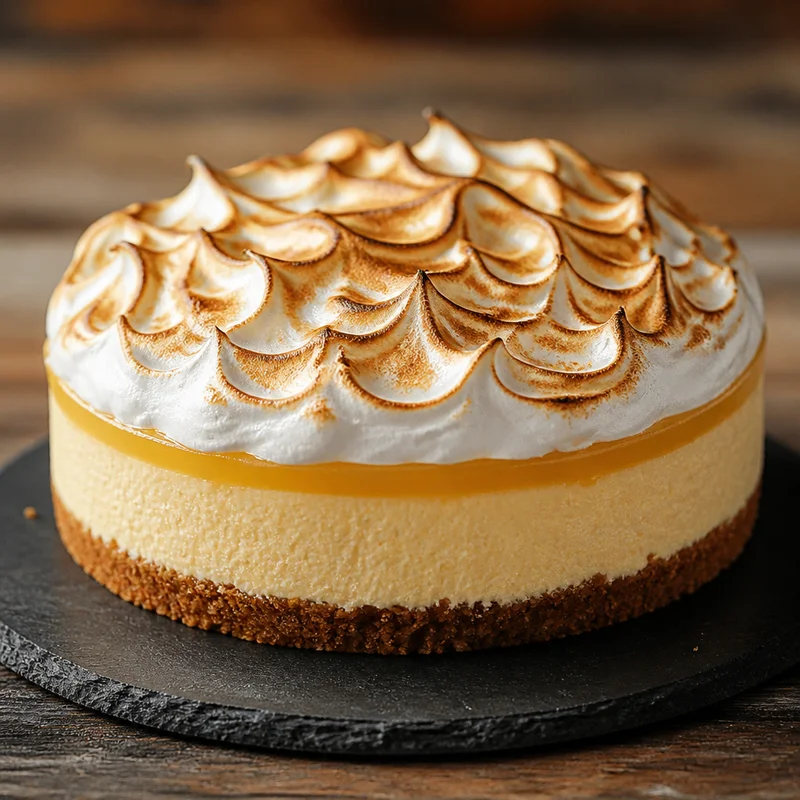
A restaurant-tier dessert built in three layers: a toasted graham crust, a dense water-bathed lemon cheesecake, and a thin sheet of real lemon curd, all crowned with a cornstarch-stabilized Swiss meringue that gets torched to a burnished swirl. The stabilizer and the way you anchor the meringue to the curd are what keep it from beading, sliding, or weeping onto a cold cake.
Ingredients
Graham Crust
- 1 3/4 cups graham cracker crumbs (about 12 full sheets)
- 3 tbsp granulated sugar
- 1/4 tsp kosher salt
- 7 tbsp unsalted butter, melted
Lemon Cheesecake Filling
- 32 oz full-fat block cream cheese, room temperature
- 1 1/3 cups granulated sugar
- 2 tbsp cornstarch
- 1/2 tsp kosher salt
- 2 tbsp finely grated lemon zest (from 3 lemons)
- 4 large eggs, room temperature
- 1 large egg yolk
- 2/3 cup sour cream, room temperature
- 1/3 cup fresh lemon juice
- 1 tsp vanilla extract
Lemon Curd Layer
- 4 large egg yolks
- 1/2 cup granulated sugar
- 1/3 cup fresh lemon juice
- 1 tsp finely grated lemon zest
- 1 pinch kosher salt
- 4 tbsp unsalted butter, cut into cubes
Stabilized Swiss Meringue
- 2 tsp cornstarch
- 1/4 cup water
- 5 large egg whites (about 150 g), room temperature
- 1 cup superfine or granulated sugar
- 1/2 tsp cream of tartar
- 1 pinch kosher salt
- 1 tsp vanilla extract
Instructions
- Heat the oven to 325°F with a rack in the lower third. Wrap the outside of a 9-inch springform pan in two layers of heavy-duty foil, pressing tightly up the sides so no water can seep in. Lightly butter the inside.
- Make the crust: stir the graham crumbs, 3 tbsp sugar, and 1/4 tsp salt together, then pour in the melted butter and mix until it looks like damp sand. Press firmly into the bottom and 1 inch up the sides of the pan using the flat bottom of a measuring cup. Bake 10 minutes, until fragrant and just set. Cool on a rack while you make the filling; leave the oven on.
- Rub the 2 tbsp lemon zest into the 1 1/3 cups sugar with your fingertips for 30 seconds to release the oils. In a stand mixer with the paddle (or a large bowl with a hand mixer), beat the room-temperature cream cheese on medium-low for 2 minutes until completely smooth, scraping the bowl and paddle twice. Add the lemon sugar, cornstarch, and 1/2 tsp salt and beat 2 minutes more, scraping down thoroughly — every lump has to disappear now, because you cannot beat air in later.
- On the lowest speed, add the eggs and yolk one at a time, mixing just until each disappears, about 15 seconds each. Scrape the bowl. Add the sour cream, 1/3 cup lemon juice, and vanilla and mix on low just until uniform, no more than 20 seconds. Rap the bowl on the counter a few times to knock out air bubbles.
- Pour the batter over the cooled crust and smooth the top. Set the springform in a roasting pan and pour boiling water into the roasting pan until it reaches 1 inch up the sides. Bake 70 to 85 minutes, until the outer 2 inches are set and the center 3-inch circle still jiggles as one soft mass; an instant-read thermometer 1 inch from the edge should read 150°F.
- Turn the oven off, crack the door 4 inches, and let the cheesecake sit in the cooling oven for 1 hour. Remove from the water bath, peel off the foil, and cool on a rack to room temperature, about 2 hours. Run a thin knife around the edge, then refrigerate uncovered for 1 hour, then loosely covered for at least 6 hours or overnight.
- Make the curd: whisk the 4 yolks, 1/2 cup sugar, 1/3 cup lemon juice, 1 tsp zest, and a pinch of salt in a small saucepan. Cook over medium-low heat, whisking constantly and scraping the corners, 5 to 8 minutes, until it thickens enough to coat a spoon and registers 170°F. Off the heat, whisk in the butter a cube at a time until glossy. Strain through a fine sieve into a bowl and cool to room temperature, about 30 minutes.
- Spread the cooled curd over the chilled cheesecake in an even layer, stopping about 1/4 inch from the edge. Return to the refrigerator, uncovered, for at least 1 hour so the curd sets firm and its surface is dry to the touch. A tacky, wet curd surface is the number one cause of a weeping meringue.
- Make the cornstarch gel: whisk the 2 tsp cornstarch into the 1/4 cup water in a tiny saucepan and cook over medium heat, whisking, 1 to 2 minutes, until it turns into a translucent, pudding-thick paste. Scrape into a small bowl and let cool to lukewarm.
- Make the Swiss meringue: combine the egg whites, 1 cup sugar, cream of tartar, and pinch of salt in the clean, grease-free bowl of a stand mixer. Set it over a saucepan with 1 inch of barely simmering water (bowl not touching the water) and whisk constantly for 4 to 6 minutes, until the mixture reaches 160°F and feels completely smooth — rub a drop between your fingers; if you feel any grit, keep going.
- Transfer the bowl to the mixer and whip on medium-high with the whisk attachment for 6 to 8 minutes, until the meringue is thick, brilliantly glossy, holds a stiff upright peak, and the bowl is cool to the touch. With the mixer on medium, add the lukewarm cornstarch gel one spoonful at a time, then the vanilla, and whip 1 minute more to reincorporate the stiff peak.
- Take the cheesecake straight from the fridge and immediately pile the meringue on top while it is still warm and pliable. Spread it so it makes direct contact with the curd everywhere and seals all the way to the edge of the cake — no gaps, no trapped air pockets. Then use the back of a spoon or a small offset spatula to pull up dramatic peaks and swirls.
- Torch the meringue with a kitchen blowtorch held 4 to 5 inches away, moving constantly in small circles until the peaks are deep amber and the valleys are pale gold, about 2 minutes total. (No torch: slide the cake under a broiler on the lowest rack for 45 to 90 seconds, rotating once, and watch it every second.)
- Refrigerate uncovered for 30 minutes to firm up, then unclasp the springform. Slice with a long thin knife dipped in hot water and wiped dry between every cut. Serve within 24 hours.
Chef's tips
- Weeping has two causes and both are preventable: undissolved sugar (beading amber droplets on top) and a warm-meringue-meets-wet-filling seal (a watery layer underneath). Heating the whites to a full 160°F with no grit fixes the first; a fully set, dry curd surface plus edge-to-edge contact fixes the second.
- The cooked cornstarch gel is the insurance policy — it binds free water inside the meringue so it stays plush for a full day in the fridge instead of collapsing overnight.
- Any trace of fat kills meringue. Wipe the mixer bowl and whisk with a paper towel dipped in white vinegar, and separate eggs one at a time into a small cup so a broken yolk doesn't contaminate the batch.
- Cold cream cheese makes lumpy cheesecake and no amount of extra beating will save it. Let the blocks sit out for 2 hours, or microwave unwrapped in 15-second bursts to about 68°F.
- If your springform is prone to leaks, set it inside a wider cake pan and put that in the water bath — the same gentle steam, zero risk of a soggy crust.
- The cheesecake and curd can both be made two days ahead. Whip and torch the meringue no more than a few hours before serving for the best texture.
Nutrition (per serving, estimated)
620calories
9gprotein
64gcarbs
38gfat
Estimates only — values vary with brands and portions.
Made with Sprig
Lemon Meringue Cheesecake with Torched Swiss Meringue was created in Sprig — the AI chef that turns any craving into a complete recipe, plans your week, and shops with one smart list.
Free to start · 14-day Pro trial · cancel anytime
Not ready yet? Get the occasional recipe worth cooking — a couple a month at most.
You're on the list — check your inbox!
Unsubscribe anytime. Privacy Policy
More from Sprig Originals
Frozen Chocolate–Caramel Peanut Nougat Bars
Blueberry Peach Buckle with Almond Streusel
Creole Cream Cheese Cheesecake with Salted Caramel and Dark Chocolate
Are you this recipe's original author or publisher? Report a problem