Ras Malai with Hand-Kneaded Chhena and Saffron Milk
 By Sprig Originals · cooked up in Sprig
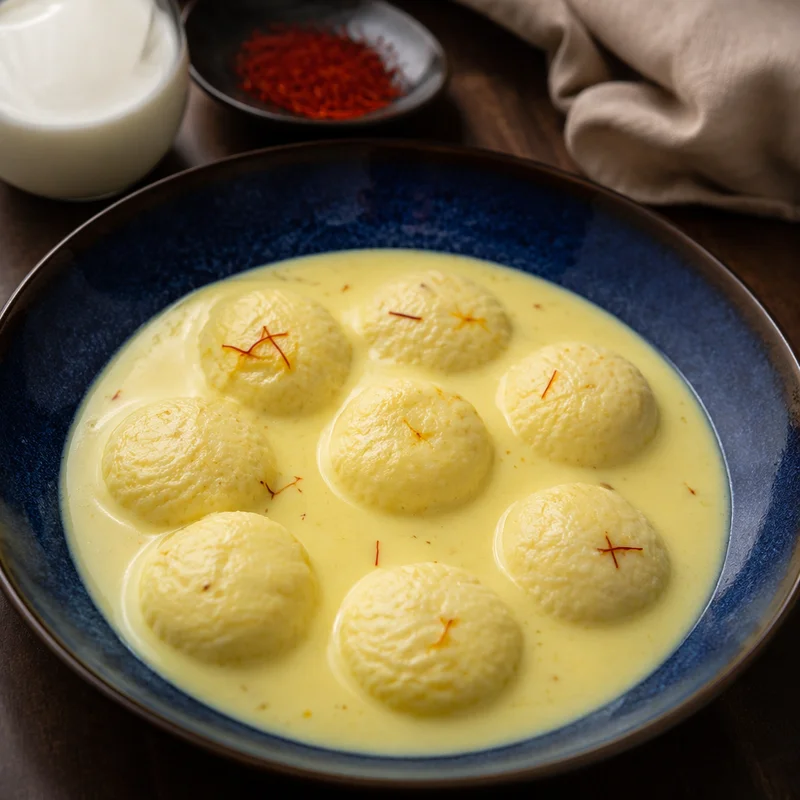
Spongy fresh-cheese discs simmered in light sugar syrup, then chilled in a reduced saffron-cardamom milk that tastes like it took all day. The whole dish hinges on two things: curdling whole milk gently so the chhena stays soft, and kneading that chhena until it turns smooth and slightly greasy under your palm. Get those right and the discs double in size in the syrup and drink up the milk overnight. Restaurant sweet-shop trays cost a few dollars a piece; a gallon of milk makes a dozen better ones.
Ingredients
- 8 cups whole milk (not ultra-pasteurized), divided use
- 3 tbsp fresh lemon juice, mixed with 3 tbsp water
- 2 tsp all-purpose flour or fine semolina
- ice cubes (about 1 cup, for shocking the curds)
- 1 1/4 cups granulated sugar
- 5 cups water
- 3 pods green cardamom, lightly crushed
- 6 cups whole milk
- 1/3 cup granulated sugar
- 1/4 tsp saffron threads
- 1/2 tsp ground green cardamom (from about 8 pods)
- 2 tbsp nonfat dry milk powder (optional, for body)
- 1/4 tsp rose water (optional)
- 2 tbsp pistachios, slivered
- 1 tbsp blanched almonds, slivered
- a few extra saffron threads
- dried rose petals (optional)
Instructions
- Start the saffron milk first so it can reduce while you work. Warm 2 tablespoons of the 6 cups of milk in a small bowl, crumble in the 1/4 teaspoon saffron, and set aside to bloom for 20 minutes — it should turn deep orange.
- Pour the remaining saffron-milk portion (about 6 cups minus the 2 tablespoons) into a wide, heavy saucepan or deep skillet. Bring to a boil over medium-high, then reduce to a steady medium simmer. Cook 30 to 40 minutes, stirring every 3 to 4 minutes and scraping the skin from the sides back into the milk, until reduced to about 3 1/2 cups and the color of heavy cream. Stir in the 1/3 cup sugar, the bloomed saffron with its milk, the ground cardamom, and the milk powder if using. Simmer 3 more minutes, then cool to room temperature and refrigerate.
- Make the chhena: bring the 8 cups milk to a full boil in a large heavy pot over medium-high heat, stirring often so the bottom doesn't scorch. The moment it foams up, kill the heat and let it sit 1 minute — you want it around 200°F, not violently boiling, or the curds will tighten.
- Add the diluted lemon juice 1 tablespoon at a time, stirring slowly in one direction after each addition. Within 30 to 60 seconds the milk should split into soft white curds and thin greenish-yellow whey. If the whey is still milky, add another teaspoon of lemon juice and wait. Stop as soon as it separates cleanly — excess acid makes rubbery cheese.
- Immediately drop in the ice cubes and stir once; this halts the cooking and keeps the curds tender. Line a colander with a doubled layer of cheesecloth or a thin cotton kitchen towel, set it over the sink, and pour everything through.
- Rinse the curds under cool running water for 20 to 30 seconds to wash off the lemon. Gather the cloth, twist into a bundle, and squeeze firmly to expel water. Hang the bundle from the faucet or press it under a plate weighted with a 2-pound can for exactly 25 to 30 minutes. You want moist, crumbly chhena that holds a shape when squeezed — not dry. Overpressing is the most common failure.
- Scrape the chhena onto a clean smooth work surface (a large cutting board or the counter itself) and sprinkle over the 2 teaspoons flour. Now knead with the heel of your hand, pushing forward and gathering back, for 8 to 10 solid minutes. It will go from grainy to a smooth, uniform, slightly tacky dough that leaves a faint sheen of fat on the surface and your palm. That sheen is your signal to stop.
- Divide the dough into 12 equal pieces (about 25 g each). Roll each between your palms into a crack-free ball, then flatten gently to a 1/4-inch-thick disc about 1 1/2 inches across, smoothing any fissures at the edges with a fingertip. Cover with a damp towel.
- In a wide pot with a lid (at least 10 inches, 4-quart capacity — the discs need room to swell), combine 1 1/4 cups sugar, 5 cups water, and the crushed cardamom pods. Bring to a rolling boil over high heat.
- Slide the discs into the boiling syrup one at a time. Cover and boil hard over medium-high for 8 minutes — the syrup must stay at a visible rolling boil, which is what puffs the cheese. Uncover, gently turn each disc with a slotted spoon, splash in 1/4 cup hot water to keep the syrup from thickening, cover again, and boil 8 to 10 minutes more. They should nearly double and feel springy, like a wet sponge.
- Turn off the heat and let the discs cool in the syrup, uncovered, for 30 minutes. Then slide the pot into the refrigerator, or transfer discs and syrup to a bowl, and chill at least 1 hour. Cooling in syrup keeps them from collapsing.
- Lift each disc out and press it flat between your palms over the sink to squeeze out most of the syrup — firm but gentle, like wringing a sponge. Drop the pressed discs into the chilled saffron milk in a single layer (use two containers if needed) and stir in the rose water if using.
- Cover and refrigerate at least 4 hours, ideally overnight. The discs will absorb the milk, swell again, and turn the color of the saffron. Serve cold, 2 discs per bowl with plenty of milk spooned over, showered with pistachios, almonds, a few saffron threads, and rose petals.
- If the discs shrink or feel dense after chilling, they were underkneaded or the syrup wasn't boiling hard enough — the fix is more kneading time and a bigger, hotter pot, not more sugar.
Chef's tips
- Ultra-pasteurized milk is the single biggest reason ras malai fails: the proteins won't form soft curds. Look for plain pasteurized whole milk, and skip anything labeled UHT or with a months-out expiration date.
- One disc is your test batch. Poach a single disc first for 15 minutes: if it breaks apart, knead the rest of the dough 2 more minutes and add another 1/2 teaspoon flour. If it stays hard and small, the chhena was pressed too dry — sprinkle in 1 teaspoon milk and knead again.
- Reducing the milk in a wide skillet instead of a tall saucepan cuts the time nearly in half because of the extra evaporation surface. Keep scraping the sides in; that's where the flavor concentrates.
- Make it two days ahead. Ras malai is genuinely better on day two, and it holds in the fridge for 4 days. Do not freeze — the cheese turns grainy.
- Grind cardamom fresh: crack 8 green pods, discard the husks, and grind the black seeds in a mortar with a pinch of the sugar. Pre-ground cardamom tastes flat by comparison.
Nutrition (per serving, estimated)
Made with Sprig
Ras Malai with Hand-Kneaded Chhena and Saffron Milk was created in Sprig — the AI chef that turns any craving into a complete recipe, plans your week, and shops with one smart list.
More from Sprig Originals
Are you this recipe's original author or publisher? Report a problem