Sprig Originals's kitchen / Classic Lemon Tart with Torched Meringue
Classic Lemon Tart with Torched Meringue
 By Sprig Originals · cooked up in Sprig
Worked out from this recipe's ingredients. If you're cooking for an allergy, always read the full ingredient list.
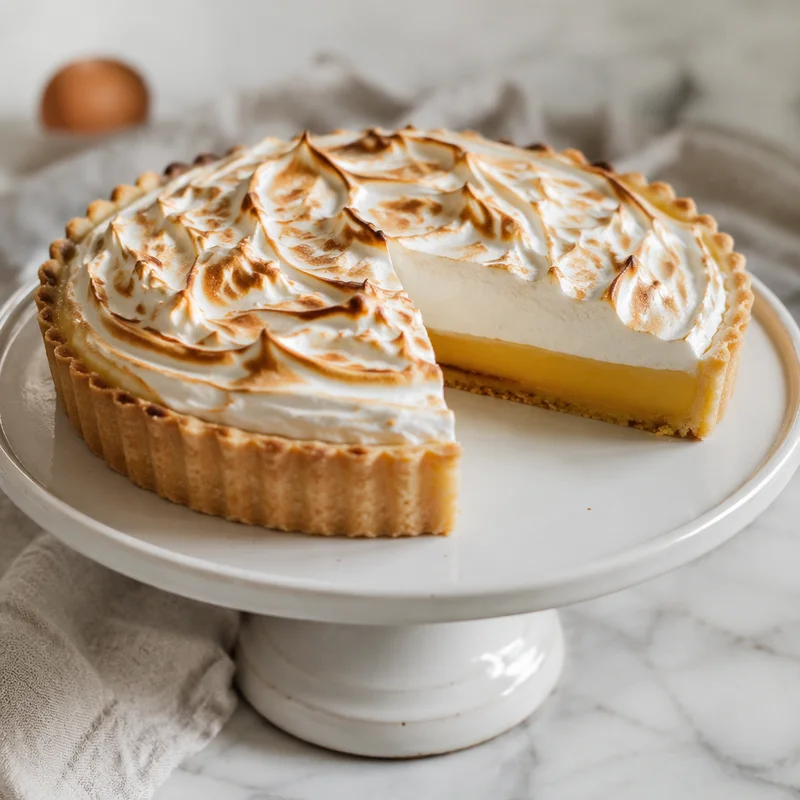
A crisp sweet pastry shell blind-baked until sandy-gold, filled with lemon curd that's cooked on the stove, strained silky-smooth, then baked just until the center holds a single soft wobble. Finish it bare and glossy like a French pâtisserie, or pile on Swiss meringue and torch it. The two-stage curd — stovetop then low oven — is what gives you that clean slice with no cracks, no weeping, and no scrambled egg.
Ingredients
Sweet Pastry Shell
- 1 1/4 cups all-purpose flour (160 g), plus more for rolling
- 1/2 cup powdered sugar (55 g)
- 1/4 tsp fine sea salt
- 8 tbsp cold unsalted butter, cut into 1/2-inch cubes
- 1 large egg yolk
- 1 tbsp cold heavy cream
- 1 large egg white, lightly beaten (for sealing the shell)
Strained Lemon Curd Filling
- 4 large eggs
- 2 large egg yolks
- 3/4 cup granulated sugar (150 g)
- 2 tsp finely grated lemon zest (from about 3 lemons)
- 2/3 cup fresh lemon juice (160 ml, from about 4 lemons)
- 1 pinch fine sea salt
- 6 tbsp unsalted butter, cut into pieces, at room temperature
- 1/3 cup heavy cream
Swiss Meringue (optional)
- 3 large egg whites (about 100 g)
- 2/3 cup granulated sugar (135 g)
- 1/8 tsp cream of tartar
- 1/2 tsp vanilla extract
Instructions
- Make the pastry: In a food processor, pulse the flour, powdered sugar, and salt to combine. Add the cold butter cubes and pulse in 1-second bursts, about 12 to 15 pulses, until the mixture looks like coarse sand with a few pea-size pieces. Whisk the egg yolk with the cold cream and drizzle it in, then pulse 8 to 10 more times, just until the dough starts clumping. Do not let it form a ball in the machine.
- Turn the dough onto a work surface, gather it with your hands, and press it into a 5-inch disk. Wrap tightly and refrigerate at least 1 hour (or up to 2 days). Chilled dough rolls without cracking and shrinks far less in the oven.
- Roll and line the pan: On a lightly floured surface, roll the disk to a 12-inch round about 1/8 inch thick, rotating a quarter turn every few passes. Drape it over a 9-inch fluted tart pan with a removable bottom. Lift the edges and let the dough settle into the corners rather than stretching it, then press it into the flutes. Roll the pin across the rim to trim the excess. Prick the base all over with a fork and freeze the shell, uncovered, for 30 minutes.
- Blind bake: Heat the oven to 350°F with a rack in the lower third. Line the frozen shell with a large piece of parchment and fill it to the very top with pie weights or dried beans, pressing them against the sides. Bake 25 minutes, then lift out the parchment and weights. The pastry should look dry and pale. Return it to the oven for 8 to 12 minutes more, until the base is sandy and evenly golden brown.
- Brush the hot shell all over — base and sides — with a thin coat of beaten egg white and return it to the oven for 2 minutes to set into a waterproof seal. Leave the shell in the pan and reduce the oven to 300°F. Keep the shell warm; pouring warm curd into a warm shell is the key to an even bake.
- Start the curd: In a medium saucepan (not over heat yet), whisk the whole eggs, yolks, sugar, lemon zest, lemon juice, and salt until completely smooth. Set over medium-low heat and cook, whisking constantly and scraping the corners, for 6 to 9 minutes, until the mixture thickens to the consistency of loose pudding and registers 170°F on an instant-read thermometer. It will steam but must never simmer.
- Off the heat, whisk in the butter a few pieces at a time until fully melted and glossy, then whisk in the heavy cream. Pour the curd through a fine-mesh sieve set over a bowl or pitcher, pressing with a flexible spatula. Discard the zest and any strands of set egg left behind — this straining step is what makes the finished slice taste like satin. Skim off any foam.
- Bake to a wobble: Set the warm tart shell (still in its pan) on a baking sheet and pull out the oven rack. Pour the warm strained curd into the shell, filling it to just below the rim. Slide the rack in and bake at 300°F for 18 to 25 minutes, until the outer inch is set and the center 2 inches jiggle as one soft unit when you nudge the pan — like set gelatin, not liquid. The surface should be matte with no browning.
- Cool the tart on a rack for at least 1 hour, then refrigerate uncovered for 2 hours (or up to 1 day) to fully set. Serve chilled or at cool room temperature. If you want a bare tart, stop here: remove the ring and slice with a hot, dry knife, wiping between cuts.
- For the optional meringue: Combine the egg whites, sugar, and cream of tartar in a heatproof mixing bowl. Set it over a saucepan of barely simmering water and whisk constantly for 3 to 5 minutes, until the sugar is fully dissolved (rub a drop between your fingers — no grit) and the mixture reaches 160°F.
- Move the bowl to a stand mixer with the whisk attachment (or use a hand mixer) and beat on medium-high for 5 to 7 minutes, until the meringue is thick, bright white, holds a stiff peak, and the bowl feels cool. Beat in the vanilla for 10 seconds.
- Remove the tart ring and dollop the meringue over the chilled curd, leaving a 1/4-inch border of exposed filling. Sweep it into swirls and peaks with the back of a spoon. Torch with a kitchen blowtorch, keeping the flame moving 3 to 4 inches away, until the tips are deep amber. No torch? Slide the tart under a broiler on the top rack for 45 to 90 seconds, watching the entire time. Serve within 3 hours of torching.
Chef's tips
- Roll the pastry between two sheets of parchment if your kitchen is warm — no flour needed and no sticking, and you can chill the whole slab flat for 5 minutes if it softens.
- If the shell cracks during blind baking, patch it with a little raw dough scrap while it's hot and bake 3 minutes more before the egg-white seal. Unpatched cracks let the curd leak and weld the tart to the pan.
- Use only fresh-squeezed juice; bottled lemon juice has a dull, cooked note that no amount of butter hides. Zest the lemons before you juice them.
- If the stovetop curd shows any lumps or looks broken, pull it off the heat immediately and blitz it with an immersion blender before straining — it will come back together.
- Meringue weeps on a warm tart. The filling must be fully chilled and set before you pile it on, and the meringue must be beaten until the bowl is cool to the touch.
Nutrition (per serving, estimated)
422calories
7gprotein
48gcarbs
23gfat
Estimates only — values vary with brands and portions.
Made with Sprig
Classic Lemon Tart with Torched Meringue was created in Sprig — the AI chef that turns any craving into a complete recipe, plans your week, and shops with one smart list.
Free to start · 14-day Pro trial · cancel anytime
Not ready yet? Get the occasional recipe worth cooking — a couple a month at most.
You're on the list — check your inbox!
Unsubscribe anytime. Privacy Policy
More from Sprig Originals
Frozen Chocolate–Caramel Peanut Nougat Bars
Blueberry Peach Buckle with Almond Streusel
Creole Cream Cheese Cheesecake with Salted Caramel and Dark Chocolate
Are you this recipe's original author or publisher? Report a problem