Sprig Originals's kitchen / Salted Caramel Cheesecake, No Water Bath
Salted Caramel Cheesecake, No Water Bath
 By Sprig Originals · cooked up in Sprig
Worked out from this recipe's ingredients. If you're cooking for an allergy, always read the full ingredient list.
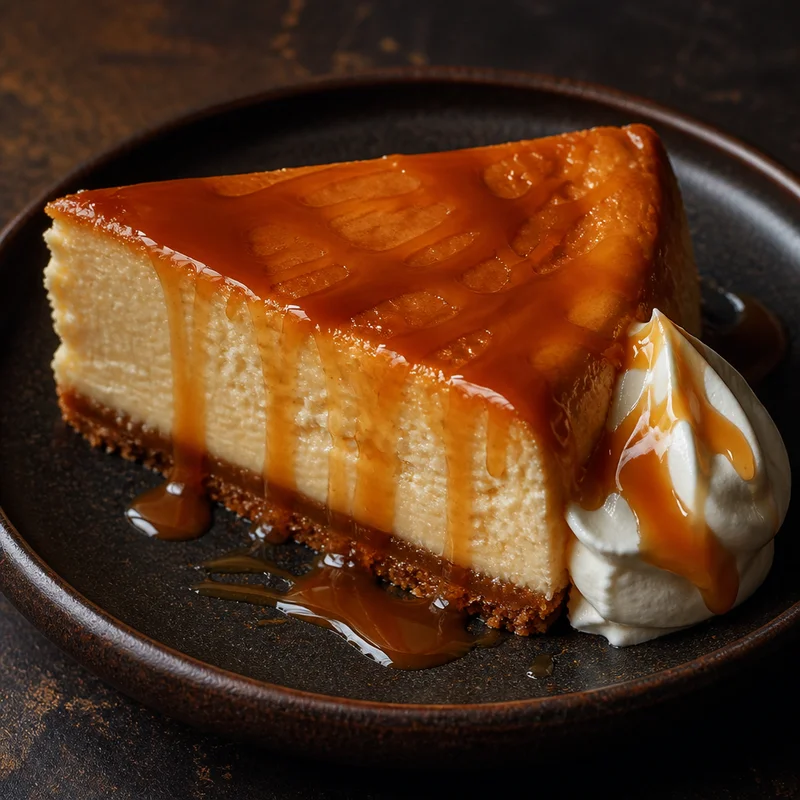
A tall, dense New York-style cheesecake baked low and slow on a dry rack — no leaky foil, no roasting pan of hot water. A low-temperature bake and a long, gradual cool keep the surface smooth, and a glossy homemade salted caramel goes on only after the cake is fully chilled, so any imperfection disappears under a layer of burnished amber. This is the $30-a-slice restaurant dessert built for a normal oven and a normal Tuesday.
Ingredients
Graham crust
- 2 cup graham cracker crumbs (about 14 full sheets)
- 3 tbsp light brown sugar, packed
- 1/4 tsp fine salt
- 7 tbsp unsalted butter, melted
Cheesecake filling
- 32 oz full-fat block cream cheese, at room temperature (four 8 oz packages)
- 1 1/4 cup granulated sugar
- 3 tbsp cornstarch
- 1/2 tsp fine salt
- 2/3 cup sour cream, at room temperature
- 1/4 cup heavy cream, at room temperature
- 1 tbsp vanilla extract
- 2 tsp lemon juice
- 4 large eggs, at room temperature
- 1 large egg yolk, at room temperature
Salted caramel
- 1 cup granulated sugar
- 1/4 cup water
- 1 tbsp light corn syrup
- 6 tbsp unsalted butter, cut into cubes
- 2/3 cup heavy cream, warmed
- 3/4 tsp flaky sea salt, crushed
- 1 tsp vanilla extract
To finish
- 1 cup heavy cream, cold (optional, for whipping)
- 1 tbsp powdered sugar (optional)
- Flaky sea salt, for sprinkling
Instructions
- Take the cream cheese, eggs, sour cream and heavy cream out of the fridge at least 1 hour before you start. Cold cream cheese is the number one cause of lumpy batter and overbeating, which is what actually cracks a cheesecake.
- Heat the oven to 350°F with a rack in the lower third. Wrap the outside bottom of a 9-inch springform pan with a single sheet of foil (this catches butter drips only — there is no water bath), and line the base with a round of parchment.
- Stir the graham crumbs, brown sugar and 1/4 teaspoon salt together, then mix in the melted butter until the crumbs look like wet sand. Press firmly into the pan bottom and about 1 1/2 inches up the sides, using the flat bottom of a measuring cup to compact it. Bake 10 minutes, until fragrant and just set. Cool on a rack while you make the filling and reduce the oven to 325°F.
- In a stand mixer with the paddle (or a large bowl with a hand mixer), beat the cream cheese alone on medium-low for 2 minutes until completely smooth, scraping the bowl and paddle twice. Whisk the granulated sugar, cornstarch and 1/2 teaspoon salt together, then add to the cream cheese and beat on low for 2 minutes more, scraping down thoroughly — you should not see a single lump.
- Beat in the sour cream, heavy cream, vanilla and lemon juice on low until just combined. Add the eggs and yolk one at a time on the lowest speed, mixing only until each disappears, about 15 seconds each. Stop the moment the last egg is incorporated; whipped-in air makes the cake souffle up and split.
- Pour the batter over the cooled crust and smooth the top. Firmly rap the pan on the counter 5 or 6 times to release trapped bubbles, and pop any surface bubbles with a toothpick.
- Bake at 325°F for 15 minutes, then — without opening the door — reduce the oven to 250°F and bake 70 to 85 minutes longer. It is done when the outer 2 inches are set and puffed slightly, and the center 3-inch circle still wobbles like loose jelly when you nudge the pan. An instant-read thermometer inserted 1 inch from the edge should read 150°F.
- Turn the oven off, prop the door open with a wooden spoon, and leave the cheesecake inside for 1 hour. This slow cooldown is what replaces the water bath. Then move it to a rack and immediately run a thin knife around the inside edge of the pan so the cake can shrink without tearing. Cool to room temperature, about 2 hours.
- Cover loosely and refrigerate at least 8 hours, preferably overnight. Do not caramel it warm.
- Make the caramel: combine the sugar, water and corn syrup in a heavy 2-quart saucepan. Stir just until the sugar is wet, then set over medium-high heat and do not stir again. Boil until the syrup turns a deep amber, 8 to 12 minutes — swirl the pan gently in the last 2 minutes for even color, and pull it at 350°F on a candy thermometer or when it smells nutty and looks like an old penny.
- Off the heat, add the butter cubes and whisk until melted (it will bubble hard), then slowly pour in the warm cream while whisking. Return to low heat for 1 minute to smooth out any set sugar, then whisk in the crushed flaky salt and vanilla. Pour into a heatproof measuring cup and cool to barely warm and pourable, about 30 to 40 minutes — it should coat a spoon like warm honey.
- Release the springform ring and slide the chilled cheesecake onto a serving plate. Pour about two-thirds of the caramel into the center and coax it outward with an offset spatula, stopping about 1/2 inch from the edge or letting a few drips run down the side. Chill 20 minutes to set the caramel. Reserve the rest of the caramel for serving.
- If using, whip the cold cream with the powdered sugar to soft peaks. Slice with a hot, dry knife — dip in hot water and wipe between every cut. Sprinkle each slice with flaky salt and serve with extra caramel and a spoonful of cream.
Chef's tips
- The center wobble is the whole game. A cheesecake that looks fully set in the oven is already overbaked, and overbaked is what cracks. Trust the 150°F edge reading.
- If your caramel seizes into a lump when you add the cream, keep whisking over low heat — it almost always melts back out in 2 to 3 minutes.
- Leftover caramel keeps 3 weeks in the fridge. Warm it 15 seconds in the microwave before pouring.
- Make it ahead: the cheesecake is better on day two. Bake and chill up to 3 days out, then pour the caramel a few hours before serving.
- For a browned-butter version, cook the 6 tablespoons of caramel butter in a separate pan until the milk solids are hazelnut brown, cool slightly, and use that in place of plain butter.
Nutrition (per serving, estimated)
790calories
9gprotein
61gcarbs
58gfat
Estimates only — values vary with brands and portions.
Made with Sprig
Salted Caramel Cheesecake, No Water Bath was created in Sprig — the AI chef that turns any craving into a complete recipe, plans your week, and shops with one smart list.
Free to start · 14-day Pro trial · cancel anytime
Not ready yet? Get the occasional recipe worth cooking — a couple a month at most.
You're on the list — check your inbox!
Unsubscribe anytime. Privacy Policy
More from Sprig Originals
Frozen Chocolate–Caramel Peanut Nougat Bars
Blueberry Peach Buckle with Almond Streusel
Creole Cream Cheese Cheesecake with Salted Caramel and Dark Chocolate
Are you this recipe's original author or publisher? Report a problem