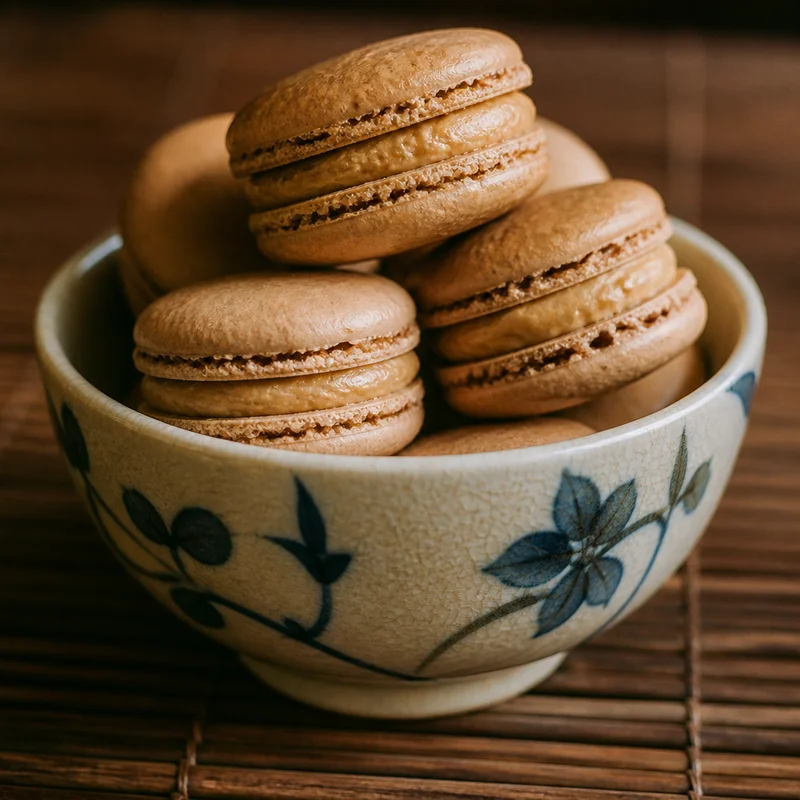
Italian-Meringue Macarons with Vietnamese Coffee Buttercream
 By Sprig Originals · cooked up in Sprig
One reliable, weigh-everything Italian meringue macaron base — the sturdy method French-Vietnamese bakeries lean on because it survives humid kitchens — filled with a condensed-milk coffee buttercream that tastes like cà phê sữa đá. The shell recipe stays identical no matter what you fill it with, so two swap fillings are included: pandan-coconut ganache and passionfruit-mango curd. Grams only, aged whites, and an oven thermometer are non-negotiable here; get those three right and macarons stop being a lottery.
Ingredients
- 150 g blanched superfine almond flour
- 150 g powdered sugar
- 55 g aged egg whites, room temperature (for the almond paste)
- 55 g aged egg whites, room temperature (for the meringue)
- 150 g granulated sugar
- 38 g water
- 1 pinch cream of tartar
- 2 g gel food coloring (optional, tan or ivory)
- 12 g instant espresso powder
- 15 g hot water
- 170 g unsalted butter, softened to 68°F
- 90 g sweetened condensed milk
- 60 g powdered sugar, sifted
- 1 pinch fine sea salt
- 1/2 tsp vanilla extract
- 170 g white chocolate, finely chopped
- 80 g canned coconut milk (full fat)
- 1 tsp pandan extract
- 25 g unsalted butter, softened
- 1 pinch fine sea salt
- 60 g passionfruit purée
- 60 g mango purée
- 70 g granulated sugar
- 2 large egg yolks
- 1 large egg
- 85 g unsalted butter, cold and cubed
- 1 pinch fine sea salt
Instructions
- Two to four days ahead, separate 110 g of egg whites into a clean container, cover with plastic wrap, poke a few holes in it, and refrigerate. Aging thins the whites and lowers moisture, which makes the meringue more stable. Bring them to room temperature (about 70°F) before you start.
- Set an oven thermometer on the middle rack and preheat the oven to 300°F. Note the real temperature once it stabilizes — most home ovens read 15–25°F off, and macarons are unforgiving about it. Line two heavy sheet pans with parchment or silicone macaron mats and trace or use 1.5-inch circles as guides.
- Sift 150 g almond flour and 150 g powdered sugar together twice through a medium-mesh sieve into a large bowl, pressing any stubborn almond bits through with a spoon. Discard more than a teaspoon of coarse residue only; if you lose more, weigh in fresh almond flour to keep the total at 300 g.
- Add 55 g of the aged whites to the dry mixture and stir with a flexible spatula until you have a thick, smooth almond paste with no dry pockets. Stir in gel coloring now if using — it will lighten slightly once the meringue goes in. Set aside, covered.
- Put the remaining 55 g whites and the pinch of cream of tartar in the bowl of a stand mixer fitted with the whisk. In a small saucepan, combine 150 g granulated sugar and 38 g water, stir once, and set over medium-high heat with a candy thermometer clipped on. Do not stir again.
- When the syrup reaches 230°F, start whipping the whites on medium speed to soft, foamy peaks. When the syrup hits 244°F (118°C), remove it from the heat, lower the mixer to medium-low, and pour the syrup in a thin, steady stream down the inside of the bowl, avoiding the whisk.
- Raise the speed to medium-high and whip 6–9 minutes, until the meringue is glossy, holds a firm beak-shaped peak, and the bowl feels barely warm (about 100°F). Under-whipping here is the most common cause of hollow shells.
- Add one third of the meringue to the almond paste and stir vigorously to loosen it — you are sacrificing this portion. Fold in the rest in two additions, then begin macaronage: press and smear the batter against the bowl, scraping and folding, until it flows off the spatula in a thick ribbon that draws a figure 8 and settles back into itself in about 10–15 seconds. Test often; two extra folds can ruin it.
- Transfer the batter to a piping bag fitted with a 1/2-inch round tip. Hold the bag vertically, tip 1/4 inch above the mat, and pipe 1.5-inch rounds, releasing pressure before you lift. Rap each pan firmly on the counter 4–5 times, rotate 90°, rap again, and pop any surface bubbles with a toothpick.
- Rest the piped shells uncovered at room temperature 20–40 minutes, until a fingertip pressed lightly on a shell comes away clean and the surface feels matte and dry. In a humid kitchen this can take an hour; run a fan in the room, not at the pans.
- Bake one pan at a time at a true 300°F for 14–17 minutes, rotating the pan front to back at minute 9. Shells are done when the feet look set and a shell shifts no more than a hair when you nudge the top. If tops still swivel on the feet, give them 2 more minutes.
- Cool the shells completely on the pan, 15 minutes, then lift them off. If they stick, they were underbaked — chill the pan 10 minutes and try again. Pair shells by size on a tray while you make the filling.
- For the coffee buttercream: dissolve 12 g espresso powder in 15 g hot water and cool completely. Beat 170 g softened butter on medium-high 3 minutes until pale, then add the sifted powdered sugar and salt and beat 2 minutes. Drizzle in the condensed milk, the coffee, and the vanilla, and whip 2 minutes more until fluffy. If it looks loose, chill 10 minutes and re-whip.
- For the pandan-coconut swap: heat the coconut milk to a bare simmer, pour over the chopped white chocolate, wait 2 minutes, then stir smooth. Stir in the pandan extract, butter, and salt, and chill 1–2 hours until pipeable. For the passionfruit-mango swap: whisk purées, sugar, yolks, and whole egg in a saucepan over medium-low, stirring constantly until it thickens and reaches 180°F, about 6–8 minutes; off heat, whisk in cold butter a cube at a time plus salt, strain, and chill 3 hours until firm.
- Pipe a mound of filling on the flat side of half the shells, leaving a 2 mm border, then top and twist gently so the filling reaches the edge. For fruit curd, pipe a ring of buttercream or ganache as a dam and fill the center with curd so the shells don't go soggy.
- Layer the finished macarons in an airtight container and refrigerate 24 hours to mature — this is what turns a crisp cookie into the chewy, even-textured macaron you paid for at a bakery. Bring to room temperature 20–30 minutes before serving.
Chef's tips
- Volume measures do not work here. A 10 g error in almond flour or sugar changes the batter's flow enough to give you cracked or footless shells — use a scale that reads in 1 g increments.
- Aged whites matter more than fresh: 2–4 days uncovered-ish in the fridge drops moisture and relaxes the protein, giving smoother tops and taller feet.
- Trust the oven thermometer over the dial. If your shells brown before the feet set, your oven runs hot; drop the dial 25°F and bake 2 minutes longer.
- Humidity is the silent killer. Above about 60% relative humidity, extend the resting time and bake one pan at a time, never with a second pan waiting in a steamy oven.
- Undermixed batter gives lumpy, nipple-topped shells; overmixed batter spreads flat and shiny with no feet. Stop macaronage the moment a figure 8 holds for a slow count of ten.
- Unfilled shells freeze beautifully for a month in a rigid airtight container. Thaw sealed at room temperature before filling so condensation forms outside the box, not on the shells.
- Fill with a scant 1 to 1.5 teaspoons per macaron — overfilled macarons squeeze out and go soft during maturing.
Nutrition (per serving, estimated)
Made with Sprig
Italian-Meringue Macarons with Vietnamese Coffee Buttercream was created in Sprig — the AI chef that turns any craving into a complete recipe, plans your week, and shops with one smart list.
More from Sprig Originals
Are you this recipe's original author or publisher? Report a problem