Sprig Originals's kitchen / Coffee & Walnut Layer Cake with Espresso Buttercream
Coffee & Walnut Layer Cake with Espresso Buttercream
 By Sprig Originals · cooked up in Sprig
Worked out from this recipe's ingredients. If you're cooking for an allergy, always read the full ingredient list.
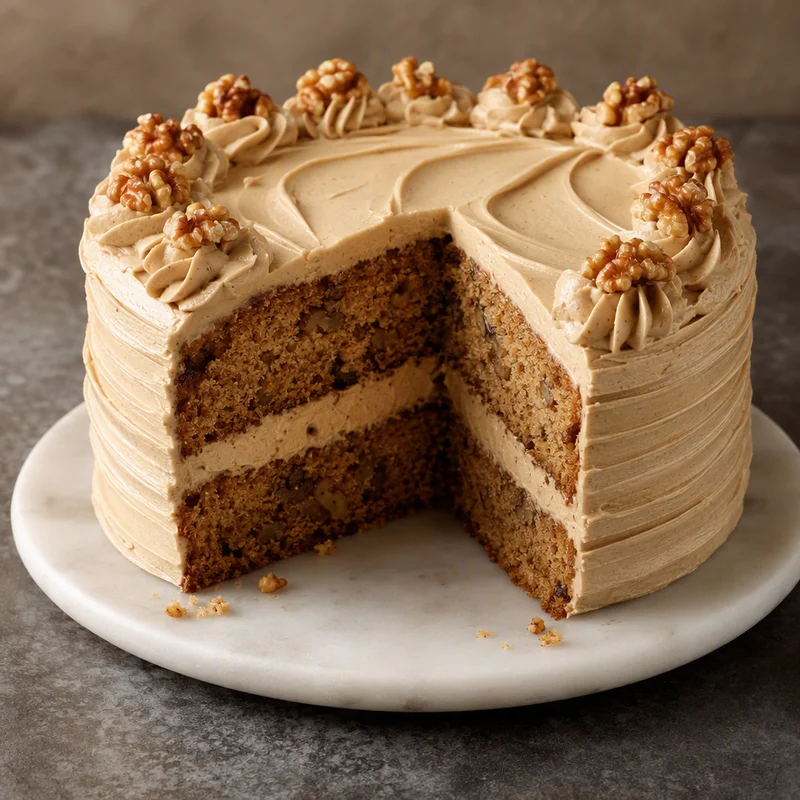
The great tearoom classic, built properly at home: two tender butter-cake layers loaded with toasted walnuts and darkened with a concentrated espresso paste, sandwiched and topped with a silky coffee buttercream. The trick is treating instant espresso like an extract — dissolved into a thick paste so you get deep roasted flavor without watering down the batter or the frosting. Crowned with toasted walnut halves, it slices cleanly and tastes even better on day two.
Ingredients
Coffee paste (for cake and frosting)
- 5 tablespoons instant espresso powder
- 5 tablespoons boiling water
Walnut coffee cake layers
- 1 1/2 cups walnut halves and pieces (about 165 g)
- 2 cups all-purpose flour (250 g), spooned and leveled
- 2 teaspoons baking powder
- 1/2 teaspoon baking soda
- 3/4 teaspoon fine sea salt
- 1 cup unsalted butter (226 g), softened to 67°F
- 3/4 cup packed light brown sugar (150 g)
- 1/2 cup granulated sugar (100 g)
- 4 large eggs, room temperature
- 2 teaspoons vanilla extract
- 1/3 cup whole milk, room temperature
Espresso buttercream
- 1 cup unsalted butter (226 g), softened
- 3 1/2 cups powdered sugar (420 g), sifted
- 1/4 teaspoon fine sea salt
- 1 teaspoon vanilla extract
- 2 tablespoons heavy cream, plus more as needed
To finish
- 12 walnut halves, toasted
Instructions
- Heat the oven to 350°F. Butter two 8-inch round cake pans, line the bottoms with parchment rounds, and butter the parchment. Spread the 1 1/2 cups walnuts and the 12 walnut halves on a sheet pan and toast 7 to 9 minutes, until fragrant and one shade darker. Cool completely, then set the 12 halves aside for decorating and finely chop the rest (you want small bits, not powder). Reserve 1/4 cup of the chopped walnuts for the top.
- Make the coffee paste: whisk the 5 tablespoons instant espresso powder with the 5 tablespoons boiling water in a small bowl until completely smooth and syrupy. Let it cool to room temperature, about 10 minutes. Measure out 3 tablespoons for the cake batter and reserve the remaining 2 tablespoons for the buttercream.
- Whisk the flour, baking powder, baking soda, and 3/4 teaspoon salt together in a medium bowl.
- In a stand mixer with the paddle (or a large bowl with a hand mixer), beat the 1 cup softened butter with both sugars on medium-high for 4 to 5 minutes, scraping down twice, until very pale and fluffy. Add the eggs one at a time, beating 30 seconds after each, then beat in the vanilla and the 3 tablespoons cooled coffee paste. The batter may look slightly split — that's fine.
- On low speed, add the flour mixture in three additions alternating with the milk in two, mixing only until each addition disappears. Stop the mixer and fold in the chopped walnuts (minus the reserved 1/4 cup) by hand with a spatula, scraping the bottom of the bowl.
- Divide the batter between the pans (about 570 g each if you have a scale) and smooth the tops. Bake on the middle rack 25 to 30 minutes, rotating the pans front to back at 18 minutes, until the tops spring back, the edges pull slightly from the pan, and a toothpick in the center comes out with only a crumb or two.
- Cool in the pans 15 minutes, then run a thin knife around the edge, turn the layers out, peel off the parchment, and cool completely on a rack, at least 1 hour. Warm layers will melt the buttercream.
- Make the buttercream: beat the 1 cup butter on medium-high for 3 minutes until light. Add the powdered sugar and 1/4 teaspoon salt in three additions on low, then beat in the vanilla, the reserved 2 tablespoons coffee paste, and the heavy cream. Whip on medium-high 3 minutes until fluffy and spreadable; add cream 1 teaspoon at a time if it's stiff.
- If the layers domed, level them with a serrated knife. Set one layer cut-side up on a plate or stand, spread with about 1 cup of buttercream all the way to the edge, and top with the second layer, bottom-side up, for a flat surface.
- Swirl the remaining buttercream over the top (leave the sides bare for the classic tearoom look, or thinly frost them). Ring the edge with the 12 toasted walnut halves and scatter the reserved chopped walnuts in the center. Let the cake sit 30 minutes before slicing so the buttercream sets, and cut with a hot, dry knife.
Chef's tips
- Instant espresso powder, not instant coffee granules, gives the deepest flavor — and dissolving it into a paste means you add big coffee flavor without extra liquid that would slacken the batter or thin the frosting.
- No espresso powder? Simmer 1 cup of very strong brewed coffee down to 5 tablespoons, cool completely, and use that instead.
- Butter temperature is everything here: 65 to 68°F, cool but dentable. Too warm and the creamed base won't hold air, giving you a dense, greasy crumb.
- Chop the walnuts by hand or pulse in short bursts — a food processor run too long turns them oily and the crumb goes heavy.
- Bake ahead: wrapped layers keep 2 days at room temperature or 2 months frozen. Frost from frozen-then-thawed layers for the cleanest crumb-free finish.
- The finished cake keeps 3 days under a cake dome at cool room temperature and genuinely improves overnight as the coffee flavor settles. Refrigerate only in hot weather, and serve at room temperature.
Nutrition (per serving, estimated)
700calories
7gprotein
74gcarbs
44gfat
Estimates only — values vary with brands and portions.
Made with Sprig
Coffee & Walnut Layer Cake with Espresso Buttercream was created in Sprig — the AI chef that turns any craving into a complete recipe, plans your week, and shops with one smart list.
Free to start · 14-day Pro trial · cancel anytime
Not ready yet? Get the occasional recipe worth cooking — a couple a month at most.
You're on the list — check your inbox!
Unsubscribe anytime. Privacy Policy
More from Sprig Originals
Frozen Chocolate–Caramel Peanut Nougat Bars
Blueberry Peach Buckle with Almond Streusel
Creole Cream Cheese Cheesecake with Salted Caramel and Dark Chocolate
Are you this recipe's original author or publisher? Report a problem