Sprig Originals's kitchen / Vanilla Bean Cheesecake
Vanilla Bean Cheesecake
 By Sprig Originals · cooked up in Sprig
Worked out from this recipe's ingredients. If you're cooking for an allergy, always read the full ingredient list.
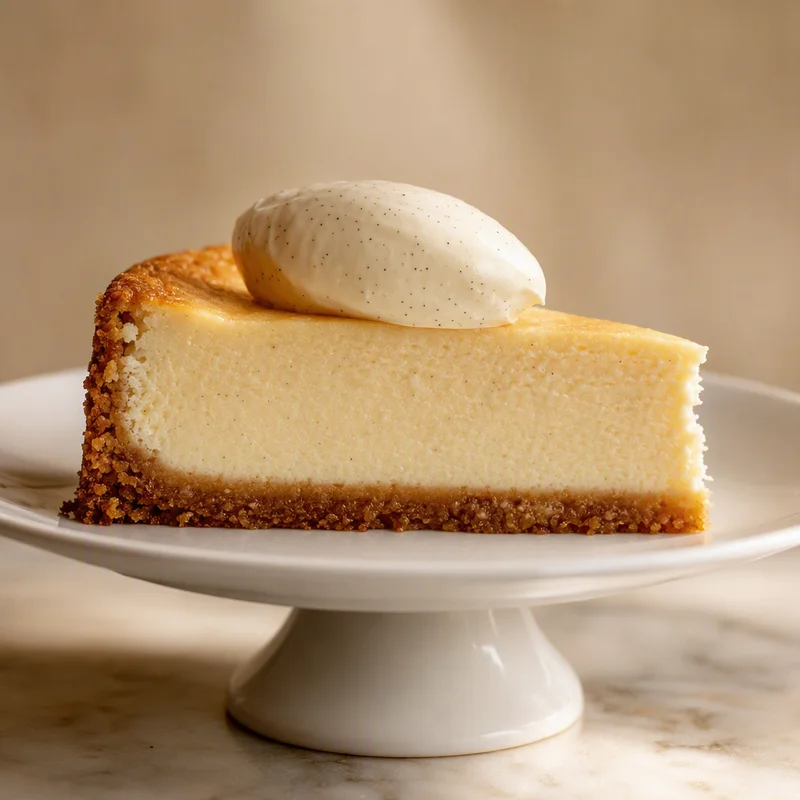
A tall, silky-custard cheesecake flecked with real vanilla bean, baked low and slow in a water bath so the top sets flat and crack-free. A buttery graham crust, a whisper of lemon, and a long overnight chill do most of the work — all you have to do is not rush it. Finished with lightly sweetened vanilla crème fraîche cream, it's the restaurant slice you were going to pay $38 for.
Ingredients
Graham Crust
- 12 sheets graham crackers (about 1¾ cups fine crumbs)
- 3 tbsp granulated sugar
- 1/4 tsp fine sea salt
- 6 tbsp unsalted butter, melted
Vanilla Bean Filling
- 32 oz full-fat block cream cheese (4 eight-ounce blocks), room temperature
- 1 1/3 cups granulated sugar
- 2 tbsp cornstarch
- 1/2 tsp fine sea salt
- 2 whole vanilla beans, split and scraped
- 2 tsp pure vanilla extract
- 1/2 cup sour cream, room temperature
- 1/2 cup heavy cream, room temperature
- 2 tsp fresh lemon juice
- 4 large eggs, room temperature
- 1 large egg yolk, room temperature
Vanilla Crème Fraîche Cream
- 1 cup heavy cream, cold
- 1/2 cup crème fraîche, cold
- 3 tbsp powdered sugar
- 1/2 whole vanilla bean, scraped (or 1 tsp vanilla bean paste)
For the Water Bath
- 2 quarts boiling water
- heavy-duty aluminum foil
Instructions
- Set the cream cheese, eggs, egg yolk, sour cream, and ½ cup heavy cream on the counter 1½ to 2 hours before you start. Genuinely room-temperature ingredients are the single biggest factor in a lump-free, crack-free cheesecake — cold cream cheese will not smooth out no matter how long you beat it.
- Heat the oven to 325°F with a rack in the lower third. Wrap the outside bottom and sides of a 9-inch springform pan with two overlapping sheets of heavy-duty foil, crimping tightly at the rim so no water can seep in. Lightly butter the inside of the pan.
- Pulse the graham crackers in a food processor to fine crumbs (or crush in a zip-top bag with a rolling pin) to get about 1¾ cups. Mix with 3 tbsp sugar, ¼ tsp salt, and the melted butter until the crumbs look like damp sand.
- Press the crumbs firmly into the bottom of the pan and about 1 inch up the sides, using the flat bottom of a measuring cup to compact them. Bake 12 minutes until fragrant and just golden. Cool on a rack while you make the filling, then lower the oven to 300°F.
- Rub the scraped seeds of 2 vanilla beans into the 1⅓ cups sugar with your fingers for 30 seconds to break up the clumps and spread the specks evenly. Whisk in the cornstarch and ½ tsp salt.
- In a stand mixer with the paddle (or a large bowl with a hand mixer), beat the cream cheese alone on medium-low for 2 minutes until completely smooth, scraping the bowl and paddle twice. Add the vanilla sugar mixture and beat 2 minutes more on medium-low, scraping down at least once. Keep the speed low throughout — you want no air in this batter.
- Beat in the sour cream, ½ cup heavy cream, lemon juice, and vanilla extract until uniform, about 30 seconds. Add the eggs one at a time, then the yolk, mixing just 15 seconds after each and scraping the bowl between additions. Stop the moment the last egg disappears; overmixing traps air, which is what causes puffing and cracks.
- Pour the batter through a fine-mesh sieve into a large bowl (this catches any stubborn lumps), then pour it over the cooled crust. Rap the pan gently on the counter 5 or 6 times and pop any surface bubbles with a toothpick.
- Set the foil-wrapped pan inside a large roasting pan and place it on the oven rack. Carefully pour boiling water into the roasting pan until it comes 1 to 1½ inches up the sides of the springform. Bake at 300°F for 80 to 95 minutes.
- The cheesecake is done when the outer 2 inches look set and matte, the center 3 inches still jiggles like loose gelatin, and an instant-read thermometer inserted 1 inch from the edge reads 150°F (about 145°F in the very center). Do not bake until the center is firm.
- Turn the oven off, prop the door open a few inches with a wooden spoon, and leave the cheesecake in the cooling oven and water bath for 1 hour. Then lift it out, remove the foil, and cool on a rack to room temperature, about 2 hours.
- Run a thin knife around the inside rim to release any stuck edge (this prevents cracks as it contracts), cover loosely, and refrigerate at least 8 hours and ideally overnight — 24 hours is best. The texture goes from soft to dense and sliceable only after a full chill.
- Just before serving, whip the cold 1 cup heavy cream, crème fraîche, powdered sugar, and the seeds from the remaining ½ vanilla bean to soft peaks, about 90 seconds. Release the springform ring, slice the cheesecake with a hot dry knife (dip in hot water and wipe between cuts), and serve each slice with a spoonful of vanilla cream.
Chef's tips
- Split vanilla beans lengthwise with a paring knife and scrape the seeds out with the back of the blade. Don't throw the pods away — bury them in a jar of sugar for vanilla sugar, or steep them in the heavy cream you'll whip for the topping.
- No roasting pan large enough? Skip the submerged bath: set the springform on a baking sheet on the middle rack and put a broiler pan or 9x13 dish of boiling water on the rack below. You get most of the steam benefit with zero leak risk.
- If your springform is a shallow 2-inch model, hold back about ¾ cup of batter rather than filling to the brim; bake the extra in a ramekin alongside as a cook's treat.
- A hairline crack is cosmetic, not a failure — the vanilla cream covers everything. Cracks come from too much air in the batter, too hot an oven, or cooling too fast, so fix those next time and enjoy this one.
- Cheesecake keeps 5 days covered in the fridge and freezes beautifully: freeze slices on a tray until firm, wrap individually, and thaw overnight in the refrigerator.
Nutrition (per serving, estimated)
587calories
10gprotein
39gcarbs
46gfat
Estimates only — values vary with brands and portions.
Made with Sprig
Vanilla Bean Cheesecake was created in Sprig — the AI chef that turns any craving into a complete recipe, plans your week, and shops with one smart list.
Free to start · 14-day Pro trial · cancel anytime
Not ready yet? Get the occasional recipe worth cooking — a couple a month at most.
You're on the list — check your inbox!
Unsubscribe anytime. Privacy Policy
More from Sprig Originals
Frozen Chocolate–Caramel Peanut Nougat Bars
Blueberry Peach Buckle with Almond Streusel
Creole Cream Cheese Cheesecake with Salted Caramel and Dark Chocolate
Are you this recipe's original author or publisher? Report a problem