Sprig Originals's kitchen / Shatter-Crisp Pistachio-Walnut Baklava with Lemon-Honey Syrup
Shatter-Crisp Pistachio-Walnut Baklava with Lemon-Honey Syrup
 By Sprig Originals · cooked up in Sprig
Worked out from this recipe's ingredients. If you're cooking for an allergy, always read the full ingredient list.
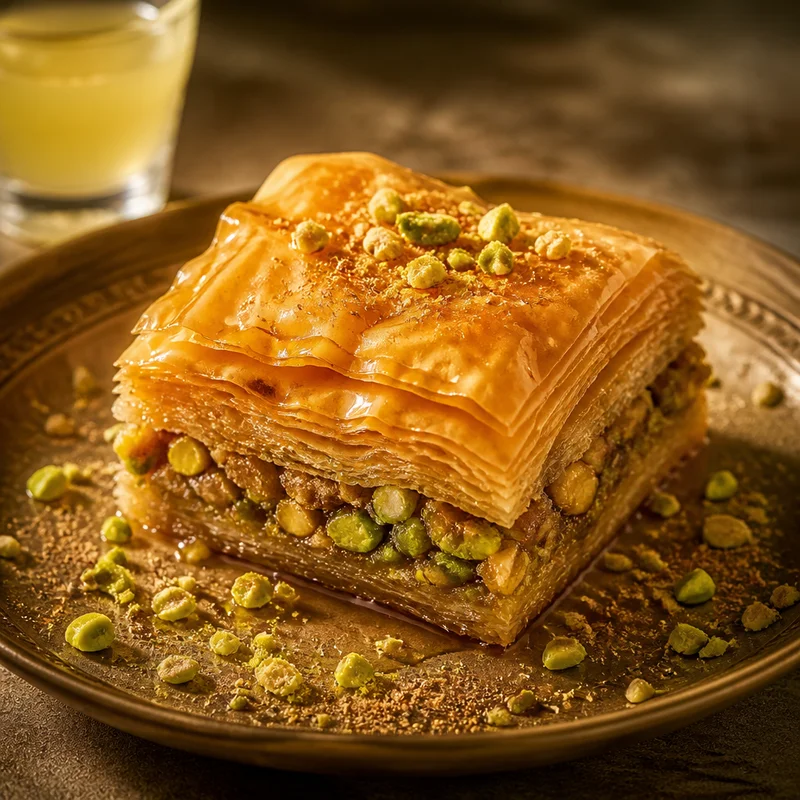
Forty-some tissue-thin layers of phyllo, brushed with clarified butter so they bake into brittle golden sheets instead of soggy ones, packed with a triple layer of pistachios and walnuts. A cooled lemon-honey syrup goes over the pastry the second it leaves the oven — that temperature contrast is what gives you the loud shatter on the first bite and a candied, glassy top. It needs six hours of unhurried resting before you cut into it, and it only gets better the next day.
Ingredients
Lemon-Honey Syrup
- 1 1/2 cups granulated sugar
- 1 cup water
- 1/2 cup honey
- 2 tablespoons fresh lemon juice
- 3 strips lemon peel, removed with a vegetable peeler
- 1 cinnamon stick
- 1 teaspoon orange blossom water or rose water (optional)
Nut Filling
- 1 1/2 cups shelled raw pistachios (about 7 oz)
- 1 1/2 cups walnut halves (about 5 1/2 oz)
- 3 tablespoons granulated sugar
- 1 teaspoon ground cinnamon
- 1/4 teaspoon ground cardamom
- 1/4 teaspoon fine sea salt
- 2 tablespoons plain dry breadcrumbs or fine semolina
Pastry
- 1 lb frozen phyllo dough (two 8-oz sleeves, #4 thickness), thawed overnight in the refrigerator
- 1 lb unsalted butter (4 sticks), for clarifying
- 3 tablespoons finely chopped pistachios, for garnish
Instructions
- Make the syrup first so it has time to cool completely. Combine the 1 1/2 cups sugar, water, honey, lemon juice, lemon peel strips and cinnamon stick in a small saucepan. Bring to a boil over medium-high heat, stirring just until the sugar dissolves, then reduce to a bare simmer and cook 10 minutes without stirring. Remove from the heat, stir in the orange blossom water if using, and let cool to room temperature (at least 1 hour). Fish out the peel and cinnamon stick before using.
- Clarify the butter: melt the pound of butter in a saucepan over low heat without stirring, 8 to 10 minutes. Skim the white foam off the top and discard, then carefully pour the clear golden butter into a bowl, stopping when you reach the milky solids at the bottom. You should have about 1 1/2 cups. Keep it warm and liquid; the milk solids are what make phyllo turn soggy, so leave them behind.
- Pulse the pistachios and walnuts separately in a food processor in short bursts until they look like coarse gravel with a little sand — 8 to 10 one-second pulses each. Do not let them turn to paste. Combine in a bowl with the 3 tablespoons sugar, cinnamon, cardamom, salt and breadcrumbs. The breadcrumbs absorb nut oil and syrup and keep the layers distinct.
- Heat the oven to 325°F with a rack in the lower third. Brush a 9x13-inch metal baking pan generously with clarified butter. Unroll the phyllo onto a work surface, trim the stack with a knife if it is much larger than the pan, and cover it with plastic wrap topped with a barely damp kitchen towel. Work with the stack covered at all times — exposed phyllo goes brittle in about 2 minutes.
- Build the bottom: lay one sheet of phyllo in the pan and brush it lightly all over with clarified butter, dabbing rather than dragging the brush. Repeat until you have 10 buttered sheets stacked in the pan. Torn sheets are fine — patch and keep going.
- Scatter one third of the nut mixture (about 1 cup) evenly over the phyllo, all the way to the corners. Top with 6 buttered sheets, another third of the nuts, 6 more buttered sheets, and the last third of the nuts.
- Finish with 10 more buttered sheets, saving the best-looking, most intact sheets for the top two layers. Brush the final sheet with a thick, even coat of butter and press the whole stack down firmly with your palms to compact it.
- Cut all the way through to the bottom of the pan with a sharp thin knife before baking: 5 evenly spaced lengthwise cuts, then cut on the diagonal across them to make about 24 diamonds. Wipe the blade between cuts. Drizzle or brush any remaining butter into the cut lines.
- Bake 70 to 80 minutes, until the top is deep golden brown and the edges have visibly pulled from the pan sides. If the top is browning unevenly, rotate the pan at the 45-minute mark. Baklava that looks blond is underbaked and will taste doughy — go for the color of toasted almonds.
- The moment the pan comes out of the oven, ladle the completely cooled syrup slowly and evenly over the hot pastry, concentrating on the cut lines. It will hiss and steam loudly. Use all of it. Sprinkle the chopped pistachios over the top while it is wet.
- Let the pan rest uncovered at room temperature at least 6 hours, ideally overnight, so the syrup distributes and the layers set. Re-cut along the original lines and lift the pieces out with an offset spatula. Serve at room temperature.
- Store loosely covered at room temperature for up to 5 days. Never refrigerate — cold turns the syrup gummy and the pastry limp.
Chef's tips
- The single rule of baklava is temperature contrast: cool syrup onto hot pastry, or hot syrup onto fully cooled pastry. Hot on hot steams the layers and gives you a soft, heavy square.
- If your phyllo cracks and shreds as you unroll it, it thawed too fast. Rewrap and give it 30 minutes in the refrigerator, then try again — cold, slightly damp phyllo is far more cooperative.
- A pastry brush with soft natural bristles or a wide silicone brush works; stiff bristles tear the sheets. Dab the butter on in spots and let it spread rather than sweeping across the surface.
- Swap the nuts freely — all walnut is the classic Levantine version, all pistachio the most luxurious, and a cup of blanched almonds in place of the walnuts makes it milder. Keep the total at 3 cups.
- For sharper diamonds, chill the assembled, uncut pan for 15 minutes before cutting; the firm butter keeps the knife from dragging the top sheets.
Nutrition (per serving, estimated)
351calories
5gprotein
31gcarbs
22gfat
Estimates only — values vary with brands and portions.
Made with Sprig
Shatter-Crisp Pistachio-Walnut Baklava with Lemon-Honey Syrup was created in Sprig — the AI chef that turns any craving into a complete recipe, plans your week, and shops with one smart list.
Free to start · 14-day Pro trial · cancel anytime
Not ready yet? Get the occasional recipe worth cooking — a couple a month at most.
You're on the list — check your inbox!
Unsubscribe anytime. Privacy Policy
More from Sprig Originals
Frozen Chocolate–Caramel Peanut Nougat Bars
Blueberry Peach Buckle with Almond Streusel
Creole Cream Cheese Cheesecake with Salted Caramel and Dark Chocolate
Are you this recipe's original author or publisher? Report a problem