Sprig Originals's kitchen / Soft Chewy Fleur de Sel Caramels
Soft Chewy Fleur de Sel Caramels
 By Sprig Originals · cooked up in Sprig
Worked out from this recipe's ingredients. If you're cooking for an allergy, always read the full ingredient list.
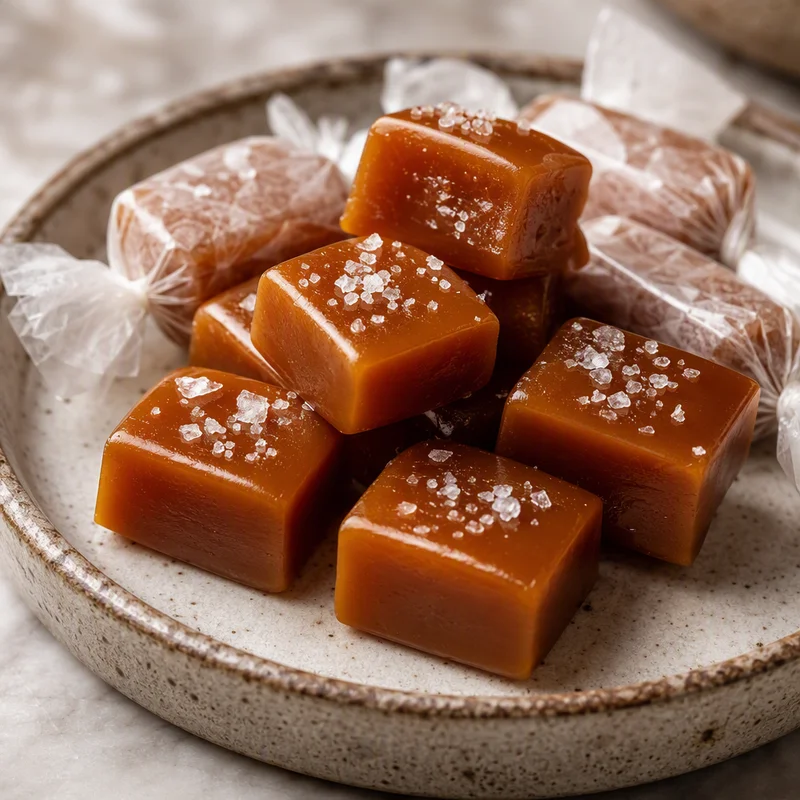
Deep amber, slow-chewing caramels with a clean dairy sweetness and crackle of flaky salt — the kind that come wrapped in little wax paper twists at a confectioner's counter. The method is straightforward: cook a dry-ish sugar syrup to a real amber, stream in hot salted cream, then take it to a precise 248°F for a caramel that's soft enough to bite but never sticks to your teeth. One candy thermometer and 45 minutes of active work gets you about 64 pieces.
Ingredients
Salted cream base
- 1 cup heavy cream
- 5 tablespoons unsalted butter, cut into cubes
- 1 teaspoon fleur de sel or flaky sea salt
- 1/2 teaspoon kosher salt
- 2 teaspoons vanilla extract
Caramel
- 1 1/2 cups granulated sugar
- 1/4 cup light corn syrup
- 1/4 cup water
Finishing
- 1 teaspoon neutral oil, for the pan and knife
- 3/4 teaspoon fleur de sel, for sprinkling
- 64 pieces wax paper squares, about 4 by 4 inches
Instructions
- Line an 8-inch square metal baking pan with two crossed strips of parchment paper, leaving overhang on all four sides. Brush the parchment lightly with neutral oil. Set the pan on a wire rack near the stove.
- Combine the heavy cream, cubed butter, 1 teaspoon fleur de sel, and kosher salt in a small saucepan. Warm over medium-low heat, swirling, just until the butter melts and the cream steams and reaches about 150°F, 4 to 5 minutes. Turn off the heat, cover, and leave it on the back of the stove — it must be hot when it goes into the caramel.
- In a heavy 3- to 4-quart saucepan with a light-colored interior (stainless steel, not black nonstick — you need to judge color), stir together the sugar, corn syrup, and water until the sugar looks like wet sand. Wipe any stray sugar crystals off the sides of the pan with a wet fingertip.
- Set the pan over medium-high heat and bring to a boil without stirring. Once boiling, clip on a candy thermometer and let it cook undisturbed, 6 to 9 minutes, until the syrup reaches 300°F. Do not stir; if crystals form on the sides, brush them down with a wet pastry brush.
- Continue cooking, now watching closely, until the syrup turns the color of an old copper penny and reads 330 to 335°F, another 2 to 4 minutes. Swirl the pan gently once or twice for even color. The moment it hits that shade, move to the next step — sugar goes from amber to burnt in about 20 seconds.
- Turn the heat to low and pour in the hot cream mixture in a slow, steady stream while whisking constantly. It will boil up violently and roughly triple in volume, so keep your hand and face clear. Whisk until smooth.
- Raise the heat to medium and cook, stirring slowly and constantly with a heatproof spatula and scraping the corners, until the caramel reaches exactly 248°F, 10 to 14 minutes. Keep the thermometer tip off the pan bottom. For firmer caramels go to 250°F; for very soft, spoonable-cool caramels stop at 245°F.
- Immediately remove from the heat, wait 30 seconds for the bubbling to subside, then stir in the vanilla extract. Pour the caramel into the prepared pan without scraping the very bottom of the saucepan (scraped-up scorched bits make grainy candy). Tilt the pan to level the surface.
- Let sit 15 minutes, until a skin forms and the surface no longer ripples, then sprinkle evenly with the 3/4 teaspoon fleur de sel. Cure at cool room temperature, uncovered, for at least 4 hours or overnight — do not refrigerate, which makes the caramels sweat.
- Lift the slab out by the parchment onto a cutting board. Oil a large chef's knife or a bench scraper and cut the slab into 8 strips, then cut each strip crosswise into 8 pieces, re-oiling and wiping the blade as needed. For clean edges, press straight down rather than sawing.
- Wrap each caramel in a wax paper square, twisting the ends. Store in an airtight container at cool room temperature for up to 3 weeks.
Chef's tips
- Test your thermometer first: it should read 212°F in boiling water. If it reads 208°F, cook your caramel to 244°F instead of 248°F, and so on. Four degrees is the difference between chewy and gluey.
- No thermometer? Use the cold-water test — drop 1/2 teaspoon of caramel into ice water; at the right stage it forms a ball that holds its shape but flattens easily when pressed (firm-ball stage).
- Corn syrup isn't optional here; it's an invert sugar that blocks crystallization and keeps the texture smooth. Golden syrup or 2 tablespoons of honey plus 2 tablespoons water can substitute, with a slightly different flavor.
- If the caramel is too soft after curing overnight, scrape it back into the pan with 1 tablespoon of cream and re-cook to 250°F — caramel is one of the few candies you can genuinely rescue.
- Soak the sticky saucepan and thermometer in hot water for 20 minutes; the hardened caramel dissolves completely and wipes out with no scrubbing.
- For chocolate-dipped caramels, chill the cut pieces 20 minutes, then dip in 8 ounces of tempered dark chocolate and finish with a pinch of flaky salt before it sets.
Nutrition (per serving, estimated)
172calories
0gprotein
23gcarbs
9gfat
Estimates only — values vary with brands and portions.
Made with Sprig
Soft Chewy Fleur de Sel Caramels was created in Sprig — the AI chef that turns any craving into a complete recipe, plans your week, and shops with one smart list.
Free to start · 14-day Pro trial · cancel anytime
Not ready yet? Get the occasional recipe worth cooking — a couple a month at most.
You're on the list — check your inbox!
Unsubscribe anytime. Privacy Policy
More from Sprig Originals
Frozen Chocolate–Caramel Peanut Nougat Bars
Blueberry Peach Buckle with Almond Streusel
Creole Cream Cheese Cheesecake with Salted Caramel and Dark Chocolate
Are you this recipe's original author or publisher? Report a problem