Layered Lemon Cheesecake
 By Ben · cooked up in Sprig
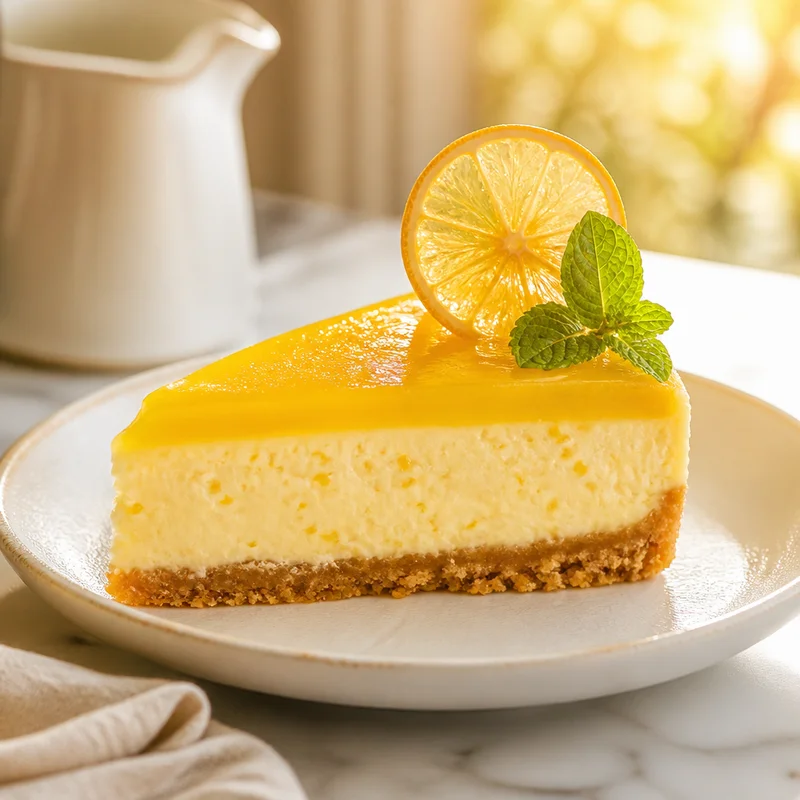
Three distinct layers make this cheesecake worth every step — a buttery graham cracker base, a dense and tangy cream cheese filling loaded with fresh lemon zest and juice, and a silky lemon curd crown that sets to a glossy, barely-trembling finish. The filling has that dense, almost fudgy pull when you slice through it cold, and the curd on top smells like sunshine the moment it hits the warm cheesecake. This is the kind of dessert you bring to a spring birthday or a dinner party where you actually want people to talk about what they just ate.
Ingredients
- 1 1/2 cups graham cracker crumbs
- 3 tablespoons granulated sugar
- 6 tablespoons unsalted butter, melted
- 1/4 teaspoon fine sea salt
- 24 ounces cream cheese, at room temperature
- 1 cup granulated sugar
- 3 large eggs, at room temperature
- 1/2 cup sour cream, at room temperature
- 2 tablespoons fresh lemon juice
- 1 tablespoon finely grated lemon zest
- 1 teaspoon pure vanilla extract
- 2 tablespoons all-purpose flour
- 3 large egg yolks
- 1/2 cup granulated sugar
- 1/3 cup fresh lemon juice (about 2-3 lemons)
- 1 teaspoon finely grated lemon zest
- 4 tablespoons unsalted butter, cut into cubes
- 1 pinch fine sea salt
Instructions
- Preheat your oven to 325°F. Wrap the outside of a 9-inch springform pan tightly with two layers of heavy-duty aluminum foil, bringing it up around the sides to prevent any water from seeping in during the water bath.
- In a medium bowl, stir together the graham cracker crumbs, 3 tablespoons sugar, and 1/4 teaspoon salt. Pour in the melted butter and mix until the crumbs are evenly moistened and hold together when pressed. Press the mixture firmly and evenly into the bottom of the prepared springform pan. Bake for 10 minutes until just set and lightly golden. Let cool on a wire rack while you make the filling.
- In a stand mixer or with a hand mixer, beat the room-temperature cream cheese on medium speed for about 2 minutes until completely smooth with no lumps. Scrape down the sides of the bowl.
- Add 1 cup sugar and beat on medium for another 2 minutes until light and creamy. Add the flour and mix briefly to incorporate. Add the eggs one at a time, mixing on low speed just until each is incorporated — do not overmix after adding eggs.
- Add the sour cream, 2 tablespoons lemon juice, 1 tablespoon lemon zest, and vanilla extract. Mix on low until just combined and smooth. Pour the filling over the cooled crust and spread evenly.
- Place the foil-wrapped springform pan in a large roasting pan. Carefully pour hot water into the roasting pan until it reaches about 1 inch up the sides of the springform. Bake at 325°F for 55 to 65 minutes, until the edges are set but the center still has a slight jiggle — like firm Jell-O, not liquid.
- Turn off the oven, crack the door open about 1 inch, and let the cheesecake rest in the oven for 1 hour. This gradual cooling prevents cracking. Remove from the water bath, peel off the foil, and let cool completely on a wire rack. Then refrigerate uncovered for at least 4 hours, or overnight.
- Once the cheesecake is fully chilled, make the lemon curd. In a small saucepan, whisk together the egg yolks, 1/2 cup sugar, 1/3 cup lemon juice, 1 teaspoon lemon zest, and a pinch of salt. Cook over medium-low heat, stirring constantly with a wooden spoon or heatproof spatula, for 8 to 10 minutes until the curd thickens enough to coat the back of the spoon and holds a line drawn through it.
- Remove from heat and immediately whisk in the cold butter cubes one at a time, allowing each to fully melt before adding the next. Strain the curd through a fine-mesh sieve into a bowl to remove any cooked bits of egg and the zest solids. Let cool for 15 to 20 minutes, stirring occasionally, until it reaches room temperature.
- Pour the cooled lemon curd over the top of the chilled cheesecake and spread it gently and evenly with an offset spatula, reaching to the edges. Return the cheesecake to the refrigerator for at least 1 hour until the curd layer is set and glossy.
- When ready to serve, run a thin knife around the edge of the springform pan before releasing the clasp. Slice with a sharp knife dipped in warm water and wiped clean between each cut. Optionally garnish each slice with a thin lemon wheel and a few small fresh mint leaves.
Chef's tips
- Temperature is everything for a crack-free cheesecake. Pull your cream cheese, eggs, and sour cream from the fridge at least 90 minutes before you start — cold dairy causes lumps and over-mixing, and over-mixing introduces air that expands and cracks in the oven.
- For the cleanest lemon curd, keep your heat at medium-low and never stop stirring. If it starts to bubble vigorously at any point, pull it off the heat immediately and keep stirring. A strained curd poured onto a fully cold cheesecake will set into a smooth, glassy layer — if the cheesecake is even slightly warm, the curd will sink in unevenly.
- The water bath is non-negotiable for this style of dense cheesecake. If you want to skip the water-soaking risk, place the springform inside a slightly larger cake pan and set that pan in the water bath — it creates the same gentle steam environment without any foil leakage worries.
Nutrition (per serving, estimated)
Made with Sprig
Layered Lemon Cheesecake was created in Sprig — the AI chef that turns any craving into a complete recipe, plans your week, and shops with one smart list.
More from Ben
Are you this recipe's original author or publisher? Report a problem